
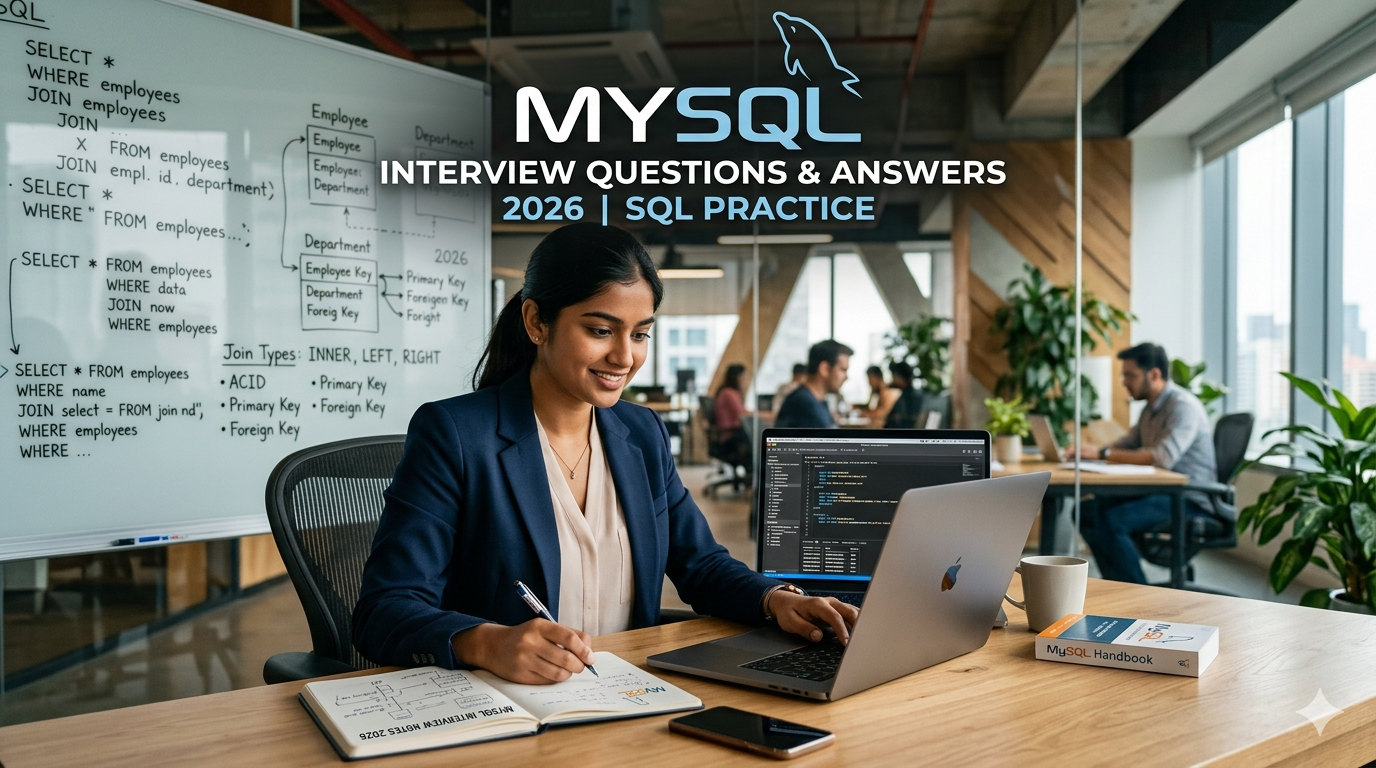
MySQL Interview Questions & Answers 2026 | SQL Practice for Freshers & Job Seekers
In 2026, companies are actively hiring professionals with database and SQL skills. From startups to large IT companies, MySQL remains one of the most widely used relational database management systems in the world. If you are preparing for technical interviews after 12th, graduation, BCA, B.Tech, or any IT course, learning MySQL can help you secure better job opportunities. Many recruiters ask SQL and MySQL interview questions during technical rounds because databases are an important part of software development, data analytics, web development, and backend engineering. In this guide, we will cover the most commonly asked MySQL interview questions and answers for freshers and job seekers. If you want professional MySQL training with practical projects, visit Aptech Learning Lucknow for career-focused IT courses. What is MySQL? MySQL is an open-source relational database management system used to store, manage, and retrieve data efficiently. It uses SQL (Structured Query Language) to interact with databases. Popular websites, applications, and software platforms use MySQL because it is fast, reliable, and easy to learn. 1. What is the difference between MySQL and SQL? SQL is a language used to manage databases, while MySQL is a database management system that uses SQL. Example: 2. What are the different types of SQL commands? SQL commands are mainly divided into: Examples: 3. What is a Primary Key? A Primary Key uniquely identifies each record in a table. It cannot contain NULL values or duplicate values. Example: 4. What is the difference between WHERE and HAVING? Example: 5. What is normalization in MySQL? Normalization is the process of organizing data to reduce redundancy and improve database efficiency. Common normal forms: 6. What is the difference between DELETE, DROP, and TRUNCATE? Command Purpose DELETE Removes selected rows TRUNCATE Removes all rows quickly DROP Deletes the complete table 7. What is a JOIN in MySQL? JOIN is used to combine records from multiple tables. Types of JOIN: Example: 8. What is the use of the GROUP BY clause? GROUP BY is used to arrange similar data into groups. Example: 9. What is indexing in MySQL? Indexes improve database query performance by allowing faster data retrieval. Example: 10. What is the difference between CHAR and VARCHAR? CHAR VARCHAR Fixed length Variable length Faster Saves storage space Important SQL Practice Questions for Freshers To crack interviews in 2026, students should practice real SQL queries regularly. Here are some common practice tasks: Practical SQL experience is often more valuable than theoretical knowledge during interviews. Career Opportunities After Learning MySQL MySQL skills can help you apply for roles such as: Companies in India and abroad continue to hire candidates with database management skills because data handling is essential in almost every industry. Why Learn MySQL in 2026? Here are some major reasons why MySQL is still in demand: Students who combine MySQL with Python, Data Analytics, or Web Development can build even stronger career opportunities. Learn MySQL with Practical Training If you are looking for professional MySQL and SQL training with live projects, interview preparation, and certification support, Aptech Learning Lucknow offers industry-oriented IT courses designed for students and job seekers. The right training program can help you improve practical skills, confidence, and placement opportunities. Frequently Asked Questions | Aptech Learning Mahangar Conclusion MySQL continues to be one of the most important skills for students and job seekers in 2026. Whether you want to become a software developer, data analyst, or backend engineer, SQL knowledge can significantly improve your career opportunities. By practicing interview questions, working on SQL queries, and learning database concepts properly, you can perform better in technical interviews and increase your chances of getting hired. Start learning today, build practical projects, and prepare yourself for the growing demand in database and analytics careers.
Explore More