
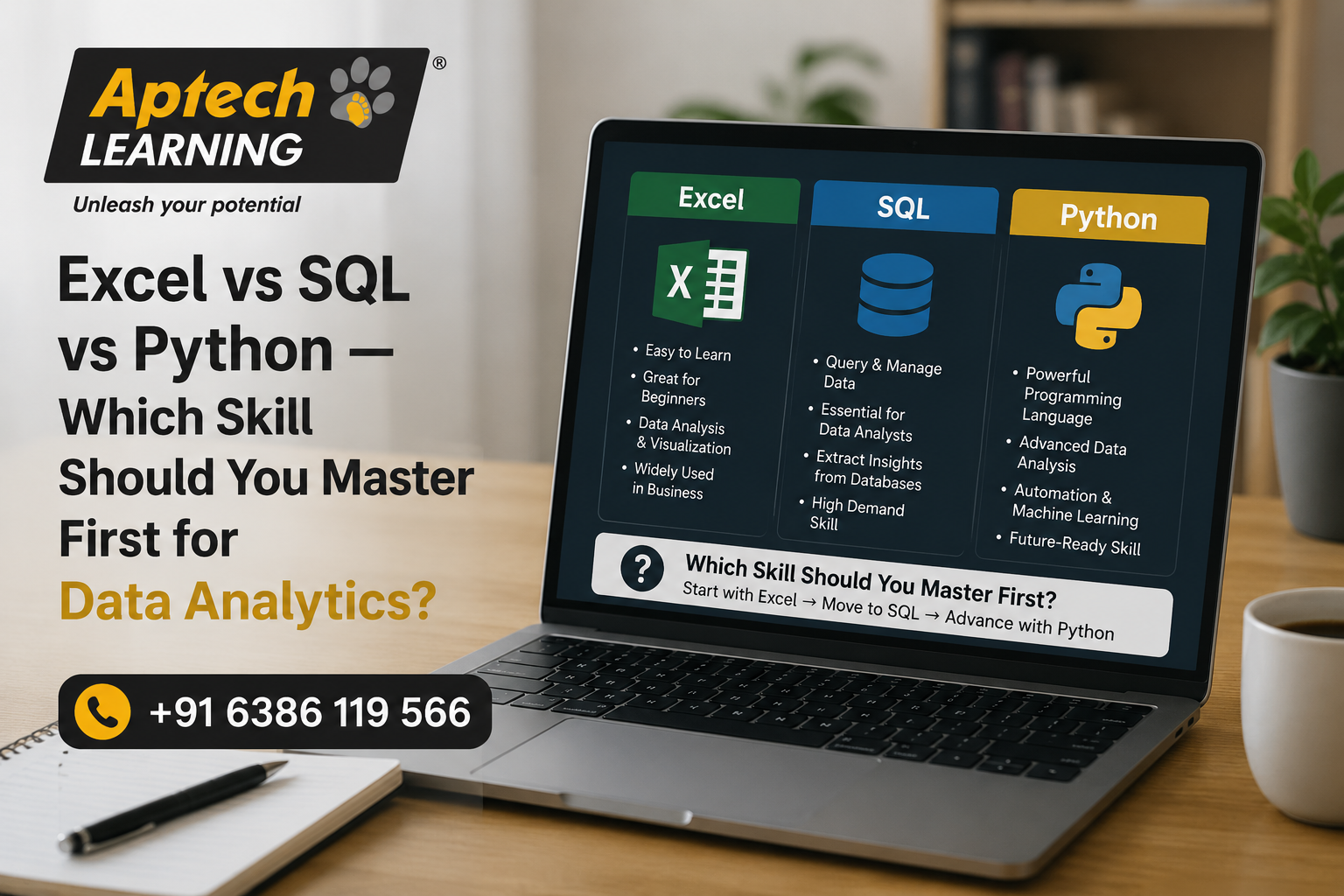
Excel vs SQL vs Python — Which Skill Should You Master First for Data Analytics?
If you’re planning a career in data analytics, one question almost every beginner asks is: should I learn Excel, SQL, or Python first? With so many courses, YouTube videos, and conflicting opinions online, it’s easy to feel stuck before you even begin. The truth is, all three tools are essential for a successful data analytics career, but there’s a smart, logical order to learning them that can genuinely speed up your growth and save you months of confusion.
In this blog, we’ll break down which skill to learn first, what each tool is actually used for in real jobs, common mistakes beginners make, and a practical step-by-step roadmap you can follow today.

Excel, SQL and Python — Where Each One Fits
| Tool | Main Use Case | Difficulty Level | Best Suited For |
|---|---|---|---|
| Excel | Data cleaning, basic analysis, reporting, pivot tables | Easy | Beginners, small datasets |
| SQL | Extracting data from databases, filtering, handling large data | Medium | Data extraction, real-world databases |
| Python | Automation, advanced analysis, machine learning, visualization | Medium-High | Career growth, advanced analytics |
Why the Order Actually Matters
A lot of beginners try to jump straight into Python because it sounds “advanced” and impressive. But without understanding how data is structured and cleaned (which Excel teaches) or how data is stored and queried (which SQL teaches), Python ends up feeling overwhelming and disconnected from real-world use. Learning in the right sequence means every new tool builds naturally on what you already know, instead of starting from scratch each time.
Step 1: Start With Excel
Excel is the foundation of data analytics. If you’re a complete beginner, starting with Excel is the easiest and most practical entry point. You should be comfortable with pivot tables, VLOOKUP/XLOOKUP, conditional formatting, charts, and building basic dashboards. Excel also teaches you essential habits like spotting errors, cleaning messy data, and organizing information logically — skills that carry over directly into SQL and Python later on.
Most small businesses and even many large companies still rely heavily on Excel for daily reporting, which means this skill alone can open early job opportunities.
Step 2: Learn SQL — The Real Source of Data
When you start working at actual companies, data usually doesn’t live in Excel sheets — it lives in databases with thousands or millions of rows. SQL (Structured Query Language) helps you pull specific information out of these large datasets, filter it, join multiple tables together, and analyze it efficiently. Almost every data analyst job posting lists SQL as a mandatory skill, often above Python.
Learning SQL after Excel also feels natural, since concepts like filtering, sorting, and summarizing data are already familiar to you from spreadsheets.
Step 3: Python — Takes Your Career to the Next Level
Python becomes essential once you want to move into automation, statistical analysis, predictive modeling, or machine learning. Python libraries like Pandas, NumPy, and Matplotlib make data analysis faster, more powerful, and far more scalable than Excel or SQL alone. If your long-term goal is to grow from data analyst into data scientist or analytics engineer, Python is a must-learn skill.
The good news is that by the time you reach Python, you already understand how data behaves (from Excel) and how it’s structured and queried (from SQL) — so Python becomes a tool for deeper analysis rather than a confusing new language.
The Right Learning Order
Excel → SQL → Python
This sequence works best for beginners because each step prepares you for the next. Excel teaches you to understand and clean data, SQL teaches you to extract and manage it at scale, and Python teaches you to analyze, automate, and visualize it at an advanced level.
Common Mistakes Beginners Should Avoid
Many learners try to study all three tools simultaneously, which often leads to half-finished knowledge in each. Others skip Excel entirely, assuming it’s “too basic,” only to struggle later with fundamental data concepts. A focused, sequential approach — spending real time mastering one tool before moving to the next — almost always produces stronger, job-ready skills.
Career Tip
If you want to learn all three skills in a structured way without wasting time figuring out what to study next, a proper data analytics course can save you months of confusion. Practical training, real projects, mentorship from industry experts, and placement support can significantly speed up your career growth compared to learning everything alone online.
Frequently Asked Questions
Q1. What should I learn first for data analytics — Excel, SQL, or Python?
For beginners, Excel is the best starting point since it builds a basic understanding of how data is organized and analyzed.
Q2. Is SQL necessary if I already know Python?
Yes, because real-world data is stored in databases, and without SQL, extracting and managing that data efficiently becomes very difficult.
Q3. How long does it take to learn Python for data analytics?
Basics can usually be learned in 2-3 months, but reaching an advanced, job-ready level may take 6 months or longer with consistent practice.
Q4. Can I get a data analyst job with just Excel skills?
It’s possible for entry-level roles, but most companies expect SQL and Python knowledge for long-term career growth.
Q5. Which skill is in the highest demand for data analytics careers?
Both SQL and Python are in high demand, but SQL is considered almost mandatory across nearly every data analyst job posting.
Q6. Can people from a non-IT background learn data analytics?
Absolutely. Data analytics is open to beginners from any background, as long as you follow the right roadmap and practice consistently.
Conclusion
Data analytics isn’t built on a single skill — it’s a combination of tools, and learning them in the right order can make your career path far smoother and far less stressful. Start with Excel to build your foundation, move to SQL to master data extraction, and then learn Python to take your analysis to an advanced, future-ready level. For anyone serious about building a long-term career in this field, following this Excel → SQL → Python roadmap is a smart, practical, and proven approach.