
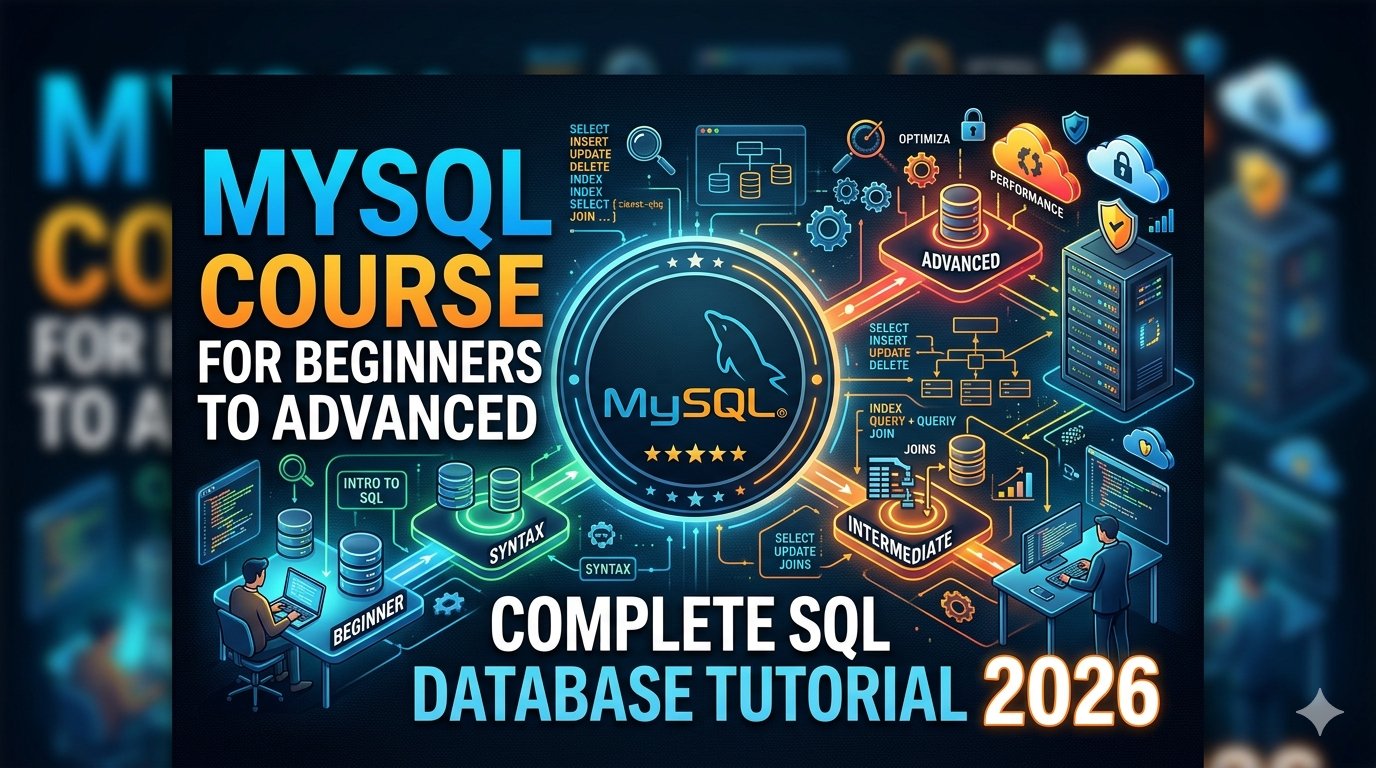
MySQL Course for Beginners to Advanced | Complete SQL Database Tutorial 2026
If you have been thinking about learning MySQL but don’t know where to start, you are in exactly the right place. This guide walks you through everything — from what MySQL actually is, why it matters in 2026, and how you can go from zero knowledge to writing advanced SQL queries, building databases, and landing real tech jobs.
Whether you are a student, a developer, a data analyst, or someone switching careers, this complete MySQL tutorial covers all the ground you need to cover. And if you are in Lucknow and want hands-on, instructor-led training, Aptech Learning Lucknow offers a structured MySQL course that takes you from beginner to job-ready.
Let’s get started.
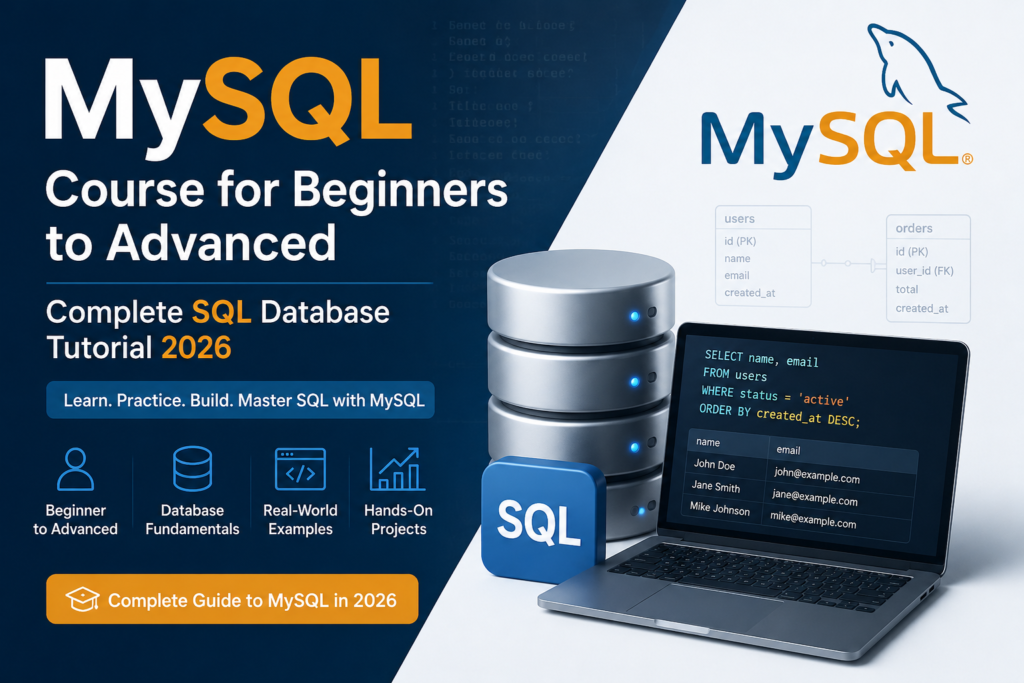
What Is MySQL and Why Should You Learn It in 2026?
MySQL is an open-source relational database management system. In plain English — it is the software that stores, organizes, and retrieves data for applications. Every time you log into a website, place an order, or check your bank balance, there is a database running quietly in the background, and more often than not, it is MySQL.
In 2026, MySQL powers some of the biggest platforms on the internet. Netflix uses it. Uber uses it. Airbnb, Shopify, Twitter, Facebook — the list goes on. It is consistently ranked as the most popular open-source database in the world, and that has been true for over a decade straight.
So why should you learn it right now?
Because data is everywhere. Every company, whether it is a startup or a Fortune 500, generates and stores data. The people who know how to manage that data — how to query it, structure it, and pull insights from it — are in extremely high demand. MySQL is the foundation skill that gets you into that world. It is free to learn, widely supported, and one of the first things employers look for in a backend developer, data analyst, or database administrator role.
Who Should Take a MySQL Course?
Before diving into the technical content, it helps to understand whether MySQL is the right fit for you. The short answer is — it probably is, regardless of your background.
Complete beginners who have never touched a database before will find MySQL surprisingly approachable. There is no programming language to memorize first. You just learn SQL — the language used to talk to databases — and you start running queries within your first few hours.
Web developers working with PHP, Python, or Node.js need MySQL to build the backend of any dynamic website. Without a database, your website cannot store users, orders, content, or anything else that needs to persist.
Data analysts use MySQL every day to extract reports, calculate KPIs, and answer business questions that spreadsheets cannot handle at scale. If you are working with data and you do not know SQL, you are missing the most important tool in the job.
Students and fresh graduates who want to enter the tech industry will find that MySQL knowledge opens doors for multiple career paths — SQL developer, database administrator, data analyst, and backend engineer all require it.
IT professionals who manage infrastructure or work in system administration often need MySQL knowledge to support the applications their organizations run.
The point is, MySQL is not a niche skill. It is a foundational one.
What Will You Learn in a Complete MySQL Course?
A well-structured MySQL course for beginners to advanced level covers the following core areas. Each builds on the previous, so by the time you reach the advanced modules, you have the context to actually understand what you are doing and why.
Module 1 — Introduction to Databases and MySQL
You start by understanding what a database is and why relational databases were invented in the first place. You will install MySQL Community Server and MySQL Workbench (both completely free), connect to your first database, and get comfortable with the interface. By the end of this module, running your first query feels natural.
Module 2 — SQL Basics: SELECT, INSERT, UPDATE, DELETE
These four commands are the heart of SQL. They are called CRUD operations — Create, Read, Update, Delete. You learn how to create tables, define data types, add data, retrieve it, modify it, and remove it. This module alone covers 60 to 70 percent of what most developers use SQL for on a daily basis.
Module 3 — Filtering, Sorting, and Grouping Data
Writing a SELECT query is just the beginning. The real power comes from narrowing down your data with WHERE clauses, sorting results with ORDER BY, grouping records with GROUP BY, and filtering grouped results using HAVING. You will also learn LIKE, IN, BETWEEN, and DISTINCT — the tools that let you ask precise questions of your data.
Module 4 — SQL Functions
MySQL has dozens of built-in functions that handle math, text manipulation, dates, and conditional logic. You learn aggregate functions like COUNT, SUM, AVG, MIN, and MAX for calculations. String functions like CONCAT, TRIM, and SUBSTRING for text. Date functions like NOW, DATEDIFF, and DATE_FORMAT for working with time-based data. CASE WHEN for adding if-else logic directly inside a query.
Module 5 — SQL Joins: Combining Multiple Tables
This is the module that separates people who know some SQL from people who really understand it. Real databases never store everything in one table. Orders are in one table, customers in another, products in a third. JOINs are how you bring that data together.
You cover INNER JOIN, which returns only rows with matches in both tables. LEFT JOIN, which returns all rows from the left table plus any matches from the right. RIGHT JOIN, the reverse. Self JOIN for comparing rows within the same table. And CROSS JOIN for generating every possible combination of two tables.
JOINs are asked in every single SQL and database interview. Spending extra time here always pays off.
Module 6 — Subqueries and CTEs
Subqueries let you nest one SQL query inside another. A CTE (Common Table Expression) written with the WITH keyword lets you break complex queries into readable, reusable named blocks. Both are essential for writing analytics queries that answer multi-step business questions — things like “which customers have placed more orders than the average” or “what percentage of revenue came from each product category.”
Module 7 — Database Design and Normalization
Understanding how to design a database properly is what separates a good developer from a great one. You learn entity-relationship diagrams, primary keys, foreign keys, and the normalization rules (1NF, 2NF, 3NF) that prevent data redundancy and keep your database clean. A badly designed database is one of the most common sources of performance problems and data inconsistencies in real applications.
Module 8 — Stored Procedures and Functions
A stored procedure is a block of SQL code saved on the MySQL server that you can call by name. Instead of sending five separate queries from your application, you call one procedure and MySQL handles all the logic internally. You learn how to create procedures with IN and OUT parameters, write user-defined functions, and use IF/ELSE, WHILE loops, and cursors inside your procedures.
This is where MySQL starts to look more like programming than just querying.
Module 9 — Triggers and Events
A trigger fires automatically when something happens in your database — a row gets inserted, updated, or deleted. Triggers are commonly used for audit logging, enforcing business rules at the database level, and keeping summary tables in sync. The MySQL Event Scheduler lets you automate recurring tasks like sending nightly reports or archiving old records.
Module 10 — Transactions and ACID Properties
In real applications, multiple things often need to happen together — or not at all. When a customer transfers money, the debit and credit must both succeed or both fail. Transactions handle this. You learn BEGIN, COMMIT, and ROLLBACK, the four ACID properties (Atomicity, Consistency, Isolation, Durability), and isolation levels that control how concurrent transactions interact with each other.
Module 11 — Indexing and Query Optimization
This is where beginners become seniors. An index is a data structure that lets MySQL find rows without scanning the entire table. Without indexes, a query on a million-row table can take seconds. With the right index, it takes milliseconds. You learn B-Tree indexes, composite indexes, covering indexes, FULLTEXT indexes, and how to use the EXPLAIN command to understand what MySQL is doing with your queries and why some queries are slow.
Module 12 — MySQL Administration and Security
You learn how to create and manage users, grant and revoke permissions, back up databases using mysqldump, and restore from backup. You also get an introduction to replication — the process of keeping a live copy of your database on a separate server — which is how large applications maintain high availability.
MySQL vs Other Databases — How Does It Compare?
A lot of beginners wonder whether MySQL is still worth learning when there are other databases like PostgreSQL, MongoDB, and SQLite. Here is a straightforward comparison.
| Database | Type | Best For | Ease of Learning | Popular With |
|---|---|---|---|---|
| MySQL | Relational (SQL) | Web apps, analytics, general use | Very Easy | Netflix, Uber, Shopify |
| PostgreSQL | Relational (SQL) | Complex queries, advanced features | Moderate | Instagram, Apple |
| SQLite | Relational (SQL) | Mobile apps, embedded systems | Easy | Android, iOS apps |
| MongoDB | NoSQL (Document) | Unstructured/flexible data | Moderate | Forbes, Lyft |
| Oracle DB | Relational (SQL) | Enterprise, banking | Hard | Banks, governments |
MySQL wins on ease of learning, job market demand, community support, and the sheer number of tutorials and resources available. For anyone starting out, it is the most practical choice by a significant margin.
Career Opportunities After Learning MySQL
Completing a MySQL course from beginner to advanced opens doors to multiple well-paying tech roles. Here is what you can realistically expect in the Indian and global job markets in 2026.
| Job Role | Skills Required | Average Salary (India) | Average Salary (US) | Demand |
|---|---|---|---|---|
| SQL Developer | Queries, stored procedures, views | ₹4–8 LPA | $75K–$95K | Very High |
| Database Administrator (DBA) | Indexing, optimization, backup, security | ₹6–14 LPA | $90K–$125K | Very High |
| Backend Developer | MySQL + PHP / Python / Node.js | ₹5–15 LPA | $85K–$130K | Very High |
| Data Analyst | SQL + Excel + BI tools | ₹4–10 LPA | $70K–$100K | High |
| Data Engineer | MySQL + Python + ETL + Cloud | ₹8–20 LPA | $100K–$150K | Growing Fast |
The common thread across all of these roles is MySQL. Even if your end goal is data science or cloud engineering, SQL is the skill you need to build first.
How to Learn MySQL Step by Step — The Right Approach
A lot of people get stuck when learning MySQL because they follow tutorials passively — watching videos without writing any code. Here is a better approach.
Start by installing MySQL Community Server and MySQL Workbench on your computer. Both are free. Load a sample database — MySQL provides the Sakila and World databases for free, and they are perfect for practice.
Write every query yourself. Do not copy-paste from tutorials. Typing the code builds muscle memory and forces you to actually understand each part of the syntax.
Practice on real data. After you get comfortable with the basics, find a publicly available dataset — something related to sales, employees, or products — and try to answer real business questions using SQL. Can you find the top 10 customers by revenue? Can you calculate month-over-month growth? These exercises build the kind of skills that actually show up in job interviews.
Do one thing each day, even if it is just 30 minutes. Consistency beats intensity when learning a technical skill. Thirty minutes a day for three months will get you further than ten hours on one weekend.
Take a structured course when you hit a wall. Self-study works for basics, but when you get to joins, subqueries, and stored procedures, having an instructor who explains things in context makes a significant difference.
Why Learn MySQL at Aptech Learning Lucknow?
If you are based in Lucknow or nearby and you want structured, hands-on MySQL training from experienced instructors, Aptech Learning Lucknow is one of the most reliable options available.
Aptech is a globally recognized IT training institution with decades of experience producing job-ready tech professionals. The MySQL course at Aptech Lucknow covers everything from SQL basics to advanced database design, with real-world projects, interview preparation, and placement support built in.
You get to practice on actual databases, ask questions in real time, and learn alongside peers who are working toward the same goals. For anyone who finds self-paced learning difficult to stick with, a classroom environment with accountability and instructor feedback makes a real difference in how fast and how well you learn.
If you want to know about batch timings, fees, or course content, visit aptechlearninglko.com or walk into the center directly.
7 Frequently Asked Questions
Q1. Is MySQL easy to learn for complete beginners?
Yes, MySQL is one of the most beginner-friendly database systems available. Unlike general programming languages, you do not need to understand complex concepts like loops, functions, or object-oriented programming before you can write useful SQL. Most beginners are writing basic SELECT queries and creating tables within their first few hours. The learning curve gets steeper with joins, subqueries, and stored procedures — but those come after you have built a solid foundation.
Q2. How long does it take to learn MySQL step by step?
With one to two hours of daily practice, most beginners can cover MySQL basics — SELECT, INSERT, UPDATE, DELETE, and simple JOINs — in about two to four weeks. To reach an intermediate level where you are comfortable with stored procedures, complex queries, and database design, plan for two to three months. Reaching an advanced level that includes query optimization, indexing strategies, and database administration typically takes three to six months of consistent learning and hands-on project work.
Q3. What is the difference between SQL and MySQL?
SQL stands for Structured Query Language. It is the standardized language used to communicate with relational databases. MySQL is a database management system — the software that stores your data and runs on a server. You use SQL as the language to give MySQL its instructions. Other databases like PostgreSQL, Microsoft SQL Server, and Oracle also use SQL, but each has minor differences in syntax. When people say they are “learning MySQL,” they mean they are learning how to use the SQL language within the MySQL database environment.
Q4. Is MySQL still relevant in 2026?
Absolutely. MySQL has been the world’s most popular open-source relational database for over a decade, and that has not changed in 2026. It powers platforms like Netflix, Uber, Airbnb, and Shopify. According to the Stack Overflow Developer Survey, MySQL consistently ranks as the most-used database year after year. The rise of cloud computing has actually increased MySQL’s relevance — all three major cloud providers (AWS, Google Cloud, and Azure) offer fully managed MySQL services as core products.
Q5. What are the prerequisites to learn MySQL?
None. Seriously. You do not need to know any programming language, and you do not need any prior database experience. Basic computer skills — knowing how to install software, navigate folders, and use a keyboard — are all you need to start. If you have any experience with spreadsheets like Excel, you already have an intuitive sense of rows, columns, and tables, which makes the initial concepts even easier to grasp.
Q6. Can I get a job after completing a MySQL course?
Yes. MySQL proficiency appears in thousands of job postings for roles like SQL Developer, Database Administrator, Backend Developer, Data Analyst, and Data Engineer. The key is to pair your MySQL knowledge with one complementary skill — PHP or Python for backend development, Power BI or Tableau for analytics, or Linux server management for DBA roles. That combination makes you significantly more hireable than someone who only knows one side of the stack.
Conclusion
MySQL is not going anywhere. If anything, its importance is growing — more data, more applications, more companies that need people who understand how to manage relational databases. Whether your goal is to build web applications, analyze business data, become a database administrator, or simply have a skill that makes you more valuable at your current job, MySQL is one of the best places to put your learning time.
The path is clear: start with the basics, practice consistently, build real projects, and seek structured training when you need guidance.
If you are in Lucknow and want to learn MySQL with proper instructor support, industry-relevant projects, and placement assistance, Aptech Learning Lucknow is worth a visit. The course is structured, the trainers are experienced, and the environment is built for people who want to learn practically rather than just theoretically.
Start today. The sooner you begin, the sooner you get results.