
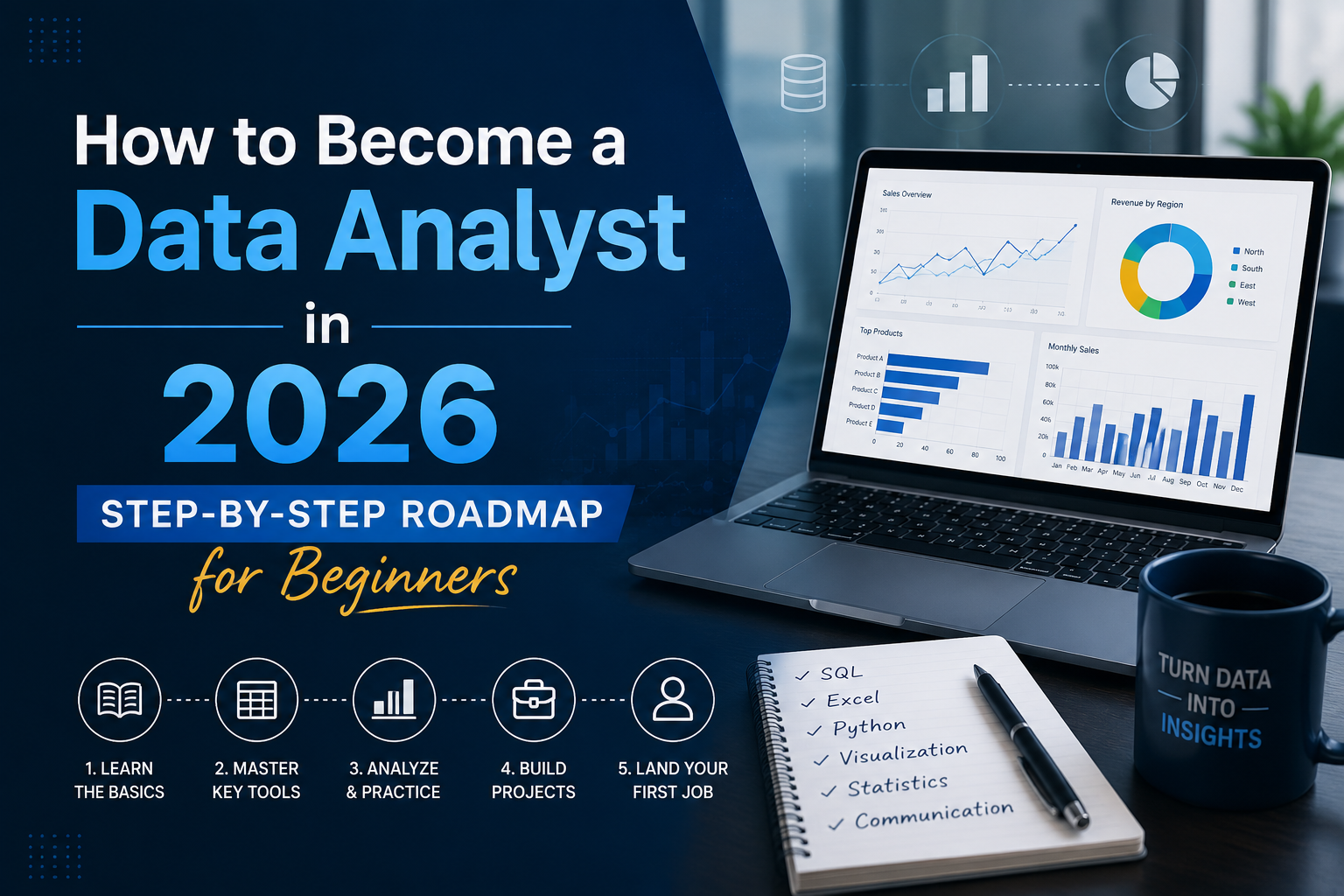
How to Become a Data Analyst in 2026 — Step-by-Step Roadmap for Beginners
Most people who want to get into data analytics do not have a clear starting point. They watch a few YouTube videos, download Python, feel overwhelmed, and stop. The problem is not the field — the problem is the lack of a proper roadmap.
Here is the truth: becoming a data analyst in India in 2026 does not require a computer science degree, a fancy bootcamp, or years of experience. It requires the right skills, in the right order, with real practice along the way.
This roadmap is built around what Indian employers actually ask for in interviews — not what looks good on a course brochure.
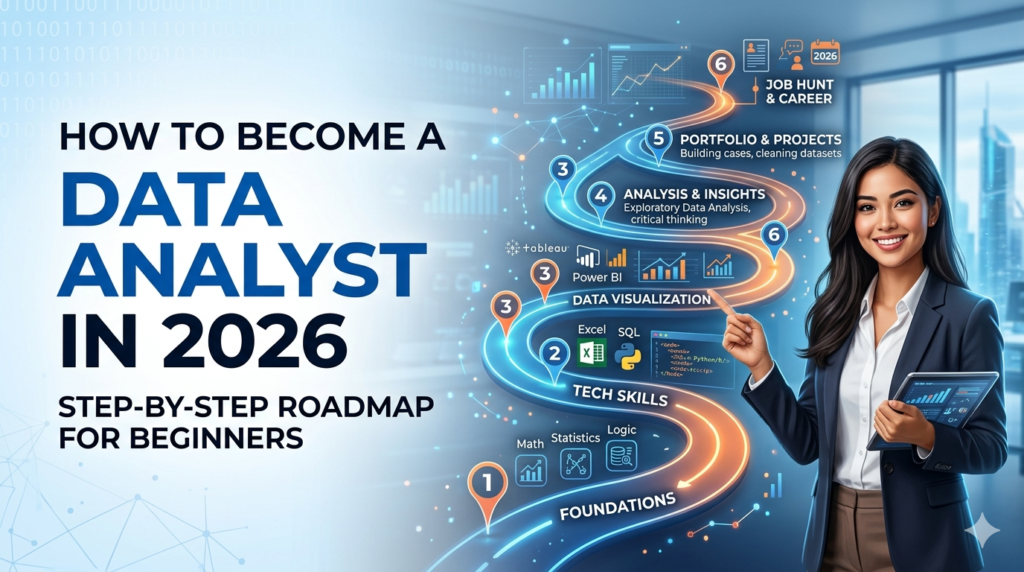
Step-by-Step Roadmap — From Zero to Hired
Follow these steps in order. Skipping ahead before finishing the previous step is the most common reason beginners stall and give up.
| Step | What to Do | Time Needed |
|---|---|---|
| Step 1 | Learn Advanced Excel — pivot tables, VLOOKUP, data cleaning | 2–3 weeks |
| Step 2 | Learn SQL — SELECT, JOINs, GROUP BY, subqueries | 3–4 weeks |
| Step 3 | Learn Python basics — Pandas, NumPy, basic charts | 4–6 weeks |
| Step 4 | Learn Power BI — build dashboards, connect data sources | 2–3 weeks |
| Step 5 | Work on 2–3 real projects using actual business datasets | 3–4 weeks |
| Step 6 | Build your resume, prepare for interviews, apply | Ongoing |
Total time from scratch to job-ready: 3 to 5 months with consistent daily practice of 2 to 3 hours.
Tools You Must Know — And Why Each One Matters
This is not a suggestion list. These are tools that appear in over 70% of data analyst job postings in India right now. If your course does not cover all of them, it is leaving gaps that will hurt you in interviews.
| Tool | What It Does | % of Job Listings Requiring It |
|---|---|---|
| Advanced Excel | Data cleaning, MIS, pivot reports | 71% |
| SQL | Database queries, data extraction | 94% |
| Python (Pandas, NumPy) | Automation, analysis, manipulation | 78% |
| Power BI | Business dashboards, visual reporting | 82% |
| Tableau | Data storytelling, enterprise reporting | 55% |
| Basic Statistics | Mean, median, distributions, correlation | 60% |
SQL is non-negotiable. It is asked in almost every data analyst interview in India. Learn it seriously, not just the basics.
Who Can Become a Data Analyst in 2026?
This field is genuinely open to people from all backgrounds. What matters is your skill set — not your degree or stream.
| Background | Can They Become a Data Analyst? | Where to Start |
|---|---|---|
| Class 12 — any stream | Yes | Excel + SQL first |
| BCom / BBA Graduate | Yes | Business analytics track |
| BA / BSc Graduate | Yes | Statistics + Power BI |
| B.Tech / MCA Graduate | Yes | Python + advanced SQL |
| Working Professional | Yes | Weekend / evening batches |
| Career Switcher | Yes | 3–4 month intensive program |
Many companies in India — especially startups and mid-size firms — hire based on skills and portfolio projects, not formal degrees.
Data Analyst Salary in India — What to Expect in 2026
Here is a realistic, current picture based on actual market data:
| Experience Level | Salary Range (India) | Monthly Take-Home |
|---|---|---|
| Fresher (0–1 year) | ₹3.5 – ₹6 LPA | ₹25,000 – ₹42,000 |
| Mid-level (2–3 years) | ₹7 – ₹12 LPA | ₹50,000 – ₹80,000 |
| Senior (4–6 years) | ₹15 – ₹25 LPA | ₹1,00,000+ |
| Remote / Product Company | ₹20 LPA+ | ₹1.4L+ |
Freshers who know SQL + Python + Power BI get shortlisted significantly faster and start at higher packages compared to those who only know Excel.
How Aptech Learning Lucknow Helps You Follow This Roadmap
Learning on your own works for some people. For most beginners, structured guidance, doubt resolution, and real placement support make the difference between completing the journey and dropping off halfway.
| Feature | What Aptech Lucknow Offers |
|---|---|
| Curriculum | Excel → SQL → Python → Power BI → Tableau, in order |
| Projects | Compulsory live projects on real business datasets |
| Batch Options | Morning / Evening / Weekend — flexible for all |
| Placement Support | Resume building + mock interviews + recruiter referrals |
| Eligibility | Class 12 pass or above, any stream |
| Duration | 3 to 6 months |
| Contact | +91 6386 119 566 |
Students from non-technical backgrounds — Commerce, Arts, BCom — regularly complete this program and get placed in analyst roles across Delhi NCR, Noida, and Bangalore, many of them working remotely from Lucknow.
Frequently Asked Questions (FAQs)
Q1. How long does it take to become a data analyst in India from scratch?
With consistent practice of 2 to 3 hours daily, most beginners are job-ready in 3 to 5 months. A structured offline program like the one at Aptech Learning Lucknow compresses this timeline because the curriculum is sequenced, doubts get resolved in real time, and placement preparation happens alongside the training.
Q2. Do I need to know coding to become a data analyst?
Basic SQL is essential — it is tested in nearly every data analyst interview in India. Python is not always mandatory for entry-level roles, but it significantly increases your salary and shortlisting chances. Both are taught from scratch at Aptech Lucknow, so no prior coding background is needed.
Q3. Can I become a data analyst without a degree?
Yes. A large number of working data analysts in India today do not have a formal data science or analytics degree. Employers care about your SQL skills, dashboard quality, and how you explain your project work — not your college name or stream.
Q4. What is the starting salary for a data analyst fresher in India in 2026?
Entry-level data analysts in India currently earn between ₹3.5 LPA and ₹6 LPA. Freshers who combine SQL, Python, and Power BI in their skill set tend to receive higher initial offers and get shortlisted faster than candidates who only know Excel.
Q5. Which tool should I learn first — SQL, Python, or Power BI?
Start with Excel for data fundamentals, then move to SQL. SQL is the single most important tool in a data analyst’s kit — it appears in over 90% of Indian job listings. Once SQL is solid, add Power BI for dashboards and then Python for automation and deeper analysis.
Q6. Is data analytics a good career in India in 2026?
Yes, strongly. India’s demand for data professionals is growing at over 30% year-on-year, and the trained talent supply is still smaller than that demand. This means freshers who complete structured training are entering a market that is actively looking for them — not competing against oversaturation.
Start Your Data Analytics Journey Today
The roadmap is clear. The demand is real. The only thing left is the decision to start.
📞 Call / WhatsApp: +91 6386 119 566 📧 Email: digilearninglko@gmail.com 🌐 Website: aptechlearninglko.com 📍 Address: First Floor, Above Radiance, 18 J Road, Near Midland Healthcare, Mahanagar, Lucknow