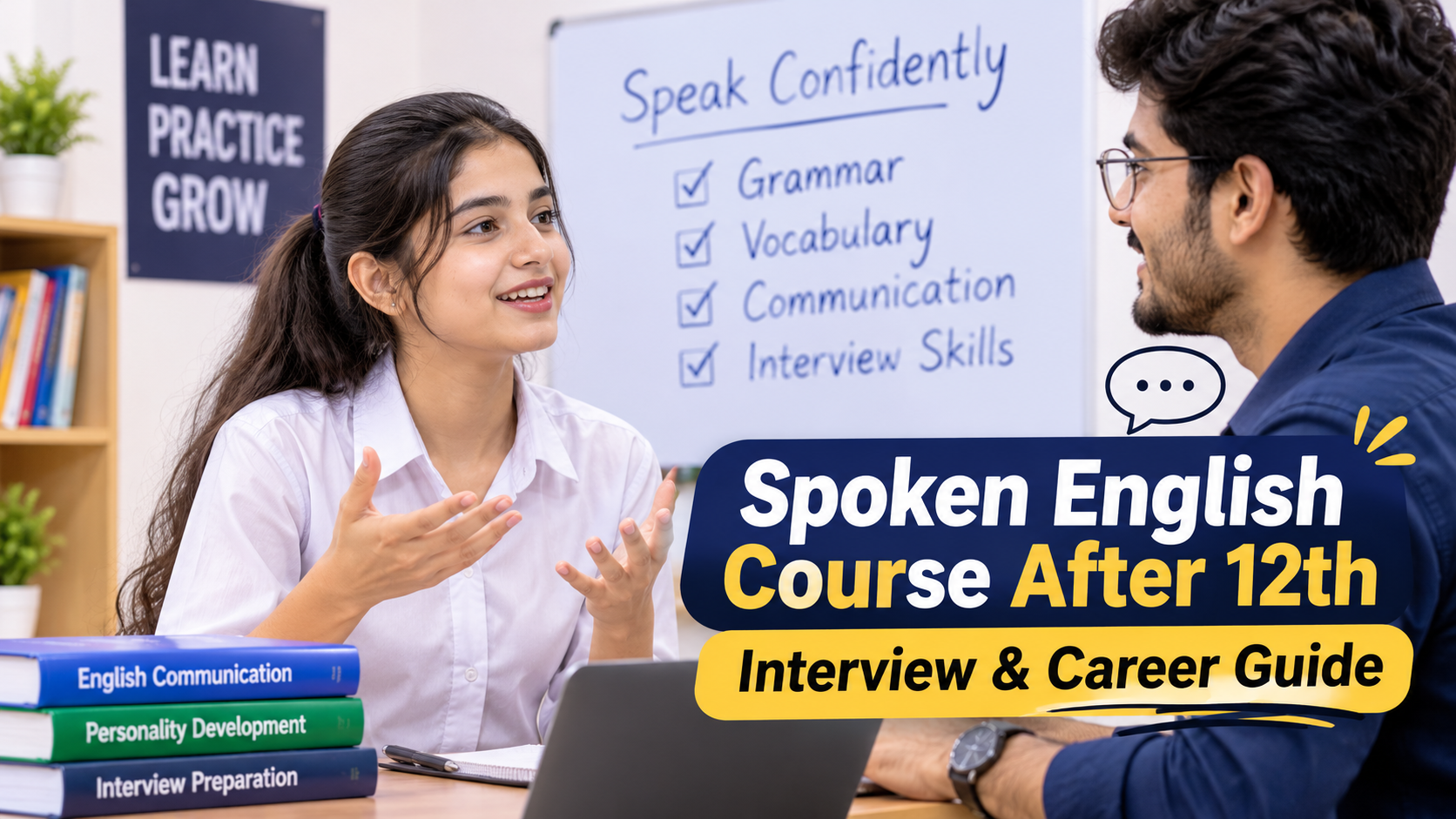
Spoken English Course After 12th: Interview & Career Guide
Spoken English Course After 12th: Interview & Career Guide
Why After 12th Is a Good Time to Start
Think about learning to swim. A child who learns early is comfortable in water by the time it matters. An adult who starts late can still learn, but fear usually gets in the way. Speaking English is similar. The longer you wait, the more embarrassing it feels to start.
After 12th, you have three advantages:
You have time. Boards are over, and a few weeks or months before college give you space for daily practice.
You have low pressure. Nobody is judging your English yet, so mistakes cost nothing.
You have runway. You still have three or four years before placements, which is more than enough to move from hesitant to confident.
Students who begin in the first semester often find group discussions and presentations in college far less scary, because they have already practised.
Common Struggles Students Face After 12th
Most students are not weak in English. They are weak in using English out loud. The usual struggles look like this:
Translating every sentence from Hindi in the head, which makes speech slow.
Fear of making mistakes in front of friends or teachers.
Limited vocabulary for everyday and professional situations.
Pronunciation worries, especially with certain sounds.
Never having practised self-introduction, group discussion, or interview-style questions.
School systems often focus on grammar and writing for exams, with little real speaking practice. That is not the student’s fault, but it explains why a speaking-focused course can feel like a different skill altogether.
What a Good Spoken English Course Should Teach
A beginner-friendly spoken English syllabus should build step by step. Look for these areas.
Vocabulary for Daily Life Common words and phrases used in conversations, shopping, travel, college, and social situations.
Basic Grammar for Speaking Tenses, sentence patterns, and common error fixes, taught through speaking rather than only through rules.
Pronunciation and Listening Clear sounds, word stress, and understanding natural speed through listening exercises.
Conversation Practice Role plays, pair talks, and short discussions on everyday topics.
Self-Introduction and Personal Branding Presenting yourself clearly in a minute or two, a skill needed again and again in college and jobs.
Group Discussion Skills Starting a point, agreeing and disagreeing politely, and finishing with a summary.
Presentation Skills Organising ideas, using simple slides, and speaking calmly to an audience.
Interview Preparation Answering common questions, handling nervousness, and practising mock interviews.
Professional Communication Basics Phone etiquette, simple emails, and workplace phrases.
Module | What It Builds | Example Activity Daily Vocabulary | Everyday expression | Describe your day in five sentences Grammar for Speaking | Accuracy | Correcting common errors in live speech Pronunciation and Listening | Clarity and understanding | Repeating short audio clips Self-Introduction | First impression | Two-minute introduction practice Group Discussion | Confidence in groups | Mock group discussion on a simple topic Interview Preparation | Interview readiness | Mock interview with feedback
How the Course Helps Interviews and Careers
Interviews are conversations under pressure. Even when your knowledge is good, unclear or hesitant speech makes it harder for the interviewer to see it.
A spoken English course helps in four practical ways:
It gives you structure. You learn how to answer in a clear pattern, such as answer, reason, example.
It builds vocabulary for your field. You learn how to describe your studies, skills, and projects.
It reduces fear. Repeated practice in a safe setting makes real interviews feel familiar.
It improves the first impression. A calm greeting, clear introduction, and steady pace shape how people see you in the first minute.
It is important to be honest: spoken English alone does not get you a job. Skills, knowledge, and preparation matter. But strong communication makes everything else you have easier to show.
Step-by-Step Plan for the First Three Months
Week 1: Check Your Level and Set a Simple Goal Record yourself speaking for one minute about your day. Note what felt difficult. Set a goal such as “speak for two minutes without stopping.”
Weeks 1 to 2: Build Everyday Vocabulary Learn phrases for greetings, introductions, college, family, and hobbies. Use each new phrase in a sentence the same day.
Weeks 2 to 3: Practise Short Conversations Talk in pairs about simple topics. Focus on being understood, not on perfect grammar.
Weeks 3 to 4: Fix Pronunciation Basics Listen to short clips and repeat them aloud. Notice sounds you find difficult and practise them slowly.
Month 2: Practise Self-Introduction and Short Talks Prepare and deliver a two-minute self-introduction, then a short talk on a familiar topic.
Month 2: Join Group Discussions Practise starting a point, adding a reason, and responding politely to others.
Month 3: Practise Presentations Prepare a short presentation on a topic you like, using three or four simple points.
Month 3: Do Mock Interviews Practise common questions such as “Tell me about yourself” and “Why do you want this course or job?”
Throughout: Record and Review Record yourself every week and compare. Visible progress keeps you motivated.
After Three Months: Review and Plan Identify what improved, what still needs work, and plan the next stage, such as internship-style communication or advanced discussion practice.
Spoken English for College Life
Many students are surprised at how often English appears in college. Presentations, viva questions, seminars, group projects, and internship applications all ask you to speak or write clearly.
Starting a spoken English course before or during the first semester helps you:
Speak up in class without feeling judged.
Make friends and network with students from different backgrounds.
Present projects more confidently.
Prepare early for internship interviews.
Build a habit of practice that continues through college.
If you are taking up a professional course such as BCA, B.Com, B.Sc., or a diploma, the communication skills you build now will quietly support every semester.
Online vs Offline Classes
Both formats can work, and the right choice depends on how you learn.
Offline classes suit students who need routine, live interaction, and group practice. Speaking with real people in the room, getting immediate correction, and joining group discussions feel natural in a classroom. For shy students, a supportive batch can make a big difference.
Online classes suit students from nearby towns or those with limited time. Choose live, interactive sessions where you actually speak. A video lecture you only watch will not build speaking skill.
Hybrid arrangements, where available, can combine both. If you are very nervous about speaking, starting with a small offline batch often helps build confidence faster.
How to Choose a Class in Lucknow
Use this checklist before you join:
Ask for the full syllabus and check that it includes speaking practice, group discussion, presentation, and interview preparation.
Ask how much of each class is actual speaking by students, not only trainer lectures.
Find out the batch size. Smaller batches give more speaking time per student.
Attend a demo class and see whether the trainer corrects kindly and explains why.
Ask whether students are grouped by level so beginners are not overwhelmed.
Check timings, especially if you plan to prepare for college or entrance exams alongside.
Ask how progress is tracked, such as through recordings or periodic reviews.
Ask what the fee includes and whether any extra charges apply.
Be wary of promises like “fluent English in 15 days” or “guaranteed job.” Real improvement takes steady practice.
Advice for Parents
If you are a parent reading this, a few honest points may help.
Look for a course that teaches speaking, not only grammar. A student can know rules and still be afraid to speak.
Let your child try a demo class first. Comfort with the trainer and batch matters a lot.
Avoid comparing your child with others. Confidence grows at different speeds.
Encourage practice at home. Even ten minutes of English conversation at dinner helps.
Be cautious with guarantees. A good institute will talk about practice, feedback, and progress, not miracles.
Celebrate small improvements, such as speaking for a full minute without stopping.
Practical Examples
Student Waiting for College Admission: A student who has finished 12th uses the gap months for a spoken English course. By the time college starts, they can introduce themselves confidently and take part in discussions.
Student From a Hindi-Medium Background: A student who studied in Hindi medium feels nervous about English-heavy courses. Short daily conversation practice and a supportive batch help the student move from silence to simple, clear answers.
Student Preparing for a Professional Course: A student joining a BCA programme practises presentations and group discussions early, which makes first-semester seminars feel manageable.
Student Looking for a Part-Time Job: A student applying for a part-time role in a shop or customer-facing setting practises basic customer conversations and a short self-introduction, and feels more prepared for the interview.
Common Mistakes Students Make
Waiting until they feel “ready.” Confidence comes from speaking, not from waiting.
Focusing only on grammar. Rules help, but speaking improves through use.
Avoiding mistakes by staying silent. Mistakes are how you learn.
Translating word by word from Hindi. This slows speech and creates unnatural sentences.
Choosing a class only by fee. A cheap class with no speaking time wastes weeks.
Practising only in class. Daily short practice at home matters.
Comparing with classmates. Everyone progresses differently.
Expecting overnight results. Real fluency builds over months.
Career Opportunities That Value Strong Spoken English
Good English speaking supports many career paths. Common areas include:
Customer Support and Service Roles — daily communication with clients and customers.
Sales and Business Development — explaining products and building trust.
Office Administration and Front Desk — handling calls, visitors, and basic correspondence.
Hospitality and Travel — dealing with guests and travellers.
Teaching and Training — explaining ideas simply.
IT and Technical Roles — explaining problems and solutions to teammates and clients.
Banking, Insurance, and Retail Roles — customer-facing communication.
Freelancing and Remote Work — communicating with clients and teams.
Spoken English does not replace skills, but it makes your skills easier to show, and it widens the range of roles you can apply for.
Salary and Career Growth
Spoken English does not have a fixed salary value by itself. Its effect is indirect. Candidates who communicate clearly often perform better in interviews, get access to customer-facing and corporate roles, and are more likely to be considered for responsibility as they grow. Pay still depends on your role, skills, company, city, and experience. It is more useful to see spoken English as a skill that supports your overall profile rather than as a separate qualification that changes your salary on its own.
Skills You Will Build
Speaking in clear, simple sentences with a comfortable pace
Building vocabulary for everyday and professional situations
Pronouncing common words more clearly
Understanding spoken English at natural speed
Delivering a self-introduction and short presentation
Taking part in group discussions politely and confidently
Answering common interview questions calmly
Tools and Daily Habits
Tool or Habit | How It Helps Voice Recording on Your Phone | Lets you hear and improve your speech Short English Audio or Video Clips | Builds listening and natural phrasing Daily Self-Introduction Practice | Strengthens your first impression Speaking Partner or Practice Group | Gives real conversation practice Short Daily Reading | Adds vocabulary and sentence sense Trainer Feedback | Corrects errors you cannot notice yourself
Eligibility
A spoken English course after 12th is open to students who have completed 12th grade from any stream. No special background is required. Basic reading ability in English is helpful, and good institutes place students in batches that match their level. Confirm the exact requirements with the institute.
Course Duration
Spoken English courses range from a few weeks for a short speaking-practice programme to a few months for a fuller course covering vocabulary, grammar, group discussion, presentation, and interview preparation. The right duration depends on your starting level and how consistently you practise. Many students prefer a three-month plan during the gap before college or alongside the first semester. Confirm the schedule and total hours with the institute.
Who Should Join
Students who have just finished 12th and want to be ready for college
Students who understand English but hesitate to speak it
Students planning internships, part-time jobs, or early career moves
Students who studied in a Hindi-medium or regional-language school and want to build confidence
Students who want to prepare early for group discussions and campus placements
Frequently Asked Questions
Is a spoken English course useful after 12th?
Yes. It helps you build confidence before college, group discussions, internships, and interviews, and gives you years to practise before placements.
Do I need good English to join?
No. Beginner batches start from basic sentences. Good courses place students by level so no one is left behind.
Is grammar necessary for speaking?
Basic grammar helps, but speaking improves mainly through practice. Good courses teach grammar through speaking.
Should I choose online or offline classes?
Offline suits students who want routine and group practice. Live online classes suit those with limited time or living outside the city.
What should a good spoken English course include?
It should include vocabulary, pronunciation, conversation practice, group discussion, presentations, and mock interviews.
Does spoken English help in getting a job?
It helps you perform better in interviews and customer-facing roles, but jobs also depend on skills and experience.
Conclusion
The months after 12th are a useful window to build a skill that will follow you through college and your career. A good spoken English course does not turn you into a different person. It helps you say clearly what you already know, in a calm, steady way.
Start early, practise daily, choose a class where you actually speak, and give yourself time. Small improvements add up quickly. By the time interviews and placements arrive, you will not be starting from fear. You will be building on months of practice.
Tags:
Share Article:
Aptech Learning Center Lucknow
Aptech Learning Center is a computer training institute in Mahanagar Extension, Kapoorthala, Lucknow offering job-oriented courses in AI, Data Analytics, Tally & Accounting, Digital Marketing, Cyber Security and NIELIT O Level — with certified trainers, live projects and placement assistance. All course guides are reviewed by our counselling team.
Aptech Learning Center in Mahanagar Extension, Kapoorthala offers industry-certified courses in Data Analytics (Excel, SQL, Power BI, Python), Artificial Intelligence & Machine Learning, Full Stack Web Development (MERN Stack), Python, Java, Tally Prime with GST & E-Way Bill, Advanced Excel MIS Reporting, and NIELIT O Level certification. All programs include practical hands-on labs, real-world case studies, and 100% placement assistance.
We offer both training formats. Classroom offline training is conducted at our modern lab facility located at 19, J Road, near Midland Healthcare, Mahanagar Extension, Kapoorthala, Lucknow. For students from Kanpur, Barabanki, Sitapur, Raebareli, Hardoi, and other parts of Uttar Pradesh, we provide live interactive online batches with recorded sessions and instructor support.
Aptech Learning Center in Mahanagar Extension is recognized as a premier institute for Data Analytics and AI training in Lucknow. The curriculum covers foundational to advanced Python, SQL database management, Power BI interactive dashboard creation, and machine learning models, backed by mock interviews and placement drives for top job roles.
Course fees depend on the selected program and duration (ranging from 2-month short-term skill tracks to 1-year diploma programs) and can be paid via flexible installments. We conduct flexible weekday and weekend batches between 9:30 AM and 8:00 PM for college students and working professionals. You can call +91-6386119566 or visit our center for a free career counseling session.
Yes. Students enrolling in our live online batches from nearby cities like Kanpur, Sitapur, Barabanki, Hardoi, Unnao, and Raebareli get complete access to our dedicated placement cell, resume-building workshops, corporate mock interviews, and placement drives.
Our center is conveniently located at 19, J Road, near Midland Healthcare and Research Center, Mahanagar Extension, Kapoorthala, Lucknow (PIN 226006). It is easily accessible via public and metro transit from Aliganj, Hazratganj, Gomti Nagar, Indira Nagar, and IT Chauraha.
Aptech Learning Center, Mahanagar Extension, Kapoorthala, Lucknow is a trusted computer training institute in Lucknow offering job-oriented courses — Data Analytics, AI & Machine Learning, Digital Marketing, Full Stack Development, Python, Tally Prime with GST, NIELIT O Level, Advanced Excel and Spoken English. Certified faculty, practical labs and placement assistance.