

Career Opportunities After Learning Tally: Complete Guide
Tally is accounting software used by businesses to manage their day-to-day financial transactions, such as sales, purchases, payments, receipts, and inventory. It also handles GST compliance, payroll, and financial reporting, making it one of the most widely used business accounting tools in India.
Think of Tally as a digital version of the old-fashioned accounting ledger books, but far more powerful. Instead of manually writing entries and calculating totals by hand, Tally automates calculations, generates reports instantly, and keeps records organised in a way that is easy to search and verify later.
Because so many small and mid-sized businesses in India rely on Tally for their core accounting needs, it remains one of the most practical, job-ready skills a commerce student or working professional can learn.
Why Learning Tally Matters for Your Career
Tally continues to matter as a career skill for a few clear reasons:
A large number of small and medium businesses across India use Tally for daily accounting, creating consistent demand for people who know how to operate it confidently.
It is often listed as a required or preferred skill in job postings for accounting, billing, and finance-support roles, even at the entry level.
Tally skills are relatively quick to learn compared to full accounting degrees, making it accessible for students and career changers looking for a practical, job-focused skill.
It supports GST-related work, which has become an essential part of business compliance in India, adding real value to a candidate’s profile.
It acts as a strong foundation for professionals who later want to move into broader accounting, finance, or ERP-related roles.
Types of Roles That Use Tally
Tally skills are used across a range of roles, particularly in accounting and finance-support functions.
Accounts and Billing Roles
Roles like accounts executive or billing executive use Tally daily for recording sales, purchases, and payment entries.
GST and Compliance Roles
Roles focused on GST filing and compliance use Tally to generate accurate tax reports and maintain proper documentation.
Inventory and Store Roles
Roles managing stock and inventory use Tally to track goods movement, stock levels, and purchase orders.
Payroll Roles
Roles handling employee salaries use Tally’s payroll features to manage salary processing and related compliance.
Small Business Owner or Self-Employed Roles
Business owners themselves often learn Tally to manage their own company’s accounts without depending fully on external accountants.
Role Type | How Tally is Used | Example Task
Accounts Executive | Recording daily transactions | Sales and purchase entries
GST Executive | Tax compliance and filing | Generating GST reports
Inventory Executive | Stock management | Tracking purchase and stock levels
Payroll Executive | Salary processing | Managing employee payroll records
How Tally Skills Are Used at Work (Step-by-Step)
- Set Up Company Accounts
A business’s basic accounting structure, such as ledgers and accounts, is created and organised within Tally. - Record Daily Transactions
Sales, purchases, payments, and receipts are entered regularly to keep financial records accurate and up to date. - Manage Inventory
Stock levels, purchase orders, and goods movement are tracked within Tally for businesses that deal with physical products. - Handle GST Compliance
Tally is used to generate GST-related reports and documentation required for regular tax filing. - Generate Financial Reports
Reports like profit and loss statements, balance sheets, and cash flow summaries are generated directly from recorded data. - Reconcile Accounts
Bank statements and business records are matched and reconciled to ensure accuracy and catch any discrepancies early. - Support Audits and Reviews
Organised, accurate Tally records make it easier for businesses to prepare for internal reviews or external audits when required.
Tally vs Manual Accounting vs Other Accounting Software
These represent different approaches to managing business accounts.
Manual accounting involves recording transactions by hand in physical ledgers, which is time-consuming and more prone to human error, especially as transaction volume grows.
Tally automates much of the accounting process, handling calculations, report generation, and GST compliance far more efficiently than manual methods, while remaining relatively simple to learn.
Other accounting software, such as larger ERP systems, often offers more advanced features suited to bigger enterprises, but can be more complex and expensive compared to Tally’s straightforward approach for small and mid-sized businesses.
In simple words: manual accounting is slow and error-prone, Tally strikes a practical balance of automation and simplicity, and larger ERP systems are generally reserved for bigger, more complex organisations.
Practical Examples
Retail Shop: A shop owner uses Tally to record daily sales and purchases, automatically tracking stock levels and generating monthly profit reports.
Small Manufacturing Business: An accounts executive uses Tally to manage raw material purchases, production costs, and finished goods inventory.
Service-Based Business: A billing executive at a service company uses Tally to generate and track client invoices, along with payment follow-ups.
Accounting Firm: A junior accountant at a CA firm uses Tally to manage multiple client accounts, ensuring accurate GST filing and financial reporting for each business.
Educational Institute: An accounts team uses Tally to manage fee collection records, staff payroll, and overall institutional expenses.
Common Mistakes Beginners Make
Learning only data entry without understanding accounting basics. Tally is a tool, and without basic accounting knowledge, entries can be recorded incorrectly.
Ignoring GST-related features. Many beginners focus only on basic transactions and skip learning GST compliance features, which are highly valued by employers.
Not practising with realistic business data. Learning Tally using overly simple examples makes it harder to handle real, more complex business scenarios later.
Skipping report generation practice. Beginners sometimes focus only on data entry and do not practise generating and interpreting financial reports.
Not learning keyboard shortcuts. Tally is widely used with keyboard shortcuts for speed, and skipping this slows down real workplace efficiency.
Overlooking inventory management features. Some learners focus only on accounting entries and ignore inventory tracking, which is important for product-based businesses.
Career Opportunities
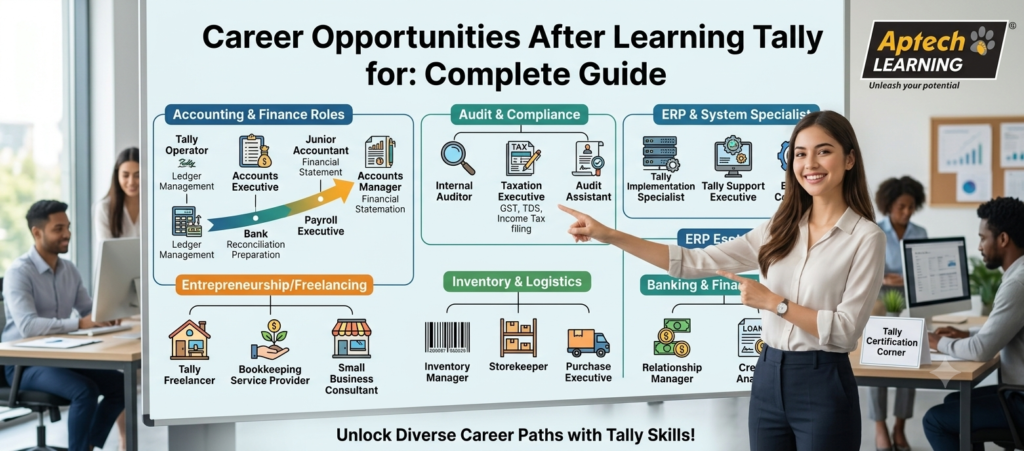
Tally skills support a range of entry-level and mid-level career paths, especially in accounting and finance-support roles. Common roles include:
Accounts Executive — handles daily accounting entries and financial record-keeping.
Tally Operator — focuses specifically on data entry and transaction recording within Tally.
Billing Executive — manages invoicing, billing, and payment tracking for a business.
GST Executive — focuses on GST compliance, filing, and related documentation.
Junior Accountant — supports broader accounting functions, often starting with Tally-based tasks.
Inventory Executive — manages stock records and purchase tracking using Tally.
As professionals gain experience, Tally skills often support a natural progression into senior accounting roles, broader finance positions, or specialised GST and compliance work.
Salary Information
Salary for roles that rely on Tally skills depends on factors such as your city, the size and industry of the business, your specific role, your skill level, and your years of experience. Entry-level roles naturally pay less than senior accounting positions, and metro cities generally offer higher packages than smaller towns. Rather than fixed numbers, it is more useful to know that Tally skills tend to strengthen your overall profile and can support steady salary growth, especially when combined with broader accounting knowledge and GST expertise.
Skills Required
Technical Skills
Basic understanding of accounting principles, such as debit, credit, and ledgers
Comfort with data entry and recording daily business transactions
Understanding of GST compliance and how it is managed within Tally
Ability to generate and interpret financial reports like profit and loss statements
Basic inventory management knowledge for product-based businesses
Non-Technical Skills
Attention to detail, since small entry errors can lead to inaccurate financial records
Organisational skills, especially when managing multiple accounts or clients
Basic numerical comfort for handling calculations and reconciliations
Reliability and consistency, since accounting work depends on accurate, regular record-keeping
Communication skills, especially when coordinating with vendors, clients, or internal teams
Tools and Features Used in Tally
Feature | Primary Use
Ledger Creation | Organising accounts for accurate transaction recording
Voucher Entry | Recording sales, purchases, payments, and receipts
GST Reports | Generating tax reports for compliance and filing
Inventory Management | Tracking stock levels and purchase orders
Payroll Management | Processing employee salaries and related records
Financial Statements | Generating profit and loss statements and balance sheets
Eligibility
There is no single fixed background required to learn Tally, though it is especially useful for commerce students and those interested in accounting or finance roles. Generally, learners should have completed at least higher secondary education (12th grade), preferably with a commerce background, though non-commerce students can also learn it with some additional focus on basic accounting concepts. Prior accounting knowledge is helpful but not always compulsory, since many courses cover fundamentals alongside Tally training.
Course Duration
Tally courses can range from a few weeks for focused, certification-style programs to slightly longer durations for in-depth training covering GST compliance, payroll, and inventory management alongside core accounting entries. The right duration depends on your current understanding of accounting basics and how deep you want to go into GST and reporting features. It is best to confirm the exact course structure and duration directly with the training provider.

Who Should Learn Tally
Commerce students who want a practical, job-ready accounting skill after school or college
Working professionals looking to move into accounting or finance-support roles
Job seekers who want a widely recognised skill that applies across small and mid-sized businesses
Business owners who want to manage their own company’s accounts without full dependence on external accountants
Career changers looking for a relatively quick, practical entry point into the finance field
Frequently Asked Questions
What career opportunities open up after learning Tally?
Learning Tally opens up roles like accounts executive, tally operator, billing executive, GST executive, and junior accountant, since many businesses in India rely on Tally for daily accounting.
Is Tally enough to get an accounting job?
Tally alone can support entry-level accounting and billing roles, but combining it with broader accounting knowledge and GST expertise often strengthens career opportunities further.
Which industries hire people with Tally skills?
A wide range of industries hire for Tally skills, including retail, manufacturing, services, education, and accounting firms, since most small and mid-sized businesses use Tally for their accounts.
Do I need a commerce background to learn Tally?
A commerce background is helpful but not compulsory. Non-commerce students can also learn Tally, especially when the course includes basic accounting fundamentals alongside software training.
What is the difference between Tally and manual accounting?
Manual accounting involves recording transactions by hand, which is slower and more error-prone, while Tally automates calculations, reporting, and GST compliance far more efficiently.
Can Tally skills help me get promoted in an accounting role?
Yes, strong Tally skills, especially in GST compliance and reporting, often help professionals handle more responsibility, which can support career growth within accounting teams.
Conclusion
Tally remains one of the most practical, job-ready skills for anyone interested in accounting or finance-support roles in India. Its widespread use across small and mid-sized businesses means that learning it can open real, immediate career opportunities, not just theoretical ones.
The key is to go beyond basic data entry, build genuine understanding of GST compliance and financial reporting, and practise with realistic, business-style transactions. Strong Tally skills can meaningfully support a stable, practical career start in accounting and finance.
Soft Call to Action
If you are based in Lucknow and want structured, hands-on training instead of learning everything alone, Aptech Learning Lucknow offers Tally courses designed for students and working professionals alike. You can visit the institute, speak with their counsellors, or attend a demo class to understand how the course is structured and whether it fits your career goals.