

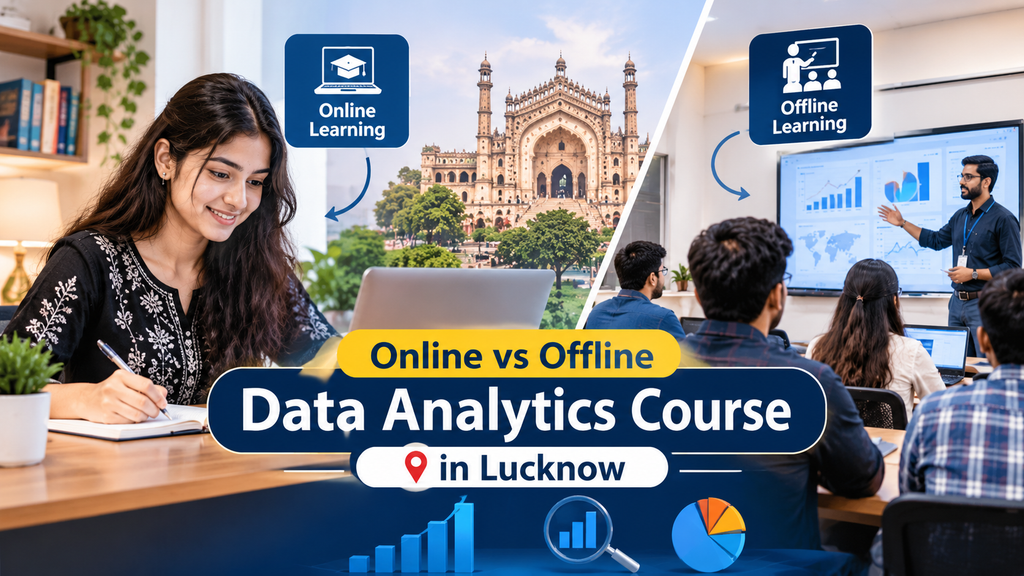
Online vs Offline Data Analytics Course in Lucknow
Why This Choice Matters More Than It Seems
Data analytics is a hands-on skill. You do not learn it by watching someone else use Excel, SQL, or Power BI. You learn it by cleaning messy data, getting stuck, fixing mistakes, and trying again. So the format you choose should make that cycle of practice and correction as easy as possible.
Quick Answer: Offline batches suit beginners who want discipline, mentor access and placement help; online batches suit working professionals and students outside Lucknow. Aptech Learning Center offers both — classroom batches at Mahanagar Extension, Kapoorthala, plus live online classes across Uttar Pradesh.
Think of learning to ride a bicycle. You can read about balance and watch videos, but you only learn when you actually ride, and it helps enormously if someone runs beside you in the first few days. Offline classes can be that person running beside you. Online classes can be the same, if they are designed well, or they can be a video you watch alone and then abandon.
Many people choose a format based on convenience alone and then discover, three weeks in, that it does not match how they learn. A few minutes of honest thinking now saves months of lost momentum later.
What Offline Learning Looks Like
In an offline course, you travel to a training centre, sit in a classroom or lab, and learn with a trainer and a batch of classmates. The software is usually already installed on the lab computers, so you can start practising from day one.
The main strengths of this format are:
The trainer can see your screen and spot a wrong formula, a broken query, or a messy chart immediately.
A fixed timetable builds a routine, which helps people who struggle with self-discipline.
Classmates create a natural study environment, and comparing approaches teaches you things a video cannot.
Distractions at home are reduced because you are physically in a learning space.
Face-to-face interaction makes it easier to ask small questions you might hesitate to type or schedule a call for.
The trade-offs are travel time, fixed batch timings, and the need to live or work reasonably close to the centre.
What Online Learning Looks Like
In an online course, you join sessions from home or work, using your own laptop. The format ranges from live, interactive classes to completely pre-recorded videos you watch at your own pace, and the difference between these two matters a lot.
The main strengths of this format are:
You save travel time and can learn from anywhere, which suits learners outside Lucknow too.
Timings can be more flexible, especially with recorded sessions or evening and weekend batches.
You can pause, rewind, and revisit difficult topics as often as you like.
You practise on your own system, which means you learn to set up and troubleshoot your tools, a useful real-world skill.
The trade-offs are weaker accountability, more distractions, and a greater chance of drifting away from the course if nobody notices you have stopped attending.
Online vs Offline: Side-by-Side Comparison
Factor | Offline Classes | Online Classes
Trainer Attention | Direct, in person, on your screen | Depends on live interaction and batch size
Doubt Clearing | Immediate | Immediate in live classes, delayed in recorded ones
Discipline Needed | Lower, since routine is fixed | Higher, since you manage your own time
Flexibility | Fixed timings and location | Flexible, especially for working learners
Travel | Required | None
Practice Environment | Lab systems ready to use | Your own laptop and software setup
Peer Learning | Natural, in the classroom | Possible through groups, but needs effort
Best Suited For | Beginners and routine seekers | Working professionals and distant learners
How to Decide Between the Two (Step-by-Step)
- Be Honest About Your Discipline
If you usually finish what you start without reminders, online will work. If you need a routine to stay on track, offline is safer. - Check Your Daily Schedule
If your work or college hours leave very little free time, look at live online or evening batches before you rule out classroom learning. - Consider Your Starting Level
Complete beginners often benefit from live, in-person guidance in the first few weeks. Learners who already know Excel well may adapt faster to online learning. - Count the Travel Cost in Time and Money
A long daily commute can quietly drain energy and consistency. Factor that into your decision. - Check Your Equipment and Internet
Online learning needs a reliable laptop and stable internet. If either is uncertain, offline lab access becomes more attractive. - Look at Practice Hours
Ask each institute how many hours go into hands-on work. Format matters less than practice time. - Try a Demo Class
Many institutes offer demo sessions. Experiencing the teaching style tells you more than any brochure. - Consider a Hybrid Option
Some institutes combine classroom sessions with online support or recorded revision. If available, this can balance routine and flexibility. - Choose, Commit, and Review After Two Weeks
Give your chosen format a fair trial. If you are consistently falling behind, adjust early instead of waiting until the course is half over.
Types of Learners and Which Format Fits
Fresh Graduates and Final-Year Students
Usually benefit from offline or hybrid learning, since structure and peer energy help them build habits before their first job.
Working Professionals
Often prefer live online or weekend batches, because their time is limited and travel adds strain.
Career Changers From Non-Technical Fields
Often do better with offline guidance at the start, because both the tools and the thinking style are new.
Learners Outside Lucknow, Including Nearby Towns
May find live online classes more practical than commuting, particularly if the institute offers interactive sessions.
Self-Motivated Learners With Prior Excel Experience
Can often succeed online, since they already understand data basics and only need structured guidance on new tools.
Practical Examples
Student Who Struggled With Self-Study: A commerce graduate tried free videos for a month and kept postponing practice. After joining a classroom batch with fixed timings, attendance created consistency and the skills finally started to build.
Working Professional With a Busy Schedule: An executive in a Lucknow office joined a live evening online batch, practised on weekends, and avoided a long daily commute, finishing the course without leaving work.
Learner From a Nearby Town: A student living outside the city chose live online classes, then visited the centre occasionally for doubt-clearing sessions, combining the flexibility of online with some in-person support.
Learner Who Switched Formats: Someone who started online felt isolated and kept missing sessions, so moved to an offline batch and noticed better focus within the first week.
Common Mistakes People Make
Choosing the cheapest option without checking what it includes. A low fee that skips live support or practice may cost more in lost time.
Confusing recorded videos with a course. Recorded lessons alone rarely give the feedback you need for a practical skill.
Assuming offline is automatically better. A crowded classroom with little individual attention can be worse than a well-run live online batch.
Assuming online is automatically easier. Without discipline and a plan, it is easy to fall behind quietly.
Ignoring internet and device reliability. Frequent connection problems can ruin an online course.
Never practising outside class. In either format, the real learning happens on your own time with real datasets.
Not asking for a demo or trial. Choosing blindly based on a brochure or advertisement leads to poor fit.
What Both Formats Must Include
Whichever format you choose, a good data analytics course should offer the following:
A syllabus covering Excel, SQL, a visualisation tool such as Power BI or Tableau, and basic statistics, ideally with an introduction to Python.
Plenty of hands-on practice with realistic datasets, not just demonstrations.
A way to get feedback on your work, such as reviewed assignments or live code and dashboard reviews.
A clear chance to ask questions and have them answered properly.
At least one project that combines the tools you have learned.
Honest communication about outcomes. Avoid any institute that guarantees a job or a specific salary.
Cost Considerations
Fees vary by institute, syllabus depth, batch size, and trainer experience, so it is more useful to compare value than headline numbers. Online courses can reduce indirect costs such as travel, while offline courses often include lab access and in-person support that would otherwise cost you extra at home. Recorded-only courses are usually cheaper but offer the least feedback. When comparing, ask what the fee includes: live sessions, project reviews, certificates, study material, lab hours, and any additional charges. A slightly higher fee for a course that actually keeps you practising and gives feedback is usually better value than a very low fee for content you never finish.
Does the Format Affect Career Outcomes
Employers generally care about what you can do, not whether you learned in a classroom or on a screen. In interviews, you may be asked to clean a dataset, write a query, or explain a dashboard you built. A strong portfolio and clear explanations count far more than the format of your training.
That said, format can indirectly influence outcomes. If one format helps you practise consistently, finish the course, and build projects, it will produce better results for you. The best format is the one that gets you to the end with real, demonstrable work.
Skills You Will Build in Either Format
Cleaning and organising raw data in Excel
Writing SQL queries to extract and combine data
Creating charts and dashboards in Power BI or Tableau
Using basic statistics to interpret results correctly
Presenting findings in clear, simple language
Working through a project from question to conclusion
Tools You Will Use
Tool | Purpose
Microsoft Excel | Data cleaning, formulas, and pivot tables
SQL with MySQL | Extracting and joining data from databases
Power BI or Tableau | Building dashboards and reports
Python (in advanced courses) | Deeper analysis and automation
Google Sheets | Collaborating and sharing simple analysis
Video Meeting Tools | Joining live online classes
Eligibility
Data analytics courses usually accept students who have completed 12th grade, and graduates and working professionals are welcome. You do not need a computer science background. Basic computer comfort, logical thinking, and willingness to practise are enough for a beginner course. For online learning, make sure you have a working laptop and a dependable internet connection.
Course Duration
Data analytics courses typically range from a couple of months for a focused programme to several months for a more complete one with projects. Online and offline versions often cover similar syllabi, but the weekly schedule differs. Offline batches usually follow a fixed timetable, while online batches may offer more flexible timing. Confirm the exact duration and weekly hours with the institute.
Who Should Choose What
Choose offline if you are a beginner, need routine, prefer live correction, and can attend regularly.
Choose live online if your schedule is tight, you live far from the centre, and you can stay disciplined.
Choose hybrid if you want a mix of structure and flexibility, and the institute offers it.
Avoid recorded-only courses if you are new to the subject and need feedback.
If you are still unsure, attend a demo class and ask how doubts and assignments are handled in each format.

Frequently Asked Questions
Which is better for data analytics, online or offline classes?
Neither is better for everyone. Offline suits beginners who want routine and live guidance, while live online suits busy learners who stay disciplined.
Can I become a data analyst through an online course?
Yes. Many people do, provided the course has live interaction, regular practice, project work, and feedback, and you practise consistently on your own.
Is online learning cheaper than offline?
Often, but not always. Online can reduce travel costs, while offline may include lab access and in-person support. Compare what each fee actually includes.
Can working professionals do an offline course?
Yes, if there are evening or weekend batches. If travel is difficult, a live online batch may be more practical.
Are recorded courses enough to learn data analytics?
They can help with revision, but beginners usually need live feedback on their work. Recorded-only learning works best for self-motivated people with prior experience.
What should I ask before choosing a data analytics course?
Ask about the syllabus, tools covered, practice hours, batch size, project work, feedback process, timings, and what the fee includes.
Conclusion
Online and offline data analytics courses can both lead to a good career start. The real difference is not the screen versus the classroom, but how much practice, feedback, and consistency each format gives you. Offline learning gives structure and live correction. Online learning gives flexibility and saves travel, as long as the classes are live and you stay disciplined.
Be honest about how you learn, check your schedule, and attend a demo before deciding. Then commit fully, practise on real datasets, and build a few projects. Whichever format you choose, your portfolio and your ability to explain your work will matter more than where you studied.
Soft Call to Action
If you are in or around Lucknow and want to compare formats before deciding, you can visit Aptech Learning Lucknow at Mahanagar, speak with the counsellors, and attend a demo class to see how the course is taught
Want structured, mentor-led training instead of self-study? Explore our Data Analytics course in Lucknow, or read our guides on who can join a data analytics course and Excel vs SQL vs Python for analytics. Indicative fee: ₹25,000 to ₹45,000, with a flat 10% festive discount on admission and placement assistance included. Call +91 63861 19566 for batch dates and free counselling.
🎓 Explore Job-Ready Courses at Aptech Lucknow
DATA ANALYTICS₹25,000–₹45,000 · Placement aidView Course →POWER BI & TABLEAU₹10,000–₹20,000 · Real dashboardsView Course →ADVANCED EXCEL₹8,000–₹20,000 · MIS + VBAView Course →SQL & MYSQL₹8,000–₹20,000 · Hands-on DBView Course →PYTHON₹10,000–₹25,000 · ProjectsView Course →💬 Free CounsellingBatch dates · Fees · Career planWhatsApp Now →

Aptech Learning Center is a computer training institute in Mahanagar Extension, Kapoorthala, Lucknow offering job-oriented courses in AI, Data Analytics, Tally & Accounting, Digital Marketing, Cyber Security and NIELIT O Level — with certified trainers, live projects and placement assistance. All course guides are reviewed by our counselling team.