
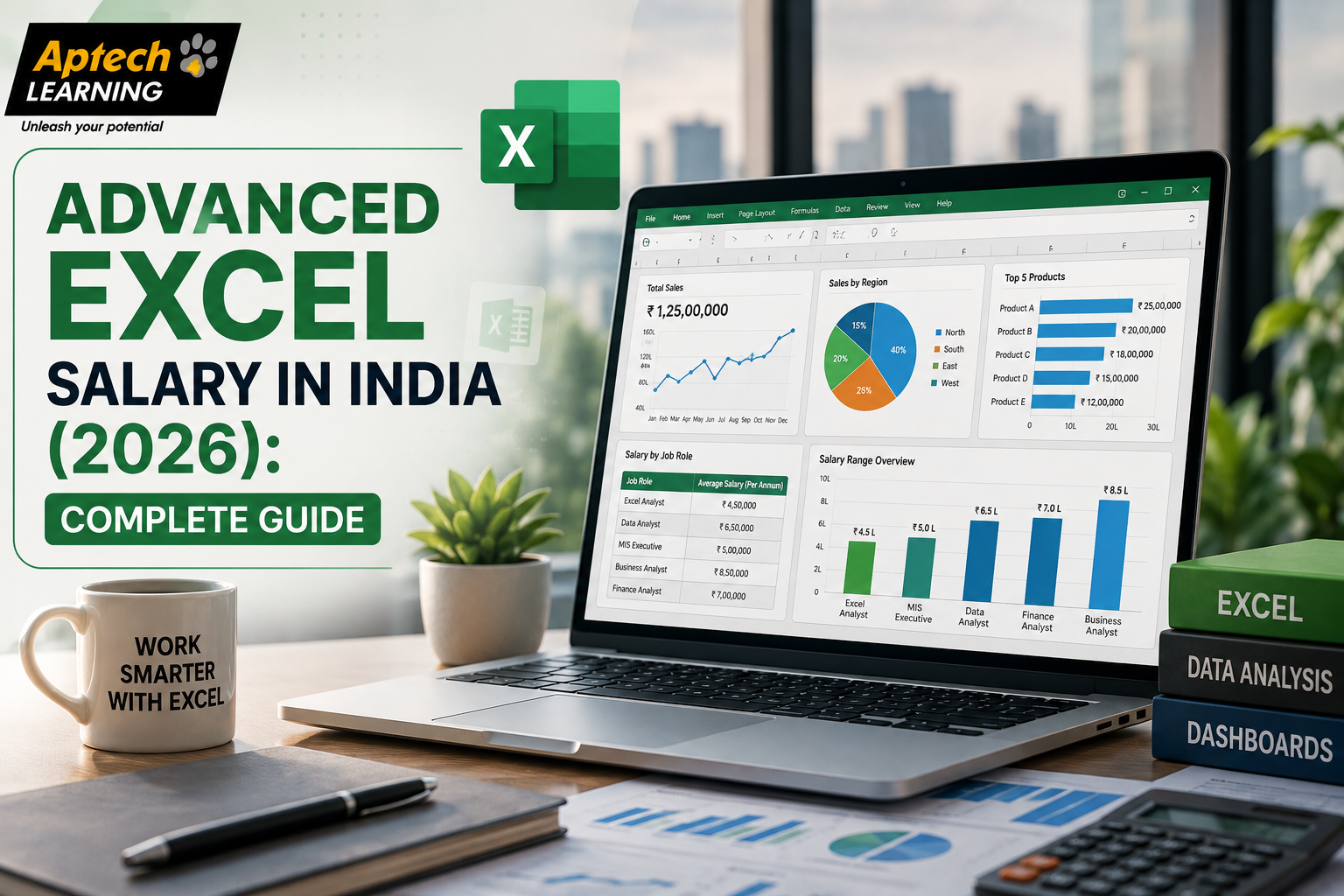
Advanced Excel Salary in India (2026): Complete Guide
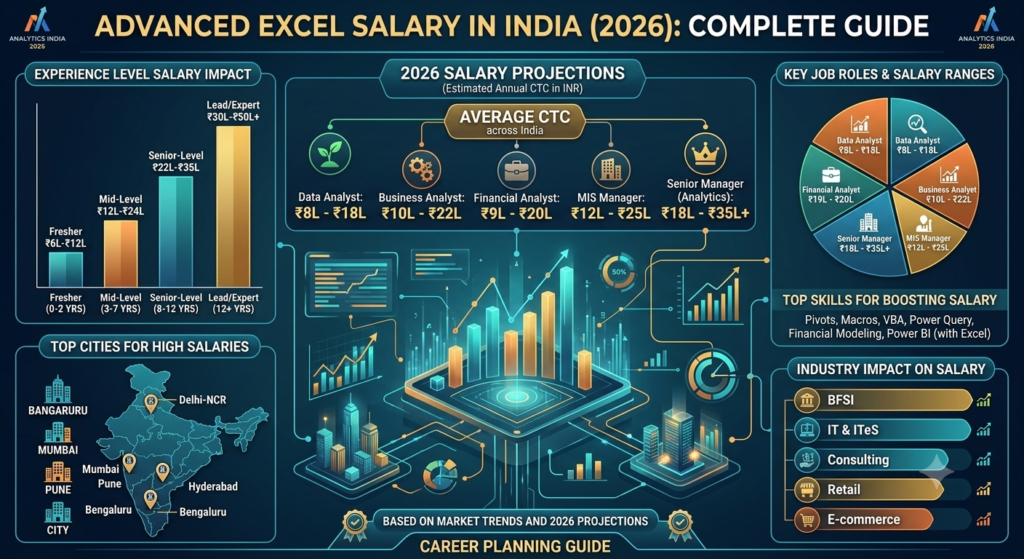
Advanced Excel Salary Overview in India
Advanced Excel is not usually a standalone job title, but it is one of the most widely valued skills across finance, operations, HR, sales, and data-focused roles in India. Rather than one fixed salary figure, it is more useful to think of advanced Excel as a skill that consistently strengthens pay potential across many different job roles.
A fresher just starting out with advanced Excel skills will naturally earn less than someone with several years of experience building complex financial models or business dashboards. Similarly, a generalist reporting role usually pays differently compared to a specialised role like a financial analyst who relies heavily on advanced Excel. Instead of chasing one exact number, it helps to understand the factors that influence pay, since these are things you can actively work on.
Factors That Affect Advanced Excel Salary
Several factors directly influence how much professionals with advanced Excel skills earn in India:
Experience level: More years of hands-on experience with real business data generally means higher pay, especially experience building actual reports and models used for decisions.
Job role and department: Roles in finance or business analysis that rely heavily on Excel often pay more than general administrative or coordination roles.
City and company: Metro cities like Bangalore, Mumbai, and Delhi NCR, along with larger companies and MNCs, generally offer higher packages than smaller cities or companies.
Additional skills: Combining advanced Excel with tools like Power BI, basic SQL, or data analysis techniques often supports stronger pay compared to Excel skills alone.
Industry: Sectors like banking, finance, and consulting often rely heavily on Excel-based reporting and modelling, which can reflect in the packages they offer.
Skill depth: Strong command of pivot tables, complex formulas, and dashboard building tends to be valued more than basic spreadsheet familiarity alone.
Salary by Experience Level
Experience Level | Typical Role | General Salary Trend
Entry-Level (0–2 years) | MIS Executive, Junior Data Analyst | Lower end of the pay scale, growing with hands-on reporting exposure
Mid-Level (2–5 years) | Business Analyst, Financial Analyst | Noticeably higher than entry-level, based on analytical and modelling skills
Senior-Level (5–10 years) | Senior Financial Analyst, Senior Business Analyst | Significantly higher, reflecting deeper expertise and responsibility
Leadership (10+ years) | Finance Manager, Analytics Manager | Among the higher pay levels, tied to strategic and managerial responsibility
Note: These are general trends, not fixed figures. Actual pay depends on the specific company, city, and individual skill set.
Salary by Job Role
Different roles that rely on advanced Excel come with different responsibilities, and pay usually reflects that.
MIS Executive: Builds and maintains regular reports and dashboards for management, often an entry point into Excel-heavy roles.
Data Analyst: Uses Excel alongside other tools to clean, analyse, and report on business data.
Financial Analyst: Uses advanced Excel for budgeting, forecasting, and financial modelling, often requiring strong formula and analytical skills.
Business Analyst: Uses Excel to analyse business performance and support decision-making across departments.
Operations Executive: Uses Excel to track processes, inventory, and logistics data, often requiring strong reporting skills.
HR Analyst: Uses Excel to manage and analyse workforce-related data, such as attendance and payroll summaries.
Salary by City
City generally plays a meaningful role in salaries for advanced Excel-related roles across India, mainly because of cost of living and concentration of finance, IT, and corporate companies.
Metro cities like Bangalore, Mumbai, Delhi NCR, and Pune tend to offer higher packages, largely due to a higher concentration of corporate offices, finance companies, and MNCs actively hiring for reporting and analysis roles.
Tier-2 cities like Lucknow, Jaipur, and Indore are steadily growing in terms of corporate and finance-related job opportunities, though packages may currently trend lower compared to metro cities.
Remote and hybrid roles have also become more common in reporting and analysis-based positions, which is gradually reducing the gap between city-based and location-independent pay in some companies.
How Additional Skills Impact Salary
Advanced Excel alone can support certain roles, but combining it with additional skills often strengthens salary potential further. Professionals who pair strong Excel skills with tools like Power BI, basic SQL, or foundational data analysis techniques are often better positioned for higher-paying reporting and analyst roles.
Employers generally value candidates who can not only build spreadsheets but also interpret data and present clear, actionable insights. This is why many advanced Excel courses now include exposure to complementary tools like Power BI, helping learners build a more well-rounded, higher-value skill set.
Highest Paying Roles That Use Advanced Excel
While exact figures vary by company and location, certain roles that rely heavily on advanced Excel are generally recognised as being among the higher-paying paths as professionals gain experience:
Senior Financial Analyst — builds complex financial models and forecasts using advanced Excel functions.
Senior Business Analyst — uses Excel alongside broader analytical skills to guide business strategy.
Analytics Manager — oversees reporting and analysis functions, often requiring both Excel expertise and team leadership skills.
Finance Manager — combines advanced Excel skills with broader financial planning and strategic responsibilities.
Operations Manager — uses Excel-based reporting to oversee and optimise business processes at a senior level.
How to Increase Your Advanced Excel Salary
Build strong command of pivot tables, complex formulas, and dashboard creation, not just basic spreadsheet skills.
Learn complementary tools like Power BI or basic SQL to strengthen your overall data and reporting skill set.
Practise with realistic business datasets rather than only simple, generic examples.
Focus on a specific industry, such as finance or operations, where advanced Excel skills are especially valued.
Develop strong communication skills to clearly explain your reports and findings to decision-makers.
Consider relocating to or working remotely for companies based in metro cities if location flexibility is possible for you.
Skills That Help You Earn More
Strong command of formulas like VLOOKUP, INDEX-MATCH, and SUMIFS
Confidence building and using pivot tables for large datasets
Experience creating clear, visually effective dashboards and reports
Basic understanding of data analysis concepts and business reporting
Familiarity with complementary tools like Power BI for stronger analytical positioning
Clear communication skills for presenting data-driven insights to management
Career Growth Path
A typical advanced Excel-related career often follows a path like this: starting as an MIS Executive or Junior Data Analyst, moving into a more specialised role like Business Analyst or Financial Analyst, then progressing into Senior Analyst positions, and eventually into leadership roles like Analytics Manager or Finance Manager. Growth at each stage usually depends on a combination of experience, additional skill-building, and consistent, reliable reporting work.
Who Should Consider Building Advanced Excel Skills
College students looking for a practical, widely applicable skill that supports many career paths
Working professionals wanting to strengthen their reporting and analytical capabilities
Finance, HR, sales, or operations professionals looking to increase their earning potential
Job seekers interested in a skill that offers strong pay growth when combined with additional tools
Frequently Asked Questions
What is the average advanced Excel salary in India?
Advanced Excel-related salaries in India vary significantly by role, experience, city, and industry. Entry-level roles pay less than specialised or senior positions, with pay generally rising steadily over time.
Which role that uses advanced Excel pays the highest in India?
Senior and leadership roles like Senior Financial Analyst, Analytics Manager, and Finance Manager are generally among the highest paying, reflecting years of specialised experience and responsibility.
Does experience really affect advanced Excel-related salary?
Yes, experience significantly impacts salary. Professionals with hands-on experience building real business reports and models typically earn more than those with only basic spreadsheet knowledge.
Do additional tools like Power BI increase advanced Excel salary?
Yes, combining advanced Excel with tools like Power BI or basic SQL often strengthens a candidate’s profile and can support higher pay in reporting and analyst roles.
Which city offers the best advanced Excel-related salary in India?
Metro cities like Bangalore, Mumbai, and Delhi NCR generally offer higher packages due to a larger concentration of corporate, finance, and IT companies.
Is advanced Excel a well-paying skill for freshers?
Entry-level roles like MIS executive may start on the lower end compared to senior positions, but pay tends to grow steadily with hands-on experience and skill development.
Conclusion
Advanced Excel-related salaries in India depend on a mix of experience, role, city, and additional skill development, rather than a single fixed number. While entry-level roles naturally start lower, strong Excel skills consistently support long-term pay growth across finance, operations, and analytical career paths.
If you are serious about increasing your earning potential through advanced Excel, focus less on chasing an exact starting figure and more on building real, practical skills, combining Excel with complementary tools, and gaining experience with realistic, business-style data.
Soft Call to Action
If you are based in Lucknow and want to build practical, job-ready advanced Excel skills through structured, expert-guided training, Aptech Learning Lucknow offers advanced Excel courses designed for students and working professionals. You can visit the institute, speak with their counsellors, or attend a demo class to understand how the course can support your career goals.