
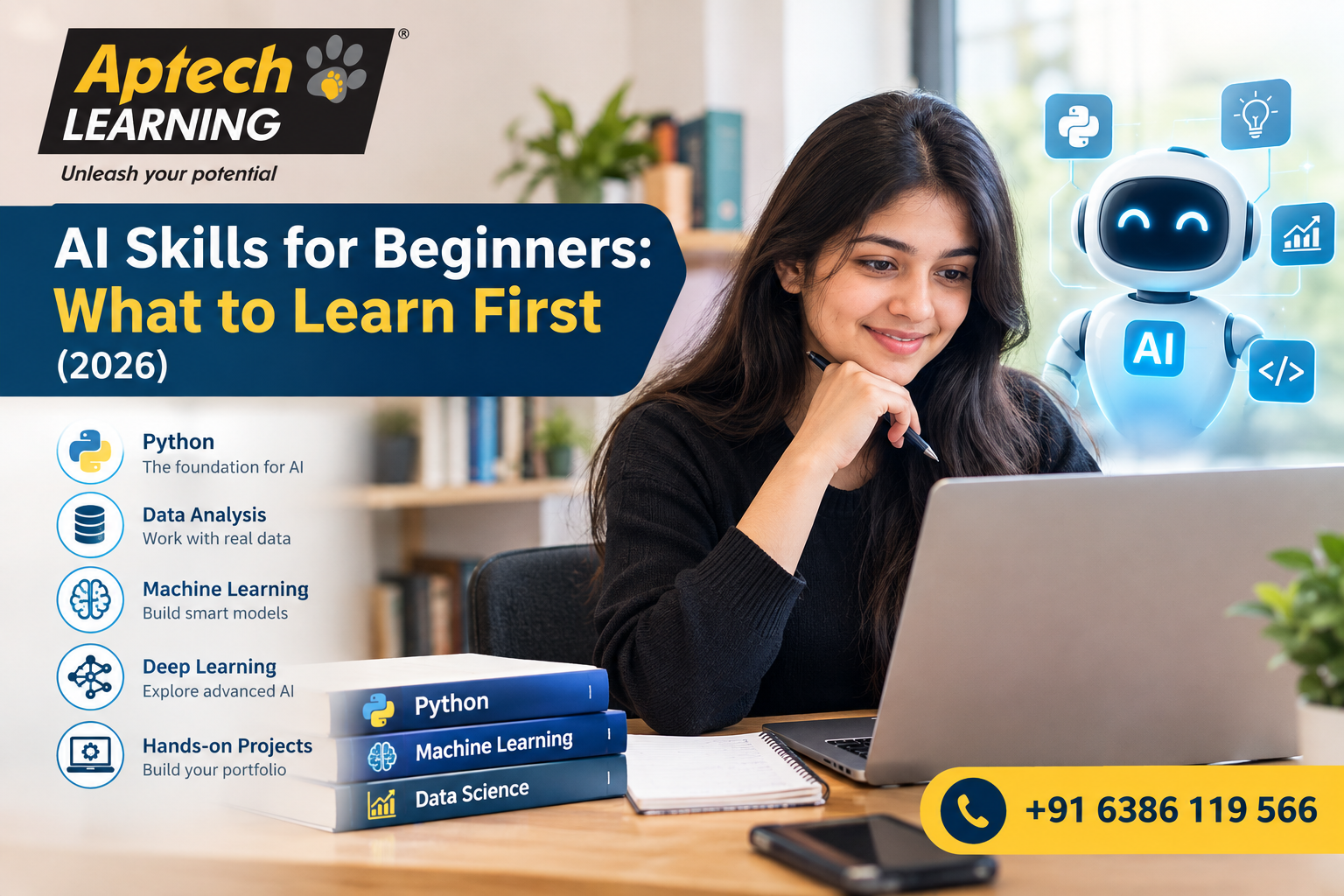
AI Skills for Beginners: What to Learn First

Almost every beginner who asks about AI starts with the same question: where do I even begin? There are hundreds of tools, courses and YouTube videos, and most of them assume you already know something. If that sounds like you, relax. You don’t need a computer science degree or a maths PhD to get started.
This guide covers the AI skills for beginners in the order that actually makes sense, so you don’t waste months learning the wrong things first.
What Are AI Skills, Really?
AI skills are the abilities that help you understand, use and eventually build systems that learn from data. Think of chatbots, the recommendations on a shopping app, or the spam filter in your email. All of it runs on a few core building blocks. As a beginner, your job isn’t to master everything. It’s to learn the right things in the right sequence.
1. Basic Computer Skills and Logical Thinking
Before any tool, get comfortable with how computers handle information: files, folders, spreadsheets, browsers and simple if-this-then-that logic. It sounds obvious, but many learners skip it and feel lost later. If you can break a problem into small steps, you already have the mindset AI work needs.
2. Python Programming
Python is the first real technical skill on the list. It’s readable, beginner-friendly and used in most AI and machine learning work. Start with variables, loops, functions and lists. Then move to libraries like NumPy and Pandas for handling data. You don’t need to become an expert. A few weeks of steady practice gets you surprisingly far.
3. Maths and Statistics (the Light Version)
Nobody expects you to solve university-level proofs. What helps is a working feel for averages, probability, percentages and basic linear algebra ideas, like rows and columns of numbers. Statistics tells you whether a result means something or is just noise. Learn these alongside your Python practice, not before it, so the concepts actually stick.
4. Working With Data
AI runs on data, and real data is messy. Learn to clean it, filter it and read it. Excel and SQL are still very useful here, and they’re a friendly place to start. Being able to look at a table and ask “what is this really telling me?” is one of the most underrated AI skills.
5. Machine Learning Basics
Once Python and data feel comfortable, meet machine learning. Understand the difference between supervised learning, where a model learns from labelled examples, and unsupervised learning, where it finds patterns on its own. Try small projects like predicting house prices or sorting emails into spam and not spam. Small projects teach more than long theory.
6. Prompt Engineering and AI Tools
This is the fastest skill to pick up, and it’s useful even if you never write code. Prompt engineering means giving AI tools clear instructions, context and examples so you get better answers. Practise with tools like ChatGPT, Gemini and Claude, and always double-check the output. AI can sound confident and still be wrong, so your own judgement matters.
7. Ethics and Responsible AI
Bias in data, privacy and copyright are real issues, and employers increasingly look for people who understand them. Get into the habit of asking: where did this data come from, and who could be affected if the model gets it wrong?
A Simple Learning Roadmap for Beginners
Here’s an order that works for most people:
- Month 1: Computer basics, logical thinking, Python fundamentals
- Month 2: Data handling with Excel, SQL and Pandas, plus basic statistics
- Month 3: Machine learning basics with small hands-on projects
- Month 4: Prompt engineering, AI tools and one portfolio project
Timelines vary. If you’re studying alongside college or a job, it will take longer, and that’s completely fine. Consistency matters more than speed.
Learn AI in Lucknow With Guided Training
Self-study works for some people, but many beginners get stuck without feedback. Structured training with a mentor helps you avoid common mistakes and build projects you can actually show in interviews. At Aptech Learning Lucknow, students in Hazratganj can learn Python, data science and AI-related skills through instructor-led sessions and hands-on practice. If you’re unsure where to begin, visit the centre or book a counselling session, and we’ll help you match a course to your background.
Frequently Asked Questions
Q1. What are the basic AI skills required for beginners?
Start with computer basics and logical thinking, then Python, light maths and statistics, data handling, machine learning basics and prompt engineering. Ethics is a useful add-on.
Q2. Do I need coding to learn AI?
For using AI tools, no. For building AI models, yes, mainly Python. Most beginners do well by learning the tools first and picking up coding gradually.
Q3. Which programming language is best for AI beginners?
Python. It has simple syntax and a huge library ecosystem, and it’s the most widely used language in AI and machine learning.
Q4. Is maths compulsory to learn AI?
You need the basics: percentages, averages, probability and a little algebra. Deeper maths becomes important only if you move into research or advanced model building.
Q5. How long does it take to learn AI from scratch?
With regular practice, most beginners build a solid foundation in about four to six months. Becoming job-ready usually takes longer and depends on projects and practice.
Q6. Can I learn AI after 12th or in a non-IT stream?
Yes. Many learners begin after 12th or after graduation in commerce, arts or science. Starting with Python and data basics is enough to get going.
Conclusion
Learning AI can feel overwhelming at first, but it gets much easier once you stop trying to learn everything at once. Start with the basics: get comfortable with Python, learn to read and clean real data, and build one small project that you can explain in your own words. That single project will teach you more than a dozen tutorials.
The skills covered here work whether you’re a student, a fresher or someone changing careers. AI is moving fast, but the fundamentals stay the same, and beginners who practise consistently usually end up ahead of those who keep waiting for the perfect moment.
If you’d rather learn with proper guidance, visit Aptech Learning Lucknow in Hazratganj and talk to our counsellors. We’ll help you pick a starting point that fits your background and your goals. Your first step doesn’t have to be big. It just has to be today.