
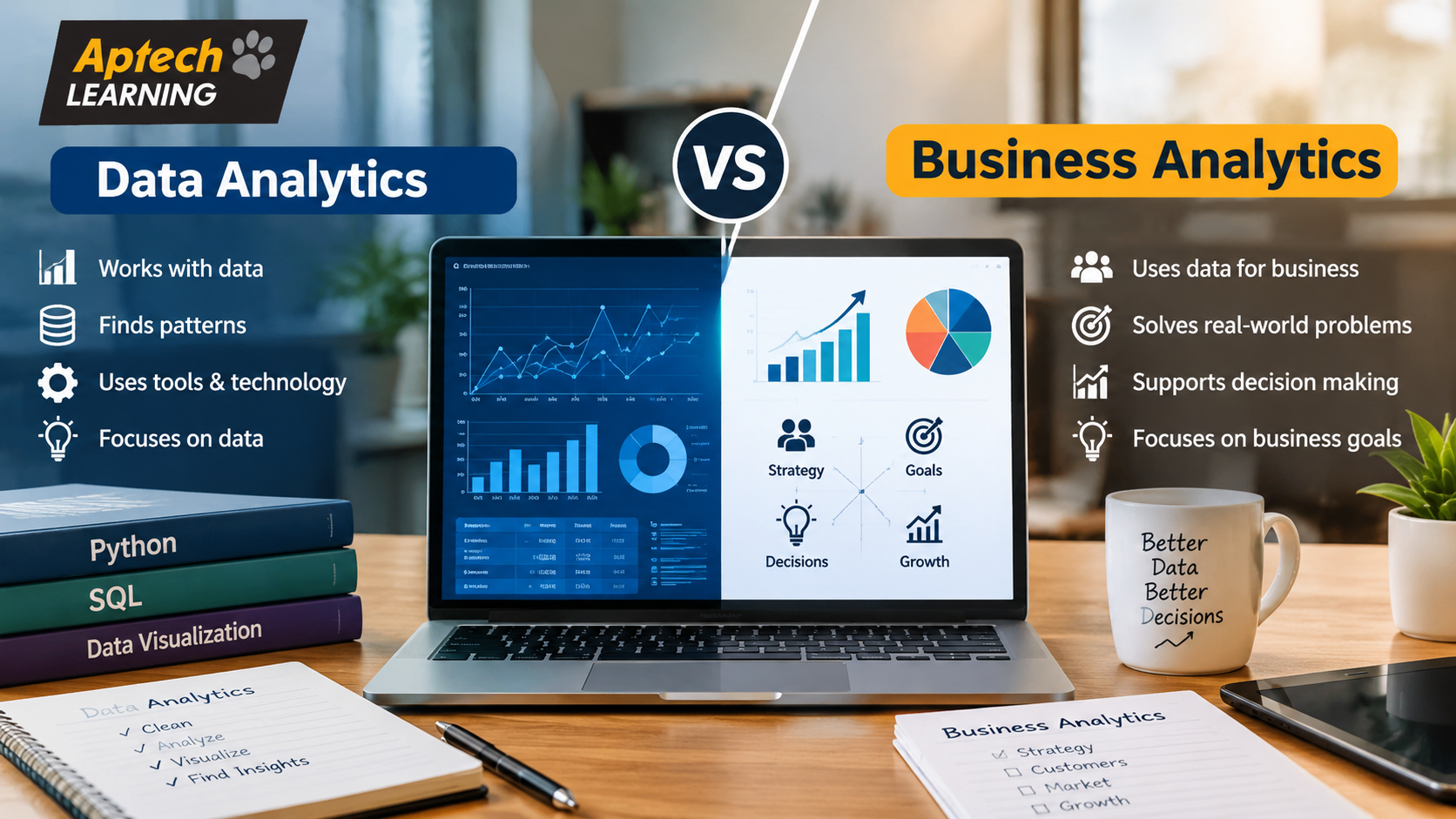
Data Analytics vs Business Analytics: The Difference
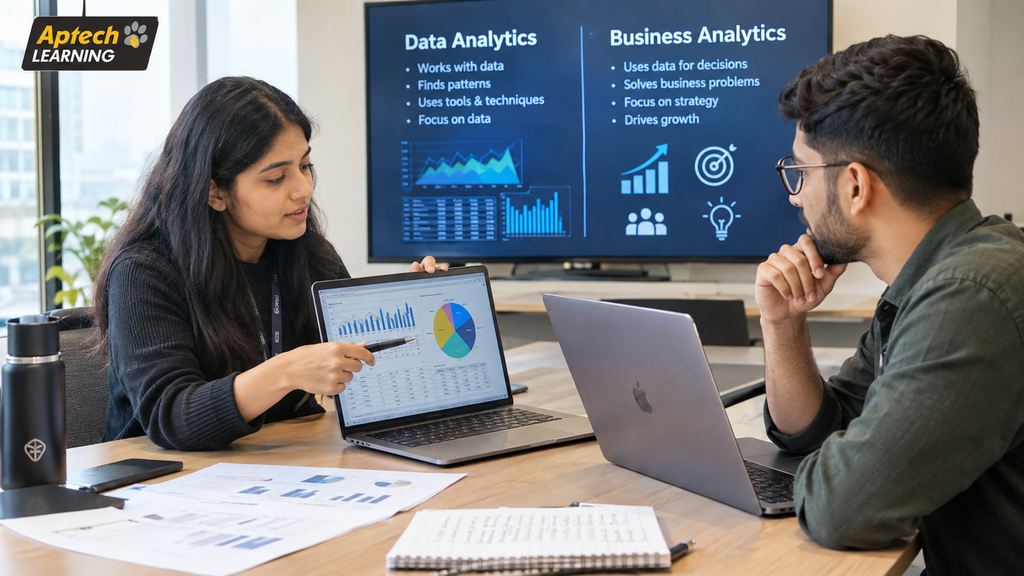
What is Data Analytics
Data analytics is the process of collecting, cleaning, and studying data to identify patterns, trends, and answers to specific questions. It is a fairly technical field, relying heavily on tools like Excel, SQL, and data visualisation software to work directly with raw data and extract meaningful insights from it.
Think of a data analyst as someone working closely with the raw material itself, cleaning messy spreadsheets, writing queries to pull specific information from databases, and building charts that clearly show what the numbers actually reveal. The focus here is primarily on the technical process of working with data accurately and efficiently, answering questions like “what happened” and “why did it happen” through direct data work.
What is Business Analytics
Business analytics is a broader field that combines data analysis with business strategy, decision-making frameworks, and organisational understanding. While it still involves working with data, its primary focus is on using those insights to guide business decisions, identify opportunities, and solve strategic problems, rather than purely on the technical process of data handling itself.
Think of a business analyst as someone standing a bit further back from the raw data, using insights, sometimes produced by a data analyst, to answer bigger-picture questions like “what should the business do next” or “how should we approach this market opportunity.” The focus shifts from the technical mechanics of data work toward applying those insights within a broader business and strategic context.
Why This Distinction Genuinely Matters
Understanding the real difference between these two fields matters for a few practical reasons:
It helps you choose the right course or learning path, since data analytics courses often go deeper into technical tools, while business analytics programs typically include more business strategy and decision-making content.
It clarifies job descriptions, since companies sometimes use these titles inconsistently, and understanding the core distinction helps you evaluate what a specific role actually involves.
It helps you play to your natural strengths, since some people are drawn more to technical, detail-oriented data work, while others are more interested in strategic, big-picture business thinking.
It supports better long-term career planning, since these two paths can lead to somewhat different specialisations and growth trajectories over time.
It prevents miscommunication in professional settings, where using these terms accurately reflects genuine understanding of your own role and skill set.
Key Differences Between Data Analytics and Business Analytics
Aspect | Data Analytics | Business Analytics
Primary Focus | Technical data collection, cleaning, and analysis | Applying insights to business strategy and decisions
Core Tools | Excel, SQL, Power BI, sometimes Python | Business intelligence tools, forecasting models, strategic frameworks
Typical Questions Answered | What happened, why did it happen | What should we do next, how do we solve this business problem
Skill Emphasis | Technical, detail-oriented data handling | Strategic thinking combined with data interpretation
Common Job Titles | Data Analyst, Reporting Analyst | Business Analyst, Business Intelligence Analyst
Educational Background Fit | Works well for detail-oriented, technically curious learners | Works well for strategically minded, business-focused learners
How the Two Fields Work Together (Step-by-Step)
- Data is Collected and Organised
This foundational step is largely handled through data analytics processes, gathering and organising raw data from various sources. - Data is Cleaned and Analysed
Data analytics techniques are used to clean the data and identify initial patterns, trends, or anomalies within it. - Initial Findings Are Documented
The technical findings from data analysis are documented clearly, often through reports or visualisations, ready to inform further business interpretation. - Business Context is Applied
This is where business analytics comes in, interpreting the technical findings within the context of business goals, market conditions, and organisational priorities. - Strategic Recommendations Are Formed
Business analytics work translates data insights into specific, actionable business recommendations or strategic options. - Decisions Are Made and Implemented
Business leaders use these insights and recommendations to make informed decisions, often relying on both the technical accuracy of the data analysis and the strategic framing provided by business analytics. - Outcomes Are Measured and Reviewed
After implementation, data analytics is often used again to measure the actual outcomes, creating a continuous cycle between the two fields.
Data Analyst vs Business Analyst as Job Roles
Looking at these as actual job roles helps clarify the distinction further.
A data analyst typically spends most of their time directly working with data, writing SQL queries, cleaning datasets, building dashboards, and identifying patterns, focusing primarily on the technical accuracy and clarity of the analysis itself.
A business analyst typically spends more time understanding business processes, gathering requirements from stakeholders, and translating data insights or business needs into clear recommendations or specifications for change.
There is often meaningful overlap between these roles in smaller companies, where one person may handle both responsibilities, while larger organisations tend to separate them into more distinct, specialised positions.
Practical Examples
Retail Sales Analysis: A data analyst studies raw sales data to identify which products are underperforming in specific regions, while a business analyst uses these findings to recommend a specific regional marketing or pricing strategy adjustment.
New Product Launch: A data analyst analyses customer survey and market data, while a business analyst combines this with competitive market understanding to recommend whether and how the company should proceed with the new product launch.
Process Improvement Project: A data analyst identifies bottlenecks in a company’s operational data, while a business analyst works with different departments to design and recommend a specific process change based on those findings.
Customer Churn Reduction: A data analyst builds a report identifying patterns in customer churn data, while a business analyst uses this information to propose specific retention strategies aligned with overall business goals.
Common Mistakes People Make When Choosing
Assuming the two fields are essentially identical. While overlapping, they genuinely emphasise different skill sets, technical data work versus strategic business application.
Choosing based only on job title popularity without understanding actual role content. Some learners pick a path based on which title sounds more appealing, without checking what the actual day-to-day work involves.
Not considering personal strengths and interests. Choosing a highly technical data analytics path despite genuinely preferring big-picture strategic thinking, or vice versa, can lead to less career satisfaction.
Assuming one path is definitively “better” than the other. Both fields offer strong, legitimate career opportunities; the better choice depends entirely on individual interest and strengths, not inherent superiority.
Ignoring the overlap between the two fields. Some learners treat these as completely separate, unrelated fields, missing how frequently they work together in real business environments.
Not researching specific course content before enrolling. Course names can be inconsistent, so it is important to check actual syllabus content rather than assuming based on the course title alone.
Career Opportunities Compared
Career paths differ somewhat between the two fields, though meaningful overlap exists.
Data Analytics Career Opportunities
Data Analyst — collects, cleans, and analyses data to answer specific business questions
Reporting Analyst — focuses specifically on building and maintaining regular data reports
Data Visualisation Specialist — focuses on building clear, effective dashboards and visual reports
Junior Data Scientist Pathway — data analytics often serves as a foundational step toward more advanced data science roles
Business Analytics Career Opportunities
Business Analyst — translates data insights and business requirements into actionable recommendations
Business Intelligence Analyst — combines data reporting with broader business performance monitoring
Strategy Analyst — applies data-driven insights specifically to strategic business planning
Management Consultant Pathway — business analytics skills often support entry into broader business consulting roles
Salary Information Compared
Salary for both data analytics and business analytics roles depends heavily on factors such as your city, the size and industry of the company, your specific role, your skill level, and your years of experience, rather than the field name alone determining pay. Generally, highly technical, specialised data analytics roles and broader, strategic business analytics roles can both offer strong salary growth over time, particularly as professionals build deeper expertise or move into senior, specialised positions. Rather than comparing salary in isolation between the two fields, it is more useful to focus on building strong, demonstrable skills in whichever path genuinely matches your interests and strengths.
Skills Required for Each Path
Data Analytics Skills
Strong command of Excel for data handling and basic analysis
SQL for extracting and managing data from databases
Data visualisation skills using tools like Power BI or Tableau
Basic understanding of statistics for interpreting data accurately
Attention to detail for ensuring data accuracy and clean analysis
Business Analytics Skills
Strong business and strategic thinking abilities
Stakeholder communication and requirement-gathering skills
Understanding of business processes and organisational structures
Ability to translate data insights into clear, actionable recommendations
Basic familiarity with data analysis tools, even if not the primary technical focus
Tools Used in Each Field
Field | Common Tools
Data Analytics | Excel, SQL, Power BI, Tableau, sometimes Python
Business Analytics | Business intelligence platforms, forecasting tools, process mapping software, presentation tools
Eligibility
There is no single fixed educational background required for either data analytics or business analytics courses, since both fields are generally accessible to students from commerce, science, or arts backgrounds, along with working professionals from various industries. Generally, learners should have completed at least higher secondary education (12th grade) or be graduates, along with basic comfort using computers. The right path often depends more on personal interest and strengths than on a specific prior academic qualification.
Course Duration
Both data analytics and business analytics courses can range from a few weeks for focused, foundational programs to several months for more comprehensive, project-based training. Data analytics courses often include more hands-on technical tool training, which can influence duration, while business analytics courses may include more case-study and strategic framework content. It is best to confirm the exact course structure and duration directly with the specific training provider you are considering.
Who Should Choose Data Analytics, Business Analytics, or Both
Choose data analytics if you enjoy working directly and closely with data, technical tools, and detailed, accurate analysis
Choose business analytics if you are more drawn to strategic thinking, business problem-solving, and translating insights into actionable recommendations
Consider both if you want a well-rounded profile combining strong technical data skills with broader business and strategic understanding
Reflect honestly on your natural interests and strengths before deciding, rather than choosing based solely on job title trends or assumptions
Frequently Asked Questions
What is the main difference between data analytics and business analytics?
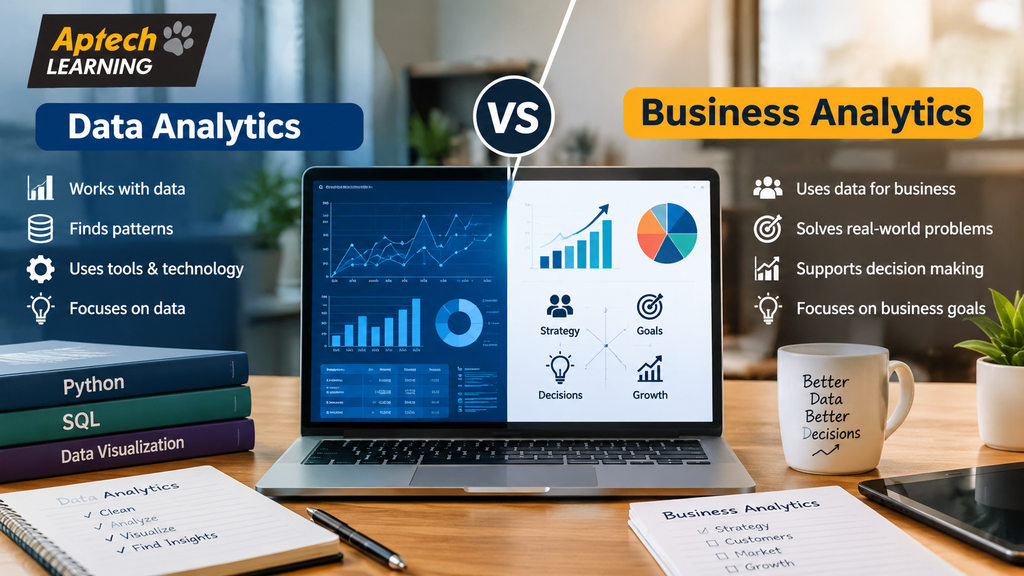
Data analytics focuses primarily on the technical process of collecting, cleaning, and analysing data, while business analytics focuses more on applying data insights to strategic business decisions.
Is business analytics the same as data analytics?
No, while they overlap significantly, business analytics leans more heavily into business strategy and decision-making, while data analytics is more focused on technical data handling and analysis.
Which is better, data analytics or business analytics?
Neither is inherently better; the right choice depends on whether you prefer technical, detail-oriented data work or broader, strategic business problem-solving.
Do data analysts and business analysts need the same skills?
There is meaningful overlap, but data analysts typically need stronger technical tool skills, while business analysts need stronger business communication and strategic thinking skills.
Can I switch from data analytics to business analytics later?
Yes, many professionals transition between these fields over time, especially as they build both technical data skills and broader business understanding through experience.
Which pays more, data analytics or business analytics?
Salaries in both fields vary based on experience, specific role, company, and city, and neither field consistently pays more than the other across all roles and industries.
Do I need strong technical skills for business analytics?
Some technical familiarity is helpful, but business analytics generally emphasises business and strategic thinking skills more heavily than deep technical data tool expertise.
Is SQL necessary for business analytics roles?
While not always essential at a deep level, basic familiarity with data tools like SQL can be helpful for business analysts, even though their primary focus is more strategic.
Can a data analyst become a business analyst?
Yes, with additional focus on business strategy, stakeholder communication, and organisational understanding, data analysts can transition into business analyst roles.
Conclusion
Data analytics and business analytics are closely related but genuinely distinct fields, one centred on the technical process of working directly with data, and the other focused on applying data insights to broader business strategy and decision-making. Understanding this difference helps you choose a learning path and career direction that genuinely matches your interests and strengths, rather than picking based on assumptions or title popularity alone.
The key is to honestly reflect on whether you are more drawn to detailed, technical data work or strategic, big-picture business thinking, and to research specific course content carefully, since these fields’ overlap can sometimes make similarly named courses quite different in actual focus.
Soft Call to Action
If you are based in Lucknow and want guidance on whether data analytics, business analytics, or a combination of both genuinely fits your goals, Aptech Learning Lucknow offers structured courses and counselling for students and working professionals alike. You can visit the institute, speak with their counsellors, or attend a demo class to understand which path suits you best.