

English Speaking Course Syllabus: What You’ll Learn
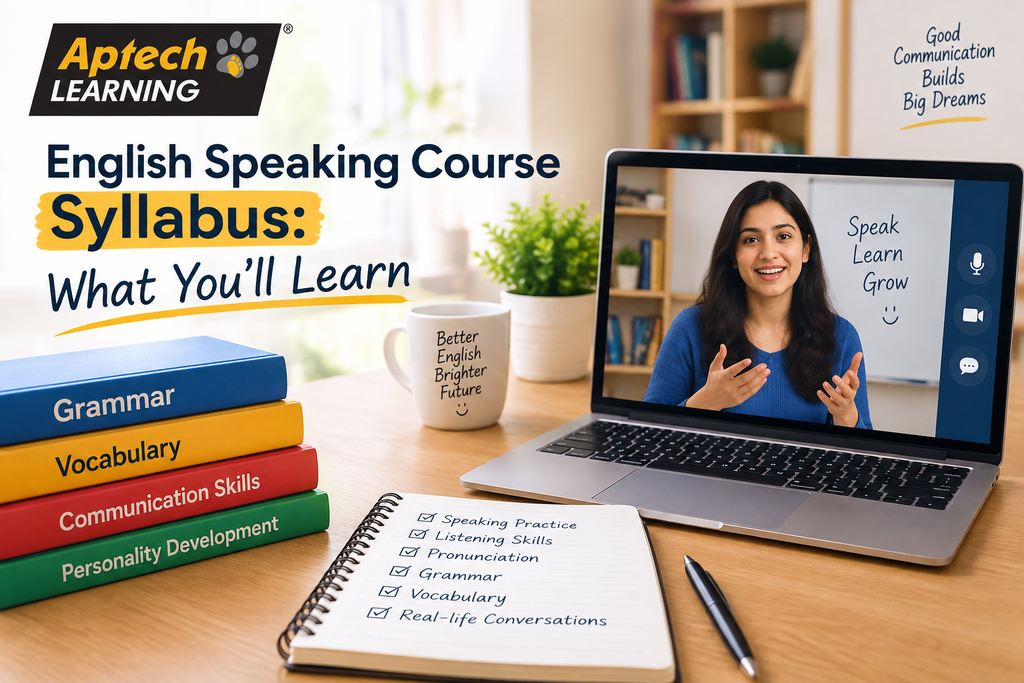
What a Genuine Spoken English Syllabus Should Cover
A genuinely effective English speaking course syllabus is not just a list of grammar topics. It should be built around actual speaking practice, structured to gradually build a learner from basic sentence formation to natural, confident conversation, covering both everyday and professional communication scenarios along the way.
Think of it like a fitness training plan. A good plan does not just list exercises randomly; it builds progressively, starting with foundational strength, then adding complexity and intensity over time. A well-designed spoken English syllabus works the same way, starting with basic vocabulary and simple sentences, then progressively adding pronunciation refinement, conversational fluency, and finally, confident, professional-level communication.
If a course’s syllabus feels vague or does not clearly show this kind of progression, that is often a sign the course itself may lack real structure.
Why Understanding the Syllabus Matters Before Enrolling
Understanding a course’s syllabus before joining matters for a few clear, practical reasons:
It helps you judge whether the course actually matches your current level and specific goals, rather than assuming all “spoken English courses” are the same.
It helps you set realistic expectations for what you will actually be able to do by the end of the course.
It allows you to compare multiple institutes meaningfully, based on actual content rather than just marketing claims.
It helps you identify gaps, such as a course that skips professional or interview-focused communication, if that happens to be your specific goal.
It supports better learning outcomes overall, since knowing the structure in advance helps you engage with each module more purposefully.
Core Modules in a Typical English Speaking Course
Most well-structured English speaking courses are built around a few consistent core modules.
Vocabulary and Grammar Foundation
This module covers practical, everyday vocabulary along with basic grammar structures needed to form clear, correct sentences.
Pronunciation and Listening Skills
This module focuses on clear pronunciation, natural speech rhythm, and active listening comprehension.
Everyday Conversation Practice
This module covers common daily conversation scenarios, such as introductions, shopping, travel, and casual discussions.
Professional and Workplace Communication
This module focuses on vocabulary and scenarios relevant to workplace settings, meetings, emails, and professional interactions.
Interview and Presentation Skills
This module focuses specifically on structured communication for interviews, presentations, and public speaking situations.
Confidence-Building and Group Practice
This module includes group discussions, role plays, and other interactive activities designed to build real speaking confidence.
Module | Main Focus | Example Activity
Vocabulary and Grammar | Building foundational language accuracy | Practising sentence construction with new vocabulary
Pronunciation and Listening | Clear speech and comprehension | Listening exercises and pronunciation drills
Everyday Conversation | Practical daily communication | Role-playing common situations like shopping
Professional Communication | Workplace-relevant English | Practising email and meeting phrases aloud
Interview and Presentation | Structured, formal communication | Mock interviews and short presentations
Confidence-Building | Real, interactive speaking practice | Group discussions on everyday topics
Module-by-Module Breakdown (Step-by-Step)
- Vocabulary and Grammar Foundation
Learners build practical, commonly used vocabulary and understand basic sentence structures needed to communicate clearly. - Pronunciation Basics
Learners practise correct pronunciation of commonly used words and sounds, often through listening and repetition exercises. - Listening Comprehension
Learners practise understanding natural spoken English through audio or video content, building comfort with different accents and speeds. - Everyday Conversation Scenarios
Learners practise common daily conversations, such as greetings, asking for directions, or discussing simple topics, through guided role play. - Building Sentence Fluency
Learners move from short, simple sentences to more naturally flowing, connected speech, reducing hesitation and unnatural pauses. - Professional Vocabulary and Scenarios
Learners build vocabulary and practice specific to workplace communication, such as describing tasks, giving updates, or participating in meetings. - Interview Preparation Practice
Learners practise structured responses to common interview questions, focusing on clarity and confident delivery. - Presentation and Public Speaking Practice
Learners practise organising and delivering short presentations, building comfort speaking in front of others. - Group Discussion and Debate Practice
Learners participate in group discussions, practising how to express opinions clearly and respond to others in real time. - Final Fluency and Confidence Building
Learners work on natural, spontaneous conversation across varied topics, consolidating everything covered throughout the syllabus.
Beginner vs Intermediate vs Advanced Syllabus Levels
A genuine syllabus typically adjusts in depth and complexity depending on the learner’s starting level.
A beginner-level syllabus focuses heavily on foundational vocabulary, basic sentence structure, and simple, everyday conversation scenarios, building initial comfort with speaking aloud.
An intermediate-level syllabus builds on this foundation, introducing more complex sentence structures, wider vocabulary, and scenarios like workplace communication or structured discussions.
An advanced-level syllabus focuses on refining fluency, handling nuanced or professional topics confidently, and building strong performance in high-pressure situations like interviews or presentations.
In simple words: beginner levels build the basic foundation, intermediate levels expand vocabulary and scenario complexity, and advanced levels refine fluency and confidence for more demanding, real-world communication situations.
Practical Examples
Complete Beginner Student: A student with very basic English starts with foundational vocabulary and simple sentence practice, gradually progressing to everyday conversation scenarios over the first few weeks.
Working Professional at Intermediate Level: A working professional with decent conversational English but weak workplace vocabulary focuses specifically on the professional communication module to strengthen meeting and email-related speaking skills.
Job Seeker Preparing for Interviews: A job seeker who is already fairly fluent focuses heavily on the interview preparation and presentation modules, since general conversation is not their main gap.
Student Building Overall Confidence: A shy student who understands grammar well but struggles to speak confidently benefits significantly from the group discussion and confidence-building module, more than from additional grammar study.
Common Mistakes People Make When Choosing a Syllabus
Assuming all English speaking courses cover the same content. Syllabus depth and focus can vary significantly between institutes, even when courses are marketed similarly.
Not checking whether the syllabus includes actual speaking practice modules, not just grammar and vocabulary lessons.
Choosing a course without checking if it matches their specific level, leading to either boredom from content that is too basic or overwhelm from content that is too advanced.
Ignoring whether the syllabus includes professional or interview-specific modules, if that happens to be a specific personal goal.
Not asking how much of the course time is dedicated to each module, since a syllabus listing many topics briefly may not provide meaningful depth in any of them.
Assuming a longer syllabus is automatically better, without considering whether the content is genuinely relevant to their specific needs.
How This Syllabus Supports Career Opportunities
A well-rounded English speaking syllabus, particularly one that includes professional communication, interview preparation, and presentation skills, directly supports better performance in job interviews, workplace communication, and client-facing roles. Employers often value clear, confident English communication as an indicator of overall professionalism and readiness, especially in corporate, customer-facing, or client-interaction roles. A syllabus that goes beyond just everyday conversation to also cover these professional communication scenarios tends to offer stronger, more direct career-related value.
What a Strong Syllabus Should Include Beyond Just Topics
A genuinely strong English speaking syllabus should also include:
A clear, progressive structure, moving logically from foundational to more advanced content
Sufficient dedicated time for actual speaking practice within each module, not just theoretical explanation
Real-world practice scenarios, such as role plays, group discussions, and mock interviews
Regular opportunities for feedback and correction throughout the course, not only at the end
A reasonable balance between vocabulary, grammar, listening, and active speaking components
Flexibility to address individual learner weaknesses, rather than a completely rigid, one-size-fits-all structure
Skills You Should Expect to Build
Practical, everyday vocabulary for common conversations and situations
Clear pronunciation and comfortable, natural speaking pace
Confidence speaking in group settings, interviews, and presentations
Stronger listening comprehension for natural, fluent conversations
Professional communication skills relevant to workplace and interview scenarios
Tools and Teaching Methods Tied to the Syllabus
Teaching Method | Purpose Within the Syllabus
Role-Play Exercises | Practising everyday and professional conversation scenarios
Listening and Shadowing Activities | Building pronunciation and natural speech rhythm
Group Discussions | Building confidence and real-time conversational response skills
Mock Interviews | Practising structured, professional communication under pressure
Recorded Practice Reviews | Helping learners self-assess pronunciation and clarity
Eligibility
There is no fixed educational background required to join an English speaking course, since syllabi are generally designed to accommodate learners from various starting levels, from complete beginners to those refining existing fluency. Most institutes assess a learner’s current level before placing them into the appropriate stage of the syllabus, ensuring the content matches their actual starting point.
Course Duration Based on Syllabus Depth
Course duration often depends directly on how much of the syllabus a specific program covers. A course focused only on foundational modules may run for a few weeks, while a comprehensive program covering everyday conversation, professional communication, and interview preparation may extend over a few months. It is best to confirm the exact syllabus depth and corresponding duration directly with the specific training provider you are considering.
Who Should Check the Syllabus Carefully Before Joining
Beginners who want to confirm a course actually starts from the basics rather than assuming prior knowledge
Job seekers who specifically need interview and professional communication modules included
Working professionals who want to confirm workplace-relevant content is genuinely covered
Anyone comparing multiple institutes who wants to evaluate based on actual content, not just marketing claims
Learners with specific goals, such as public speaking confidence, who want to confirm relevant modules are included

Frequently Asked Questions
What topics are usually covered in an English speaking course syllabus?
A typical syllabus covers vocabulary and grammar foundations, pronunciation and listening skills, everyday conversation, professional communication, interview preparation, and confidence-building group activities.
Does every English speaking course follow the same syllabus?
No, syllabus depth and focus can vary significantly between institutes, so it is important to check the specific content and structure before enrolling.
How is a beginner-level syllabus different from an advanced one?
Beginner syllabi focus on foundational vocabulary and simple conversation, while advanced syllabi focus on refining fluency and handling complex, professional, or high-pressure communication scenarios.
Does the syllabus include interview preparation?
This varies by institute, so if interview preparation is a specific goal, it is important to directly confirm whether this module is included in the course you are considering.
How much of the syllabus focuses on actual speaking practice versus theory?
This also varies significantly, so it is worth asking directly how much class time is dedicated to real speaking practice compared to grammar or vocabulary theory.
Should the syllabus include group discussions and presentations?
Yes, a strong syllabus generally includes interactive components like group discussions and presentations, since these build real speaking confidence beyond basic conversation practice.
How long does it take to complete a full English speaking syllabus?
This depends on the syllabus depth and your starting level, ranging from a few weeks for basic content to a few months for a comprehensive, multi-level program.
Does the syllabus cover professional workplace English specifically?
Many comprehensive syllabi include a dedicated professional communication module, though it is worth confirming this is included if workplace English is a specific priority for you.
What should I ask about the syllabus before enrolling?
Ask specifically about module content, time allocated to speaking practice, whether professional or interview modules are included, and how the course progresses across levels.
Conclusion
Understanding what an English speaking course syllabus actually covers helps you make a far more informed decision than relying on general marketing promises alone. A genuinely well-structured syllabus moves progressively from foundational vocabulary and grammar to real, confident speaking practice across everyday, professional, and high-pressure communication scenarios.
The key is to look beyond just a list of topics, and specifically check how much of the course is dedicated to actual speaking practice, whether it matches your current level, and whether it includes modules genuinely relevant to your specific goals, whether that is everyday fluency, workplace communication, or interview preparation.
Soft Call to Action
If you are based in Lucknow and want to see a clear, structured syllabus before enrolling, Aptech Learning Lucknow offers spoken English courses with a well-defined, progressive curriculum for students and working professionals alike. You can visit the institute, speak with their counsellors, or attend a demo class to understand exactly what the syllabus covers and whether it fits your goals.