
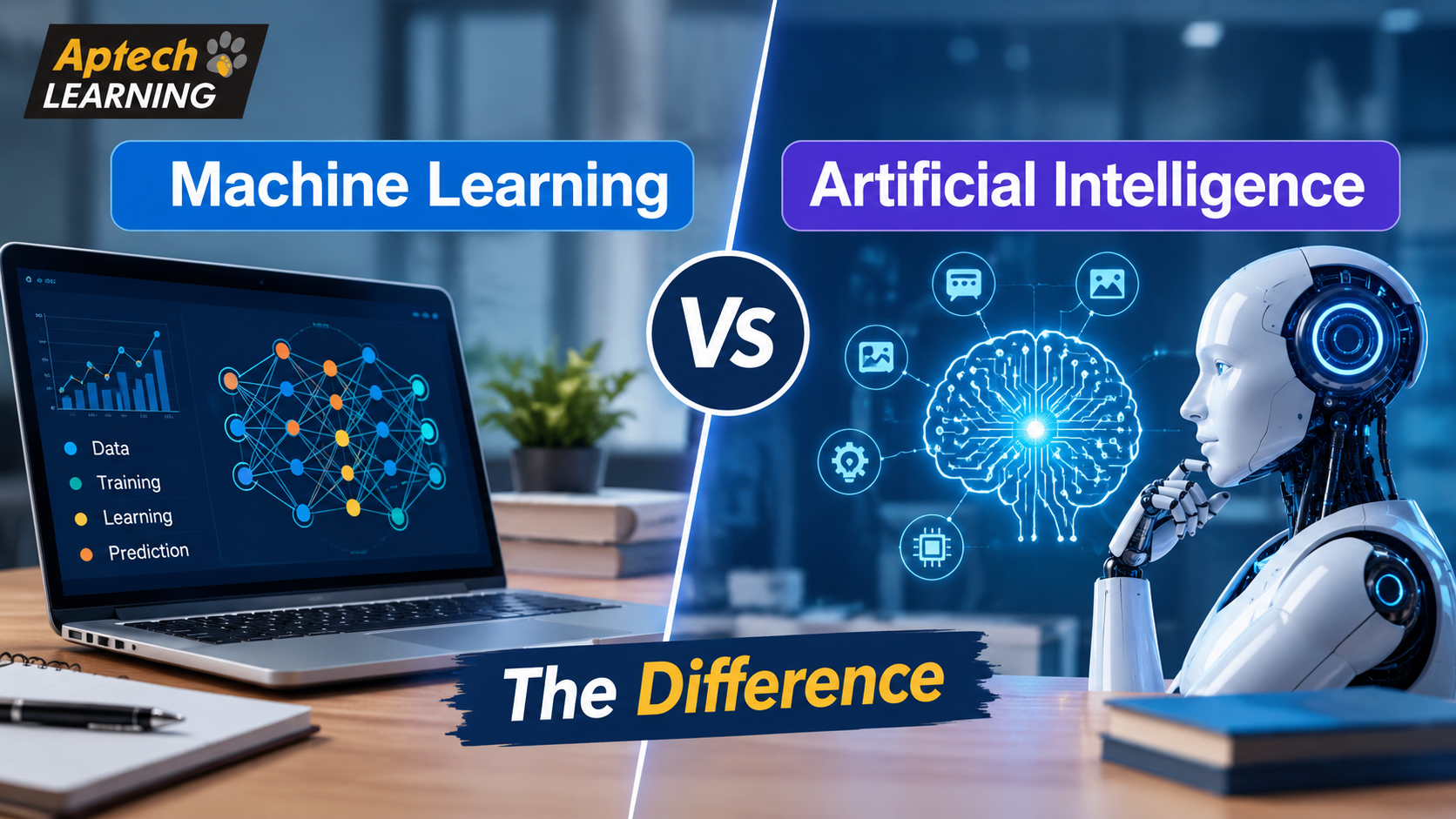
Machine Learning vs Artificial Intelligence: The Difference
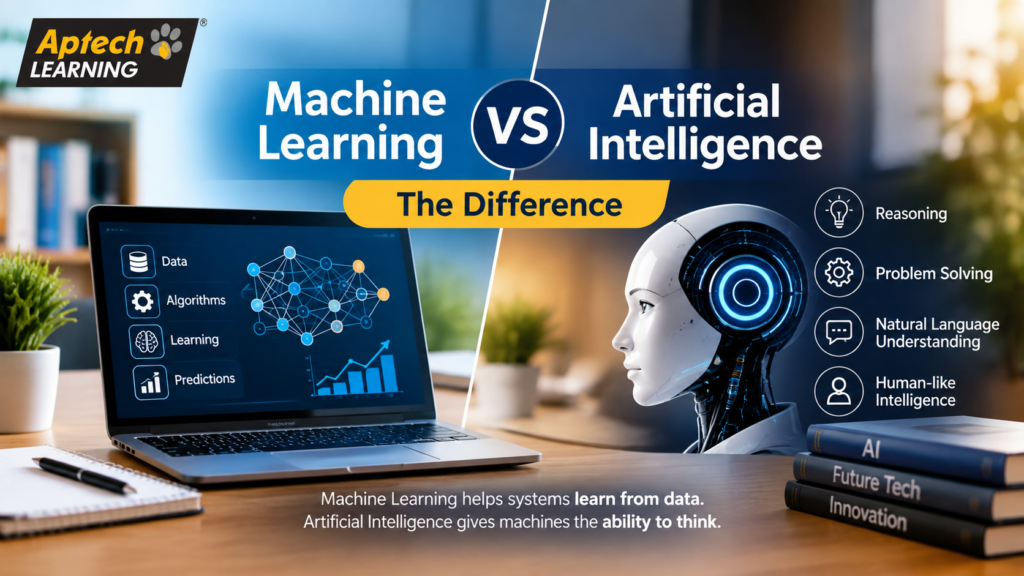
What is Artificial Intelligence
Artificial intelligence, or AI, is the broad field of computer science focused on building systems that can perform tasks that normally require human thinking, such as recognising speech, making decisions, solving problems, and adapting to new situations. AI is not one single technology or technique; it is an umbrella term covering many different approaches to building intelligent behaviour into machines.
Think of AI like the concept of “transportation.” Transportation includes cars, bikes, trains, and planes, all different methods of achieving the same broad goal of moving from one place to another. Similarly, AI includes several different techniques, rule-based systems, machine learning, deep learning, and more, all aimed at the broad goal of building intelligent, human-like behaviour into systems.
Some AI systems are built using fixed, manually written rules, while others, increasingly the more common and powerful approach today, are built using machine learning.
What is Machine Learning
Machine learning, often shortened to ML, is a specific approach within AI where systems learn patterns directly from data, rather than being explicitly programmed with fixed rules for every possible situation. Instead of a programmer writing out every rule a system should follow, a machine learning model is trained on large amounts of data and learns to recognise patterns and make predictions on its own.
Going back to the transportation comparison, if AI is the broad concept of transportation, machine learning is like one specific, particularly popular and effective vehicle within that category, say, a car. It is not the only way to achieve the goal, but it has become one of the most widely used and effective methods for building modern AI systems.
Machine learning powers many of the AI applications you likely already use, from spam email filters to product recommendation systems, all trained on data rather than manually coded rules.
Why the Difference Matters
Understanding the difference between AI and machine learning matters for a few practical reasons:
It helps you understand what you are actually studying. A course on “AI” might cover broad concepts and multiple techniques, while a course on “machine learning” specifically focuses on data-driven model building.
It clarifies job requirements. Job postings might ask broadly for “AI skills” or specifically for “machine learning experience,” and understanding the difference helps you interpret these requirements accurately.
It helps you plan a more focused learning path. Since machine learning is one of the most in-demand AI techniques today, knowing this helps you prioritise what to learn first if your goal is a technical AI career.
It prevents miscommunication in professional settings, where confidently and correctly using these terms reflects genuine understanding rather than surface-level familiarity.
It supports better career decision-making, since different AI-related roles may focus more heavily on either broader AI concepts or specifically on machine learning techniques.
How AI and Machine Learning Work Together (Step-by-Step)
- Define the Intelligent Task
The process starts by identifying a task that requires intelligent behaviour, such as recognising images, understanding language, or making predictions. - Choose an Approach Within AI
Developers decide whether to use rule-based programming, machine learning, or another AI technique, depending on the complexity and nature of the task. - If Using Machine Learning, Collect Relevant Data
For a machine learning approach, large amounts of relevant data are collected, since the system will learn patterns directly from this data. - Train the Machine Learning Model
The model studies the data repeatedly, adjusting itself to recognise patterns and relationships without being explicitly told every specific rule. - Test the Model’s Performance
The trained model is tested on new data it has not seen before, to check how accurately it performs on the intended task. - Deploy the AI System
Once the model performs reliably, it is deployed into a real application, functioning as part of a broader AI system. - Monitor and Improve Over Time
The system is monitored and updated as new data becomes available, since real-world conditions and patterns can change over time.
AI vs Machine Learning vs Deep Learning
Adding deep learning into this comparison helps complete the full picture.
Artificial intelligence is the broadest concept, covering any technique used to build intelligent, human-like behaviour into machines, whether through fixed rules or data-driven learning.
Machine learning is a specific subset of AI, where systems learn patterns from data rather than following manually programmed rules, and it includes several different techniques and algorithms.
Deep learning is a further subset of machine learning, using layered structures called neural networks, loosely inspired by the human brain, to handle particularly complex tasks like image recognition and natural language understanding.
In simple words: AI is the overall goal of building intelligent systems, machine learning is one major approach to achieve that goal using data, and deep learning is an advanced, more specialised technique within machine learning itself.
Practical Examples
Spam Email Filtering: A spam filter uses machine learning, trained on thousands of examples of spam and non-spam emails, to learn patterns that help it automatically identify new spam emails, an example of AI built using machine learning.
Voice Assistants: A voice assistant like a smart speaker combines multiple AI techniques, including machine learning models trained to recognise speech patterns and understand natural language commands.
Product Recommendations: An e-commerce website’s recommendation system uses machine learning to study your browsing and purchase history, identifying patterns that predict what you might want to buy next.
Rule-Based Chatbot (AI Without Machine Learning): A simple, rule-based chatbot that only responds to specific, pre-programmed keywords is an example of AI that does not use machine learning, since it follows fixed rules rather than learning from data.
Common Mistakes Beginners Make
Assuming AI and machine learning are the same thing. This is the most common confusion, and it can lead to misunderstanding course content and job requirements.
Thinking all AI systems use machine learning. Some AI systems are built using fixed, rule-based logic without any data-driven learning involved at all.
Jumping into machine learning without understanding broader AI concepts. Skipping the bigger picture can make it harder to understand where machine learning fits within the broader field.
Assuming machine learning and deep learning are the same. Deep learning is a specific, more advanced subset of machine learning, not an interchangeable term for it.
Focusing only on tools without understanding underlying concepts. Learning to use a machine learning library without understanding the core logic behind it can limit your ability to solve new, unfamiliar problems.
Not clarifying which term a job posting or course is actually referring to. Assuming “AI” and “machine learning” job requirements are identical can lead to applying for or studying the wrong specific skill set.
Career Opportunities
Both AI and machine learning support strong career paths, sometimes overlapping and sometimes requiring distinct specialisation. Common roles include:
Machine Learning Engineer — builds and trains machine learning models, focusing specifically on data-driven system development.
AI Engineer or AI Developer — works more broadly across various AI techniques, which may or may not centre specifically on machine learning.
Data Scientist — uses machine learning as one of several tools to analyse data and build predictive models.
AI Research Scientist — works on advancing AI techniques generally, which often includes deep involvement in machine learning research.
NLP Engineer — focuses specifically on language-based AI systems, typically built using machine learning and deep learning techniques.
Computer Vision Engineer — builds AI systems that interpret images and video, heavily relying on machine learning and deep learning methods.
As experience grows, professionals can specialise further within either broader AI development or more focused machine learning and deep learning research.
Salary Information
Salary for roles in both AI and machine learning depends on factors such as your city, the size and industry of the company, your specific role, your skill level, and your years of experience. Entry-level roles naturally pay less than senior or specialised positions, and metro cities generally offer higher packages than smaller towns. Rather than fixed figures, it is more useful to know that salaries in both fields tend to grow steadily as you build practical project experience and strengthen your skills in Python, machine learning techniques, and, for more advanced roles, deep learning.
Skills Required
Technical Skills
Strong programming skills in Python, widely used across both AI and machine learning development
Understanding of statistics, probability, and basic linear algebra
Knowledge of machine learning algorithms and when to apply them for different types of problems
Familiarity with data handling libraries such as Pandas and NumPy
Understanding of neural networks and deep learning concepts for more advanced AI roles
Non-Technical Skills
Strong logical and analytical thinking
Problem-solving mindset, especially when experimenting with different modelling approaches
Patience, since training and refining machine learning models often involves trial and error
Curiosity to keep learning, since both AI and machine learning techniques evolve quickly
Ability to explain technical AI and machine learning concepts clearly to non-technical stakeholders
Tools Used
Tool | Primary Use
Python | Main programming language for both AI and machine learning development
Scikit-learn | Building traditional machine learning models and algorithms
TensorFlow | Building and training deep learning models within AI systems
PyTorch | Flexible framework for AI and machine learning research
Jupyter Notebook | Writing and testing AI and machine learning code interactively
Pandas and NumPy | Data handling and numerical computation
Eligibility
There is no single fixed background required to start learning AI or machine learning. Students from computer science, mathematics, statistics, or even non-technical backgrounds with strong logical thinking can begin learning both fields. Generally, learners should have completed higher secondary education (12th grade) or be graduates, along with basic comfort in mathematics and computer usage. Prior programming knowledge is helpful but not always compulsory, since many beginner-focused courses build these skills from the basics.
Course Duration
AI and machine learning courses can range from a few weeks for focused, foundational programs to several months for in-depth, project-based training covering advanced machine learning and deep learning concepts. The right duration depends on your current skill level, whether you already know programming and statistics, and how deep you want to go into specialised areas. It is best to confirm the exact course structure and duration directly with the training provider.
Who Should Learn AI and Machine Learning
College students who want to enter one of the fastest-growing technical fields
Working professionals looking to transition into AI or machine learning-focused roles
Software developers who want to expand into AI-driven application development
Data-related professionals who want to move from analysis into building predictive, learning-based models
Career changers who are willing to build strong technical foundations through structured, consistent learning
Frequently Asked Questions
Is machine learning the same as artificial intelligence?
No, artificial intelligence is the broad field of building intelligent systems, while machine learning is a specific approach within AI where systems learn patterns from data.
Can AI exist without machine learning?
Yes, some AI systems are built using fixed, rule-based logic without any data-driven learning, though machine learning has become one of the most common and effective AI approaches today.
Which should I learn first, AI or machine learning?
It is generally helpful to understand broad AI concepts first, then focus specifically on machine learning, since it is one of the most widely used and in-demand AI techniques.
What is the relationship between machine learning and deep learning?
Deep learning is a specific, more advanced subset of machine learning that uses layered neural networks, particularly effective for complex tasks like image and language processing.
Do I need to know programming to learn AI and machine learning?
Yes, basic programming knowledge, especially in Python, is important for both fields, though many beginner-friendly courses teach programming fundamentals alongside core concepts.
Are AI engineer and machine learning engineer the same job?
Not exactly; AI engineers may work across various AI techniques, while machine learning engineers focus specifically on building and deploying machine learning models.
Conclusion
Understanding the difference between artificial intelligence and machine learning clears up one of the most common points of confusion in this field. AI is the broad goal of building intelligent systems, and machine learning is one of the most powerful, widely used approaches to actually achieve that goal using data rather than fixed rules.
The key is to build a solid understanding of both the broader AI landscape and the specific mechanics of machine learning, since this foundation supports smarter learning decisions and clearer career planning going forward. Whether you eventually specialise in broader AI development or focus specifically on machine learning, understanding this distinction from the start puts you on more solid footing.
Soft Call to Action
If you are based in Lucknow and want structured, hands-on training in both AI and machine learning fundamentals, Aptech Learning Lucknow offers courses designed for beginners and working professionals alike. You can visit the institute, speak with their counsellors, or attend a demo class to understand how the course is structured and whether it fits your career goals.