
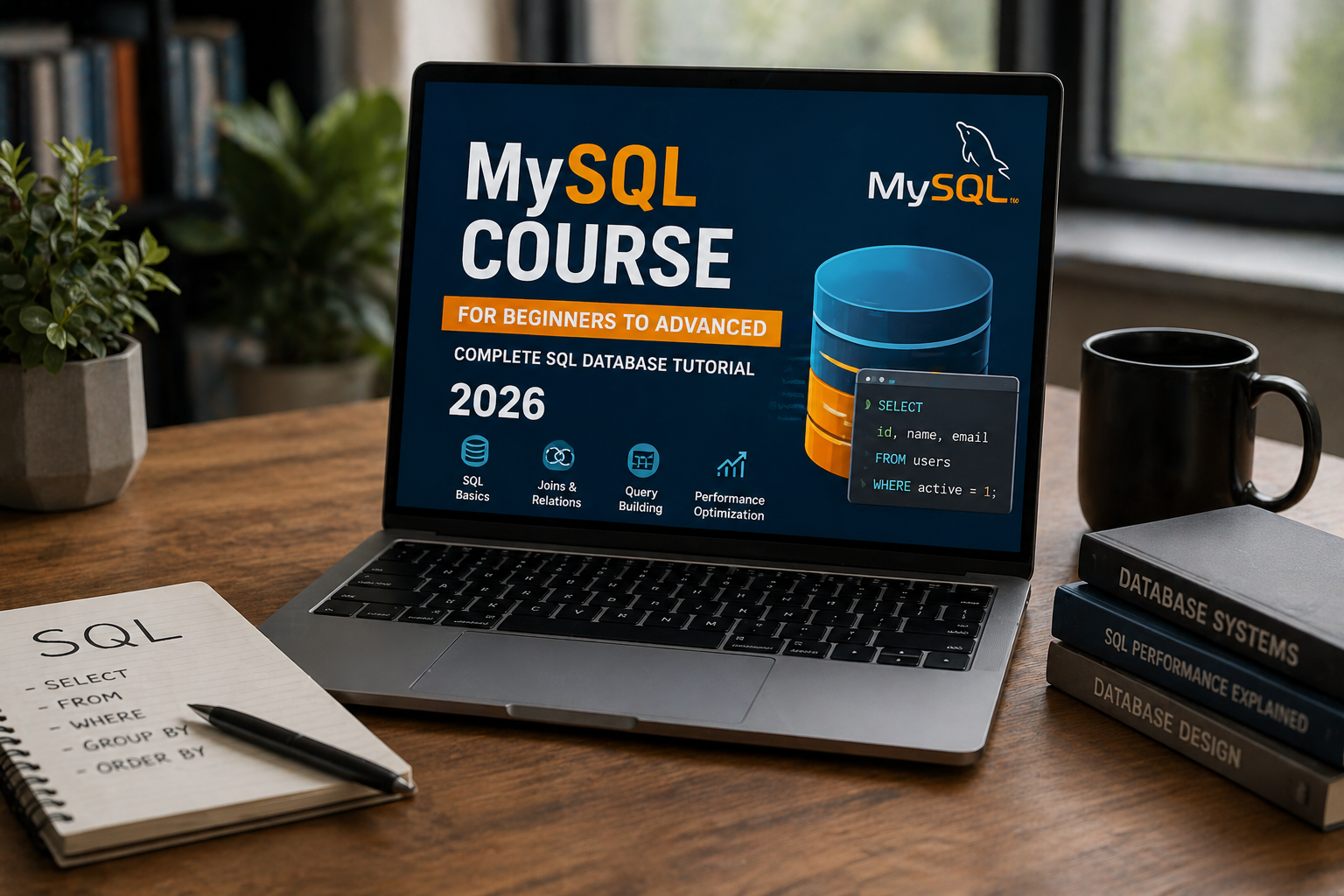
MySQL Course for Beginners to Advanced | Complete SQL Database Tutorial 2026
A MySQL course for beginners to advanced teaches how to create, manage, and optimize databases using SQL. It covers database fundamentals, queries, joins, indexing, and real-world applications, helping learners build strong data management and backend development skills.

1. What is MySQL?
MySQL is an open-source relational database management system (RDBMS) that uses SQL (Structured Query Language) to store, retrieve, and manage data efficiently. It is widely used in web development, data analytics, and enterprise applications.
2. Why Learn MySQL in 2026
- High demand for database skills
- Used in web development and backend systems
- Essential for data analytics and data science
- Works with technologies like PHP, Python, and Java
- Strong career opportunities in IT
3. MySQL Course Structure (Step-by-Step)
| Level | Topics Covered | Skills You Gain |
|---|---|---|
| Beginner | Basics of SQL, tables, queries | Data retrieval |
| Intermediate | Joins, functions, normalization | Data relationships |
| Advanced | Indexing, optimization, security | Performance tuning |
4. Beginner Level Topics
If you’re starting your MySQL course for beginners, you will learn:
- Introduction to databases
- Installing MySQL
- Creating databases and tables
- Basic SQL queries (SELECT, INSERT, UPDATE, DELETE)
Example:
SELECT * FROM users;
5. Intermediate Level Topics
Once you move ahead in your learn MySQL step by step journey:
- Joins (INNER, LEFT, RIGHT)
- Aggregate functions (COUNT, SUM, AVG)
- GROUP BY and HAVING
- Database normalization
Example:
SELECT users.name, orders.amount
FROM users
INNER JOIN orders ON users.id = orders.user_id;
6. Advanced MySQL Concepts
In an advanced MySQL tutorial 2026, you will master:
- Indexing and query optimization
- Stored procedures and triggers
- Transactions and ACID properties
- Security and user permissions
7. Real-World Projects
To become job-ready, practice these projects:
| Project | Description |
|---|---|
| Student Management System | Manage student data |
| E-commerce Database | Products, users, orders |
| Banking System | Transactions and accounts |
| Inventory Management | Stock and suppliers |
8. Career Opportunities After MySQL Course
After completing this SQL database tutorial, you can apply for:
- Database Administrator
- Backend Developer
- Data Analyst
- SQL Developer
- Software Engineer
9. Frequently Asked Questions | Aptech Learning Mahanagar
1. Is MySQL easy for beginners?
Yes, MySQL is beginner-friendly and easy to learn with basic SQL concepts.
2. How long does it take to learn MySQL?
You can learn basics in 2–4 weeks and advanced concepts in 2–3 months with practice.
3. Do I need coding knowledge to learn MySQL?
No, basic logical understanding is enough to start learning SQL.
4. Is MySQL still relevant in 2026?
Yes, MySQL remains widely used in web development and data management.
5. What is the difference between SQL and MySQL?
SQL is a language, while MySQL is a database system that uses SQL.
6. Can I get a job after learning MySQL?
Yes, MySQL skills are in high demand for backend and data-related roles.
Conclusion
A MySQL course for beginners to advanced is one of the best investments for your tech career in 2026. By learning MySQL step by step, you gain essential database skills required in almost every IT role. Start with basics, practice regularly, and work on real-world projects to become an expert.