
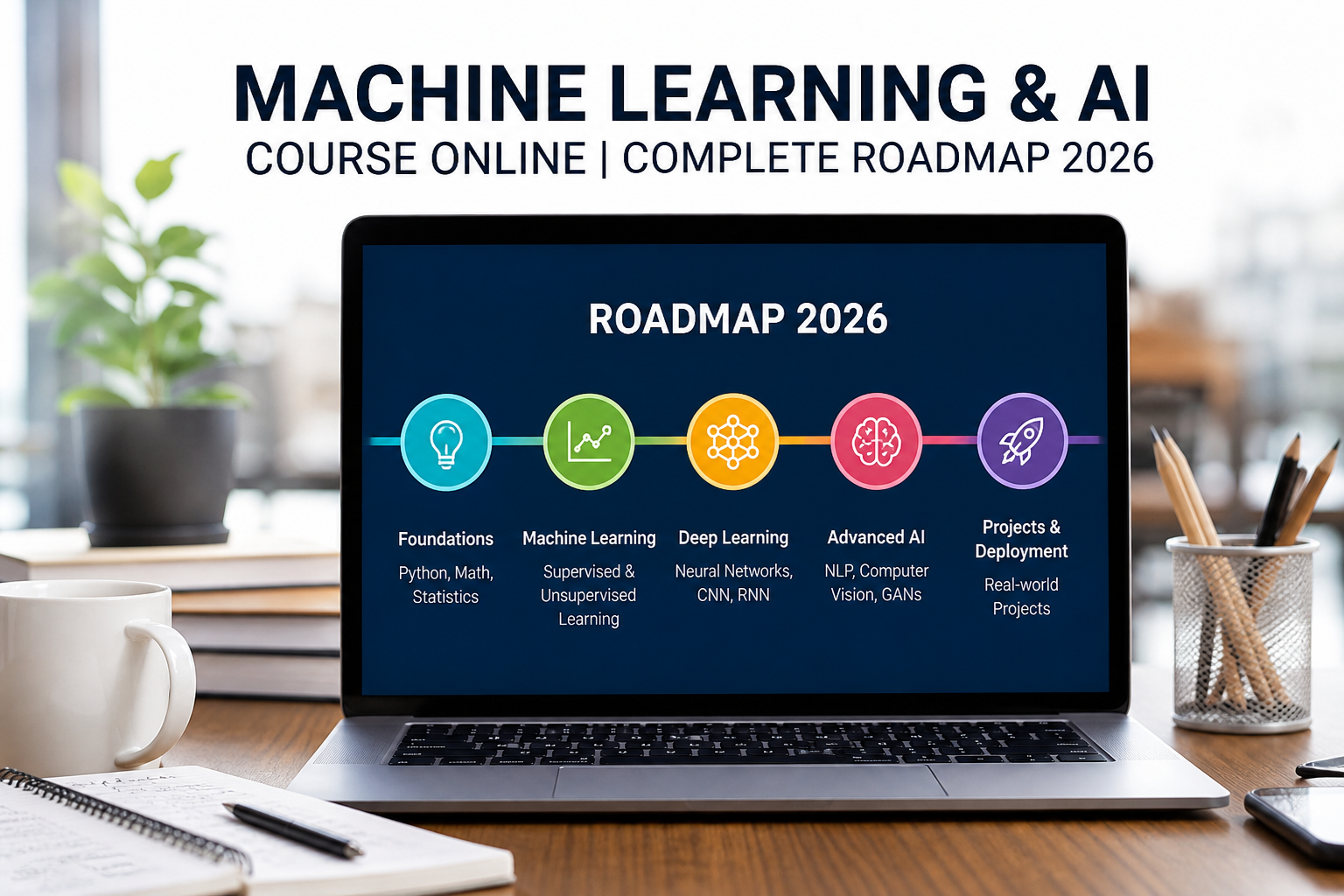
Machine Learning & AI Course Online | Complete Roadmap 2026
There is a moment when most people realize that their current skill set is not going to take them where they want to go professionally. For a lot of people in 2026, that moment comes when they see job postings asking for machine learning engineers, AI specialists, and data scientists — roles that pay two to three times what they are currently earning.
If you are in Lucknow and wondering how to actually break into this field, this guide is written specifically for you. Not a vague “learn Python” article. A real, honest roadmap from where you are right now to your first ML or AI job — with everything Aptech Learning Lucknow offers to make that journey faster and more structured.

Why Machine Learning and AI Is the Career Move That Actually Makes Sense in 2026
The global AI market crossed $600 billion in 2024 and is on track to reach $1.8 trillion by 2030. More relevant to you as a job seeker: companies across India are scaling their AI teams rapidly, and the supply of trained professionals is nowhere close to meeting that demand.
This is what that gap means in practical terms. Freshers with solid machine learning skills and a strong portfolio are getting placed at salaries between ₹4 LPA and ₹8 LPA in Lucknow and nearby cities. Professionals with two to three years of ML experience are regularly crossing ₹15 to ₹25 LPA. These are not startup flukes — these are consistent hiring patterns across IT services, fintech, healthcare tech, and e-commerce companies.
The window is open right now. The question is just whether you are going to walk through it.
Who This Roadmap Is Built For
This roadmap works across three types of learners:
Freshers and college students who want to make their resume genuinely stand out in a crowded market. Machine learning skills combined with a recognized certification make you immediately more hireable than the majority of your peers.
Working professionals in software development, data entry, or IT support who want to move into higher-paying ML and AI roles. With your existing technical exposure, the transition is faster than you think — typically 4 to 5 months of focused learning.
Career switchers from non-technical backgrounds — finance, healthcare, retail — who have domain knowledge and want to combine it with AI skills. This combination is particularly valuable because ML professionals who understand business contexts are rare and consistently well-paid.
The Complete Machine Learning and AI Roadmap for 2026
Stage 1 — Foundation (Weeks 1 to 6)
Every machine learning journey starts with the same three building blocks. Skip these and you will struggle later. Build them properly and everything that follows becomes significantly easier.
Python Programming Python runs roughly 80% of all machine learning code written in production today. The reason is simple — it has the richest ecosystem of ML libraries, the most active community, and the gentlest learning curve for beginners. Focus on data structures, functions, loops, and basic object-oriented programming. You do not need to master the entire language before moving forward.
Mathematics for Machine Learning You need a working understanding of three areas. Linear algebra — specifically vectors, matrices, and matrix operations — because this is how data is represented and transformed in ML systems. Calculus — derivatives and gradients — because this is what makes model training work through a process called gradient descent. Probability and statistics — distributions, Bayes’ theorem, and hypothesis testing — because this is how you reason about uncertainty and evaluate your models.
None of this requires a university mathematics background. The Mathematics for Machine Learning course on Coursera teaches all three areas with direct connections to ML applications, which makes it far more practical than textbook study.
Data Handling Before you build models, you need to be able to work with data. NumPy handles numerical computation. Pandas handles data cleaning, exploration, and manipulation. Kaggle’s free micro-courses on both topics are excellent and take under 10 hours combined. This is the part most beginners rush through — do not rush it.
Stage 2 — Core Machine Learning (Weeks 7 to 16)
This is where machine learning actually starts. With your foundation in place, you are ready to learn the algorithms and techniques that power real-world applications.
Supervised Learning Supervised learning is where most practical ML applications live. You will work through linear regression, logistic regression, decision trees, random forests, support vector machines, and gradient boosting methods like XGBoost. The key skill is not just knowing how these algorithms work but understanding when to use each one and how to properly evaluate your results.
Unsupervised Learning Clustering algorithms like K-means and DBSCAN, dimensionality reduction techniques like PCA and t-SNE, and anomaly detection methods are the core topics here. These techniques power customer segmentation systems, fraud detection engines, and recommendation algorithms that you interact with every day.
Model Evaluation This is where a lot of beginners get stuck because nobody emphasizes it enough early on. You need to genuinely understand train-test splits, cross-validation, the difference between overfitting and underfitting, and how to choose the right evaluation metric for your problem. Accuracy is not always the right metric — knowing when to use precision, recall, F1 score, or AUC-ROC is what separates someone who follows tutorials from someone who builds reliable systems.
Best resource for this stage: Andrew Ng’s Machine Learning Specialization on Coursera. It is the most widely respected ML course in the world and covers all of this with practical coding exercises using scikit-learn and TensorFlow.
Stage 3 — Deep Learning and Neural Networks (Weeks 17 to 24)
Once you are comfortable with classical machine learning, deep learning opens up the most exciting applications — image recognition, language understanding, voice synthesis, generative AI, and more.
Neural Network Fundamentals Start with feedforward neural networks, backpropagation, activation functions, and the optimization algorithms that make training work. The Deep Learning Specialization by Andrew Ng on Coursera is the standard resource — five courses that take you from the basics all the way through sequence models and attention mechanisms.
Convolutional Neural Networks CNNs are the foundation of computer vision. You will learn to build image classifiers, object detectors, and visual recognition systems. Kaggle has active computer vision competitions that give you real problems to solve alongside your learning — participating in even one competition significantly sharpens your practical skills.
Transformers and Large Language Models Transformers have transformed NLP in the last three years, and understanding their architecture is now essential for anyone working in AI. BERT, GPT-style models, and the attention mechanism are the core concepts. Hugging Face’s free course covers this area better than almost anything else available.
Frameworks You need to be comfortable with at least one of PyTorch or TensorFlow. PyTorch is dominant in research and growing fast in production. TensorFlow remains standard in enterprise environments. Most employers accept either — pick one and go deep.
Stage 4 — Specialization (Weeks 25 to 32)
By this stage you have a solid generalist ML foundation. Now you choose a direction based on your interests and where the job market is strongest.
Natural Language Processing Sentiment analysis, text classification, named entity recognition, question answering, summarization, and chatbot development. NLP is the highest-demand ML specialization in 2026 following the large language model boom. The Hugging Face ecosystem has become the industry standard for NLP work.
Computer Vision Object detection, image segmentation, video analysis, medical imaging. Strong demand in healthcare, automotive, manufacturing, and security sectors. Tools include OpenCV, torchvision, and the Ultralytics YOLO framework.
Generative AI and LLM Engineering Building applications on top of large language models — RAG pipelines, AI agents, prompt engineering, and fine-tuning. This is the fastest-growing area of AI hiring in 2026 and consistently commands premium salaries.
MLOps and Deployment Taking models from Jupyter notebook to production systems. Docker, FastAPI, MLflow, and cloud deployment on AWS, GCP, or Azure. Companies specifically look for people who can deploy — not just build — and this specialization pays accordingly.
Stage 5 — Build Your Portfolio (Start From Week 20)
Here is the truth that most course providers skip over: your portfolio matters more than your certificates. A candidate with two strong, deployed projects consistently beats a candidate with six certifications and nothing to show.
A strong ML portfolio project does three things. It solves a real problem — not a textbook exercise copied from a tutorial. It is deployed somewhere accessible — even a simple Streamlit app or Hugging Face Space makes your work tangible and testable. And it is documented clearly enough that a hiring manager can understand what you built, why, and what results it produced in under 10 minutes.
Aim for three to five projects: one supervised learning project, one deep learning application, one NLP or computer vision project, and one fully deployed application. That is a portfolio that generates interview calls.
Best Machine Learning and AI Courses Online in 2026
Andrew Ng’s Machine Learning Specialization (Coursera) The global gold standard for foundational ML. Three courses, approximately 90 hours total, updated in 2022 with modern tools. You can audit it free or pay for the certificate.
Deep Learning Specialization by DeepLearning.AI Five courses covering neural networks, CNNs, sequence models, and transformer architecture. Pairs perfectly with the ML Specialization above.
Fast.ai Practical Deep Learning Completely free, top-down and practical. You build working systems first and understand theory after — particularly effective for career switchers.
IBM Machine Learning Professional Certificate (Coursera) Six courses with a strong emphasis on scikit-learn and real datasets. IBM’s credential carries weight with enterprise employers hiring in India.
Hugging Face NLP Course Free and up to date with modern transformer-based NLP. Essential for anyone targeting language AI or generative AI roles.
Aptech Learning Lucknow — AI and Machine Learning Program For learners in Lucknow who want structured offline training with expert mentorship, Aptech Learning’s ML and AI program offers hands-on classroom training, real project work, and a job interview guarantee backed by 100+ hiring partners. Faculty bring 20+ years of real-world industry experience, and the curriculum is designed specifically for job placement rather than academic exploration. If you want the accountability and direct career support of a structured program alongside the theoretical depth of online resources, this combination is genuinely hard to beat.
Machine Learning Jobs You Can Target After This Roadmap
Machine Learning Engineer Builds, trains, and deploys ML models at scale. Average salary in India: ₹8 LPA to ₹25 LPA depending on experience. The most direct career outcome from this roadmap.
Data Scientist Applies statistical analysis and machine learning to generate business insights. Often the first ML-adjacent role people land. Average fresher salary in Lucknow: ₹4 LPA to ₹7 LPA.
NLP Engineer Specializes in language understanding and generation. Demand has roughly doubled since the generative AI boom of 2023 to 2024.
Computer Vision Engineer Builds systems that analyze and interpret images or video. Strong demand in healthcare, automotive, and manufacturing sectors.
MLOps Engineer Focuses on infrastructure, deployment, and monitoring of ML systems. One of the fastest-growing specializations as companies scale their AI operations.
AI Product Manager Bridges the gap between ML teams and business stakeholders. Growing rapidly as companies build more AI-powered products and need people who understand both sides.
How Long Will This Actually Take?
Complete beginner spending 8 to 10 hours per week: plan for 10 to 12 months to reach a job-ready level.
Software developer with Python experience spending 12 to 15 hours per week: 4 to 6 months is realistic.
Data analyst or IT professional spending 15 to 20 hours per week: 3 to 4 months to your first ML role.
The single biggest variable is not which course you pick. It is whether you build projects alongside learning. Passive learning without projects can double your timeline. Active project building cuts it significantly — and gives you something concrete to show employers when you start applying.
Why Aptech Learning Lucknow Is a Strong Choice for This Journey
Learning machine learning online is entirely possible, but most people underestimate how much the right environment accelerates the process. At Aptech Learning Lucknow in Aliganj, you get 100% offline hands-on training from mentors with 20+ years of industry experience, direct access to 100+ hiring partners, and a job interview guarantee that stays active until you are placed.
For learners in Lucknow who want the discipline of a structured classroom environment combined with a curriculum built specifically for employment — not just certification — Aptech’s ML and AI program is worth a serious look.
You can visit the center at First Floor, Above Radiance, 18 J Road, Near Midland Healthcare and Research Center, Mahanagar, Lucknow. Or call directly at +91 6386 119 566.
Frequently Asked Questions | Aptech Learning Mahanagar
Q1. What is the best machine learning and AI course online for beginners in 2026?
Andrew Ng’s Machine Learning Specialization on Coursera is the most widely recommended starting point for beginners worldwide. It covers all core ML concepts with practical coding exercises using modern tools like scikit-learn and TensorFlow. You can audit it completely free. For learners in Lucknow who prefer structured offline training with expert guidance and placement support, Aptech Learning’s ML and AI program offers a strong alternative that combines classroom accountability with a job interview guarantee.
Q2. How long does it take to learn machine learning and get a job in 2026?
It depends on your starting point and the hours you commit. A complete beginner spending 8 to 10 hours per week typically needs 10 to 12 months to become job-ready. Someone with existing programming experience can often reach that point in 4 to 6 months. The critical factor is building real projects alongside your learning — passive course completion without portfolio work consistently extends the timeline and reduces hiring success.
Q3. Do I need a degree to get a machine learning job in 2026?
No. In 2026, the majority of entry-level ML hires come from specialized certification programs, structured training institutes, and self-taught paths rather than traditional degrees. What employers evaluate is your portfolio, your ability to solve problems with ML tools, and a recognized certification. Many of the most successful ML professionals working today have backgrounds in completely unrelated fields.
Q4. What programming language should I learn for machine learning?
Python is the clear choice — roughly 80% of all ML code written in production today is Python. It has the richest ecosystem of ML libraries including scikit-learn, TensorFlow, PyTorch, Keras, and Hugging Face Transformers. For anyone starting in ML in 2026, Python is the language to learn first. R has use cases in academic statistics. Julia is growing in scientific computing. But for job placement, Python is what employers are looking for.
Q5. What is the salary of a machine learning engineer in Lucknow in 2026?
Entry-level ML roles in Lucknow typically start between ₹4 LPA and ₹7 LPA for freshers with a solid portfolio and recognized certification. Professionals with two to three years of hands-on experience regularly earn ₹12 LPA to ₹25 LPA. Specializations in generative AI, LLM engineering, and MLOps command the highest premiums right now. Nationally, ML engineers average between ₹8 LPA and ₹20 LPA depending on company size and location.
Q6. What is the difference between machine learning and artificial intelligence?
Artificial intelligence is the broader field — it refers to any system or technique that enables machines to simulate human-like thinking or decision-making. Machine learning is a specific subset of AI where systems learn from data rather than being programmed with explicit rules. Deep learning is a further subset of machine learning that uses multi-layered neural networks. In practice, when people say AI in 2026, they are almost always referring to machine learning or deep learning applications.
Conclusion
Machine learning and AI are not a passing trend. The demand for trained professionals is real, the salary premium is consistent, and the barrier to entry has never been lower than it is right now in 2026. The roadmap above is not theoretical — it is the path that has worked for thousands of people making the same transition you are considering.
The best time to start was two years ago. The second best time is today. Open a Kaggle account, write your first line of Python, and take the first step. Everything else follows from that one decision.