
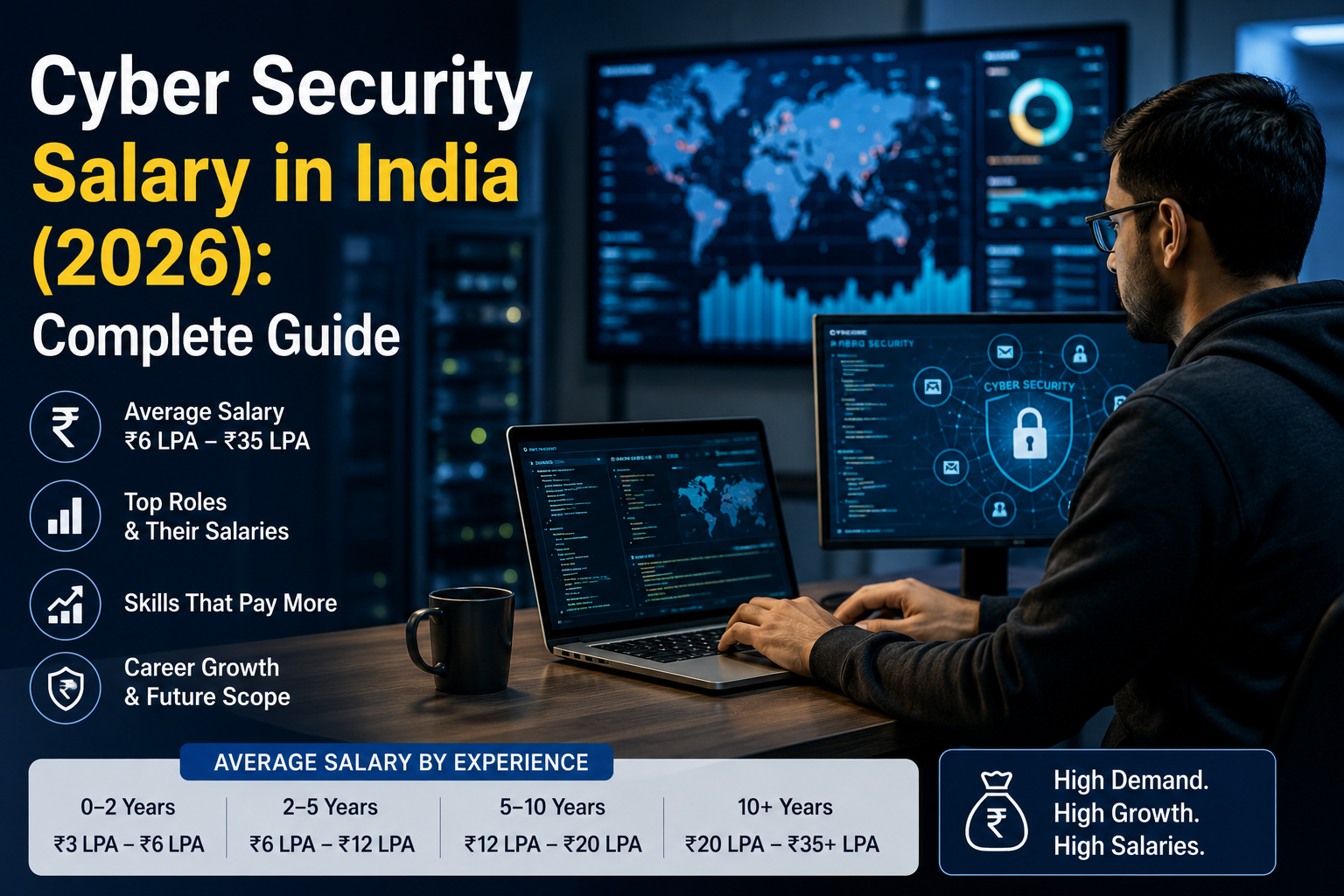
Cyber Security Salary in India (2026): Complete Guide
Cyber security is one of the fastest-growing fields in the Indian IT industry, and salaries reflect that demand. Rather than one fixed number, think of cyber security salary as a range that depends heavily on where you are in your career, which specific role you hold, and which city you work in.
A fresher just entering the field will naturally earn less than someone with five years of hands-on experience handling real security incidents. Similarly, a generalist security analyst role usually pays differently compared to a specialised role like a penetration tester or cloud security engineer. Instead of chasing an exact number, it helps to understand the factors that push salaries higher, since these are things you can actually work on.

Factors That Affect Cyber Security Salary
Several factors directly influence how much a cyber security professional earns in India:
Experience level: More years of hands-on experience generally means higher pay, especially experience handling real incidents, not just theoretical knowledge.
Job role and specialisation: Specialised roles like penetration testing or cloud security often pay more than generalist roles, since fewer professionals have deep expertise in these areas.
City and company: Metro cities like Bangalore, Mumbai, and Hyderabad, along with larger companies and MNCs, generally offer higher packages than smaller cities or companies.
Certifications: Industry-recognised certifications can strengthen your profile and often support higher pay, especially for mid-level and senior roles.
Industry: Sectors like banking, fintech, and IT services often invest more heavily in security, which can reflect in the packages they offer.
Skill set: Practical skills in tools like network monitoring, penetration testing, and cloud security platforms tend to be valued more than certificates alone.
Salary by Experience Level
Experience Level | Typical Role | General Salary Trend
Entry-Level (0–2 years) | Security Analyst, SOC Analyst | Lower end of the pay scale, growing with hands-on project exposure
Mid-Level (2–5 years) | Security Engineer, Penetration Tester | Noticeably higher than entry-level, based on specialised skills
Senior-Level (5–10 years) | Security Architect, Incident Response Lead | Significantly higher, reflecting deep expertise and responsibility
Leadership (10+ years) | CISO, Head of Security | Among the highest in the field, tied to strategic responsibility
Note: These are general trends, not fixed figures. Actual pay depends on the specific company, city, and individual skill set.
Salary by Job Role
Different cyber security roles come with different responsibilities, and pay usually reflects that.
Security Analyst: Monitors systems for threats and handles initial-level incident response. Usually an entry point into the field.
Penetration Tester: Legally tests systems to find vulnerabilities before attackers do. Requires specialised, hands-on offensive security skills.
Security Engineer: Designs and implements security infrastructure and tools. Requires strong technical and networking knowledge.
Cloud Security Specialist: Focuses on securing cloud-based systems and platforms, a fast-growing and well-paid specialisation.
Incident Responder: Investigates and manages active security breaches, requiring quick thinking under pressure.
Security Consultant: Advises organisations on improving their overall security posture, often requiring both technical and communication skills.
CISO (Chief Information Security Officer): A senior leadership role overseeing an organisation’s entire security strategy, typically requiring many years of experience.
Salary by City
City generally plays a meaningful role in cyber security salaries across India, mainly because of cost of living and concentration of IT and security-focused companies.
Metro cities like Bangalore, Hyderabad, Pune, and Mumbai tend to offer higher packages, largely due to a higher concentration of IT companies, startups, and MNCs actively hiring for security roles.
Tier-2 cities like Lucknow, Jaipur, and Indore are steadily growing in terms of IT and security-related job opportunities, though packages may currently trend lower compared to metro cities.
Remote and hybrid roles have also become more common in cyber security, which is gradually reducing the gap between city-based and location-independent pay in some companies.
How Certifications Impact Salary
Certifications alone do not guarantee a specific salary, but they often strengthen a candidate’s profile and can support better pay, especially when combined with practical skills. Some widely recognised areas of certification in the cyber security field include network security, ethical hacking, cloud security platforms, and security management frameworks.
Employers generally value certifications more when they are backed by real, hands-on project experience, rather than treated as a replacement for practical skills. This is why many training programs combine certification preparation with actual lab-based practice.
Highest Paying Cyber Security Jobs
While exact figures vary by company and location, certain roles are generally recognised as being among the higher-paying paths within cyber security as professionals gain experience:
Security Architect — designs the overall security structure for an organisation’s systems.
Cloud Security Engineer — a fast-growing, specialised role due to rising cloud adoption.
Penetration Tester (Senior-Level) — highly skilled offensive security experts are in strong demand.
Incident Response Manager — leads teams responding to major security breaches.
CISO — the senior-most cyber security leadership role in most organisations.
How to Increase Your Cyber Security Salary
Build hands-on experience through labs, internships, or real projects, not just theoretical study.
Specialise in a high-demand area like cloud security, penetration testing, or incident response rather than staying purely generalist.
Earn relevant, recognised certifications that align with your chosen specialisation.
Keep learning continuously, since cyber threats and defence techniques evolve constantly.
Develop strong documentation and communication skills, since explaining risks clearly is valued at senior levels.
Consider relocating to or working remotely for companies based in metro cities if location flexibility is possible for you.
Skills That Help You Earn More
Strong understanding of networking and how data flows between systems
Hands-on experience with tools like Wireshark, Nmap, and Metasploit
Familiarity with cloud platforms and cloud-specific security practices
Scripting knowledge, often in Python, to automate security tasks
Strong analytical thinking to identify unusual patterns quickly
Clear communication skills for explaining technical risks to non-technical teams
Career Growth Path
A typical cyber security career often follows a path like this: starting as a Security Analyst or SOC Analyst, moving into a more specialised role like Penetration Tester or Security Engineer, then progressing into Senior Security Engineer or Security Architect, and eventually into leadership roles like Security Manager or CISO. Growth at each stage usually depends on a combination of experience, specialisation, and continuous learning, rather than time alone.
Who Should Consider a Cyber Security Career
College students looking for a high-demand, future-proof career path
IT professionals wanting to specialise and potentially increase their earning potential
Working professionals from other fields looking to switch into a growing tech career
Job seekers interested in a field where skills and certifications can meaningfully impact pay growth
Frequently Asked Questions
What is the average cyber security salary in India?
Cyber security salaries in India vary significantly by role, experience, city, and certifications. Entry-level roles pay less than specialised or senior positions, with pay generally rising steadily over time.
Which cyber security role pays the highest in India?
Senior and leadership roles like Security Architect, Cloud Security Engineer, and CISO are generally among the highest paying, reflecting years of specialised experience and responsibility.
Does experience really affect cyber security salary?
Yes, experience significantly impacts salary. Professionals with hands-on experience handling real security incidents typically earn more than those with only theoretical knowledge.
Do certifications increase cyber security salary in India?
Certifications can strengthen your profile and support higher pay, especially when combined with practical, hands-on skills, rather than being relied upon alone.
Which city offers the best cyber security salary in India?
Metro cities like Bangalore, Mumbai, Hyderabad, and Pune generally offer higher packages due to a larger concentration of IT companies and security-focused roles.
Is cyber security a well-paying career for freshers?
Entry-level cyber security roles may start on the lower end compared to senior positions, but pay tends to grow steadily with hands-on experience and skill development.
Conclusion
Cyber security salaries in India depend on a mix of experience, specialisation, city, and continuous skill development, rather than a single fixed number. While entry-level roles naturally start lower, the field offers strong long-term growth for those willing to build practical, hands-on expertise over time.
If you are serious about a cyber security career, focus less on chasing an exact starting figure and more on building real skills, gaining certifications aligned with your interests, and specialising in a high-demand area as you grow.
Soft Call to Action
If you are based in Lucknow and want to build practical, job-ready cyber security skills through structured, expert-guided training, Aptech Learning Lucknow offers cyber security courses designed for beginners and working professionals. You can visit the institute, speak with their counsellors, or attend a demo class to understand how the course can support your career goals.