

Advanced Excel Career Opportunities: Complete Guide
Advanced Excel refers to a deeper set of spreadsheet skills that go well beyond basic data entry and simple formulas. It includes features like pivot tables, VLOOKUP and INDEX-MATCH functions, conditional formatting, data validation, macros, and dashboard creation using charts and slicers.
Think of basic Excel as knowing how to write a to-do list, while advanced Excel is like knowing how to build an entire planning system that automatically organises, filters, and summarises your tasks for you. Basic Excel helps you record data. Advanced Excel helps you actually make sense of that data and present it in a way that supports real decisions.
Because so many businesses still run core reporting and analysis through Excel, even alongside more specialised tools, advanced Excel remains one of the most practical, transferable skills across office-based careers.
Why Advanced Excel Skills Matter for Your Career
Advanced Excel continues to matter for a few clear reasons:
Almost every industry, from finance to marketing to operations, relies on Excel for reporting, analysis, and day-to-day decision-making.
It acts as a strong entry point into more data-focused careers, since many advanced Excel skills, like logical thinking and structured analysis, carry over directly into tools like SQL or Power BI.
Employers often look for advanced Excel skills as a baseline requirement, even for roles that are not purely data-focused, such as HR, sales, or admin positions.
It allows professionals to work more independently, since employees who can build their own reports and dashboards rely less on separate data teams for routine tasks.
It is a relatively fast skill to build compared to programming-heavy tools, making it accessible for career changers and non-technical professionals.
Types of Roles That Use Advanced Excel
Advanced Excel is used across a wide range of roles, not just those with “analyst” in the title.
Data-Focused Roles
Roles like data analyst or reporting analyst use advanced Excel heavily for cleaning, organising, and analysing large datasets.
Finance and Accounting Roles
Roles like financial analyst or accountant use advanced Excel for budgeting, forecasting, and financial reporting.
Sales and Marketing Roles
Roles in sales operations or marketing analytics use advanced Excel to track performance, campaign results, and customer data.
Operations and Supply Chain Roles
Roles like operations executive or supply chain analyst use advanced Excel to manage inventory data, logistics tracking, and process reporting.
HR Roles
HR professionals use advanced Excel to manage employee data, track attendance, and build reports for workforce planning.
Role Type | How Advanced Excel is Used | Example Task
Data Analyst | Cleaning and analysing datasets | Building pivot table summaries
Financial Analyst | Budgeting and forecasting | Creating financial models
Marketing Analyst | Campaign tracking | Building performance dashboards
Operations Executive | Inventory and process tracking | Automating stock reports
How Advanced Excel Skills Are Used at Work (Step-by-Step)
- Collect Raw Data
Data is gathered from various sources, such as sales records, survey responses, or exported reports from other systems. - Clean and Organise the Data
Advanced Excel functions are used to remove duplicates, fix errors, and structure the data properly before analysis. - Apply Formulas and Functions
Functions like VLOOKUP, INDEX-MATCH, and IF statements are used to pull, compare, and calculate values across the dataset. - Build Pivot Tables
Pivot tables are used to summarise large amounts of data quickly, allowing patterns and totals to be seen at a glance. - Create Visual Reports
Charts, graphs, and conditional formatting are used to present the data in a way that is easy to understand at a glance. - Automate Repetitive Tasks
Macros or advanced formulas are used to automate repetitive reporting tasks, saving significant time on recurring work. - Present Insights to Stakeholders
The final reports or dashboards are shared with managers or teams to support decisions based on the analysed data.
Advanced Excel vs Basic Excel vs Data Analytics Tools
These three are related but represent different levels of data handling capability.
Basic Excel covers simple tasks like data entry, basic formulas, and simple formatting, suitable for straightforward, small-scale record keeping.
Advanced Excel goes much further, using pivot tables, complex formulas, macros, and dashboard building to handle larger datasets and more detailed analysis.
Data analytics tools, such as Power BI, SQL, or Python, are generally used for even larger datasets, more complex analysis, and automation beyond what Excel can practically handle alone.
In simple words: basic Excel helps you record data, advanced Excel helps you analyse and present it effectively, and dedicated analytics tools take over when data size and complexity grow beyond what Excel can efficiently manage.
Practical Examples
Retail Business: A store manager uses advanced Excel to build a pivot table showing which products sell best in each region, helping guide restocking decisions.
Finance Team: A financial analyst builds a forecasting model in Excel using historical data and formulas to predict next quarter’s expenses.
Marketing Team: A marketing executive builds a dashboard in Excel tracking campaign performance across different platforms, using charts to compare results quickly.
HR Department: An HR executive uses advanced Excel to track employee attendance patterns and automatically flag unusual absenteeism trends.
Operations Team: A logistics coordinator uses advanced Excel formulas to track delivery timelines and automatically highlight delayed shipments.
Common Mistakes Beginners Make
Relying only on basic formulas. Many learners stop at simple SUM and AVERAGE functions without exploring more powerful tools like INDEX-MATCH or pivot tables.
Not learning pivot tables early. Pivot tables are one of the most useful advanced Excel features, and skipping them limits how efficiently large datasets can be summarised.
Ignoring data cleaning steps. Beginners sometimes analyse messy data directly, leading to inaccurate results and unreliable reports.
Overcomplicating spreadsheets. Adding too many formulas, colours, or unnecessary formatting can make a spreadsheet harder to read instead of easier.
Not practising with real datasets. Learning formulas in isolation without applying them to actual business-style data makes the skills harder to use confidently at work.
Skipping keyboard shortcuts and efficiency tricks. Beginners often work slower than necessary by not learning small efficiency habits that professionals rely on daily.
Career Opportunities
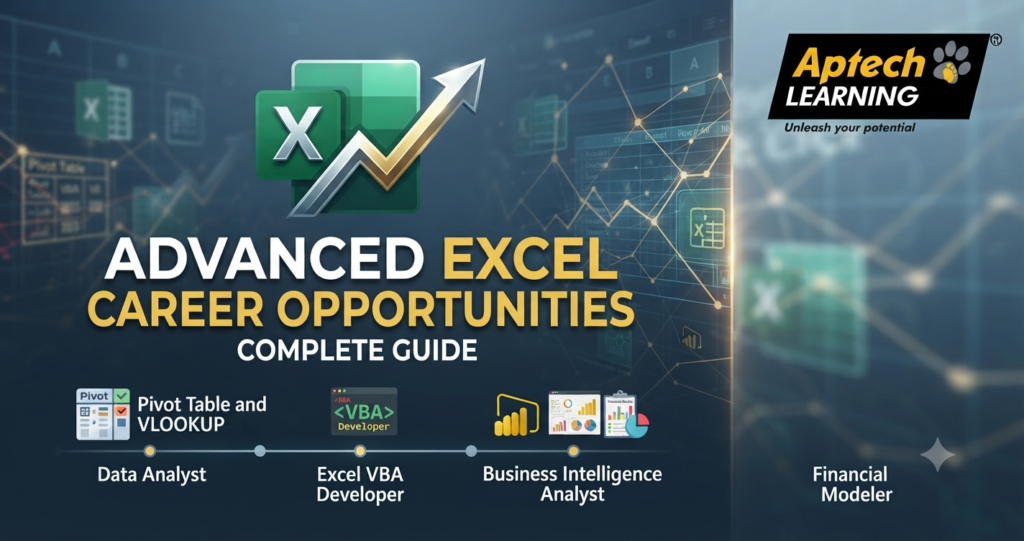
Advanced Excel skills support a wide range of career paths across industries. Common roles include:
Data Analyst — uses Excel alongside other tools to clean, analyse, and report on data.
Financial Analyst — uses Excel for budgeting, forecasting, and financial modelling.
Business Analyst — uses Excel to analyse business performance and support decision-making.
MIS Executive — builds and maintains regular reports and dashboards for management.
Operations Executive — uses Excel to track processes, inventory, and logistics data.
HR Analyst — uses Excel to manage and analyse workforce-related data.
As professionals gain experience, advanced Excel skills often support a natural transition into more specialised roles involving tools like Power BI, SQL, or broader data analytics work.
Salary Information
Salary for roles that rely on advanced Excel skills depends on factors such as your city, the size and industry of the company, your specific role, your skill level, and your years of experience. Entry-level roles naturally pay less than senior positions, and metro cities generally offer higher packages than smaller towns. Rather than fixed numbers, it is more useful to know that advanced Excel skills tend to strengthen your overall profile and can support steady salary growth, especially when combined with additional tools like Power BI or basic SQL.
Skills Required
Technical Skills
Strong command of formulas like VLOOKUP, INDEX-MATCH, and IF statements
Pivot tables for summarising and analysing large datasets
Data visualisation using charts, graphs, and conditional formatting
Basic understanding of macros for automating repetitive tasks
Data validation and cleaning techniques for accurate analysis
Non-Technical Skills
Analytical thinking to interpret what the data actually means
Attention to detail, since small errors in formulas can lead to incorrect conclusions
Clear communication to explain spreadsheet insights to non-technical colleagues
Organisational skills, especially when managing large or complex datasets
Patience, since building accurate, well-structured spreadsheets takes practice
Tools and Features Used in Advanced Excel
Feature | Primary Use
Pivot Tables | Summarising and analysing large datasets quickly
VLOOKUP and INDEX-MATCH | Searching and matching data across sheets
Conditional Formatting | Highlighting important data patterns visually
Data Validation | Ensuring data is entered correctly and consistently
Macros | Automating repetitive tasks and workflows
Charts and Dashboards | Presenting data visually for easier interpretation
Eligibility
There is no single fixed background required to learn advanced Excel. Students from commerce, science, or arts backgrounds, along with working professionals from almost any field, can learn it, since the core requirement is logical thinking rather than a specific degree. Generally, learners should have completed at least higher secondary education (12th grade) or be graduates, along with basic familiarity with computers. Prior experience with basic Excel is helpful but not always compulsory, since many courses start from the fundamentals.
Course Duration
Advanced Excel courses can range from a few weeks for focused, skill-specific programs to slightly longer durations for in-depth, project-based training covering formulas, pivot tables, and dashboard building. The right duration depends on your current comfort level with Excel and how deep you want to go into automation and reporting features. It is best to confirm the exact course structure and duration directly with the training provider.

Who Should Learn Advanced Excel
College students who want a practical, widely applicable skill for almost any office job
Working professionals looking to improve efficiency and stand out in their current role
Job seekers who want a strong, transferable skill that applies across industries
Professionals in finance, HR, sales, or operations who regularly work with data and reports
Business owners who want to better understand and manage their own company’s data
Frequently Asked Questions
What career opportunities open up after learning advanced Excel?
Advanced Excel skills support roles like data analyst, financial analyst, business analyst, MIS executive, and operations executive, since almost every industry relies on spreadsheet-based reporting and analysis.
Is advanced Excel enough to get a job?
Advanced Excel alone can support certain roles, especially reporting and coordination-based jobs, but combining it with tools like Power BI or basic SQL often strengthens career opportunities further.
Which industries hire people with advanced Excel skills?
Almost every industry hires for advanced Excel skills, including finance, retail, healthcare, HR, marketing, and operations, since spreadsheet-based reporting remains common across sectors.
Do I need a technical background to learn advanced Excel?
No, advanced Excel is accessible to learners from any background. The core requirement is logical thinking and consistent practice, not a specific technical degree.
What is the difference between basic and advanced Excel?
Basic Excel covers simple data entry and formulas, while advanced Excel includes features like pivot tables, complex formulas, macros, and dashboard building for deeper analysis.
Can advanced Excel skills help me get promoted?
Yes, advanced Excel skills often help professionals handle reporting and analysis more independently, which can strengthen their profile and support career growth within their current role.
Is advanced Excel useful for non-data roles like HR or sales?
Yes, advanced Excel is widely used in HR for workforce data and in sales for tracking performance, making it a valuable skill even outside dedicated data roles.
What is the role of pivot tables in advanced Excel?
Pivot tables allow users to quickly summarise and analyse large datasets, making it easier to identify patterns and totals without manually sorting through raw data.
Can advanced Excel skills lead to a data analyst career?
Yes, advanced Excel is often a strong starting point for a data analyst career, especially when combined with additional skills like SQL or data visualisation tools.
Conclusion
Advanced Excel is often underestimated as a career skill, but it genuinely opens doors across finance, marketing, operations, HR, and data-focused roles. Whether you use it as a standalone skill or as a foundation for moving into more advanced data careers, it remains one of the most practical, widely applicable tools you can learn.
The key is to move beyond basic formulas, build real comfort with pivot tables and advanced functions, and practice using real-world style datasets. Strong advanced Excel skills can meaningfully strengthen your professional profile, regardless of which industry you work in.
Soft Call to Action
If you are based in Lucknow and want structured, hands-on training instead of learning everything alone, Aptech Learning Lucknow offers advanced Excel courses designed for students and working professionals alike. You can visit the institute, speak with their counsellors, or attend a demo class to understand how the course is structured and whether it fits your career goals.