
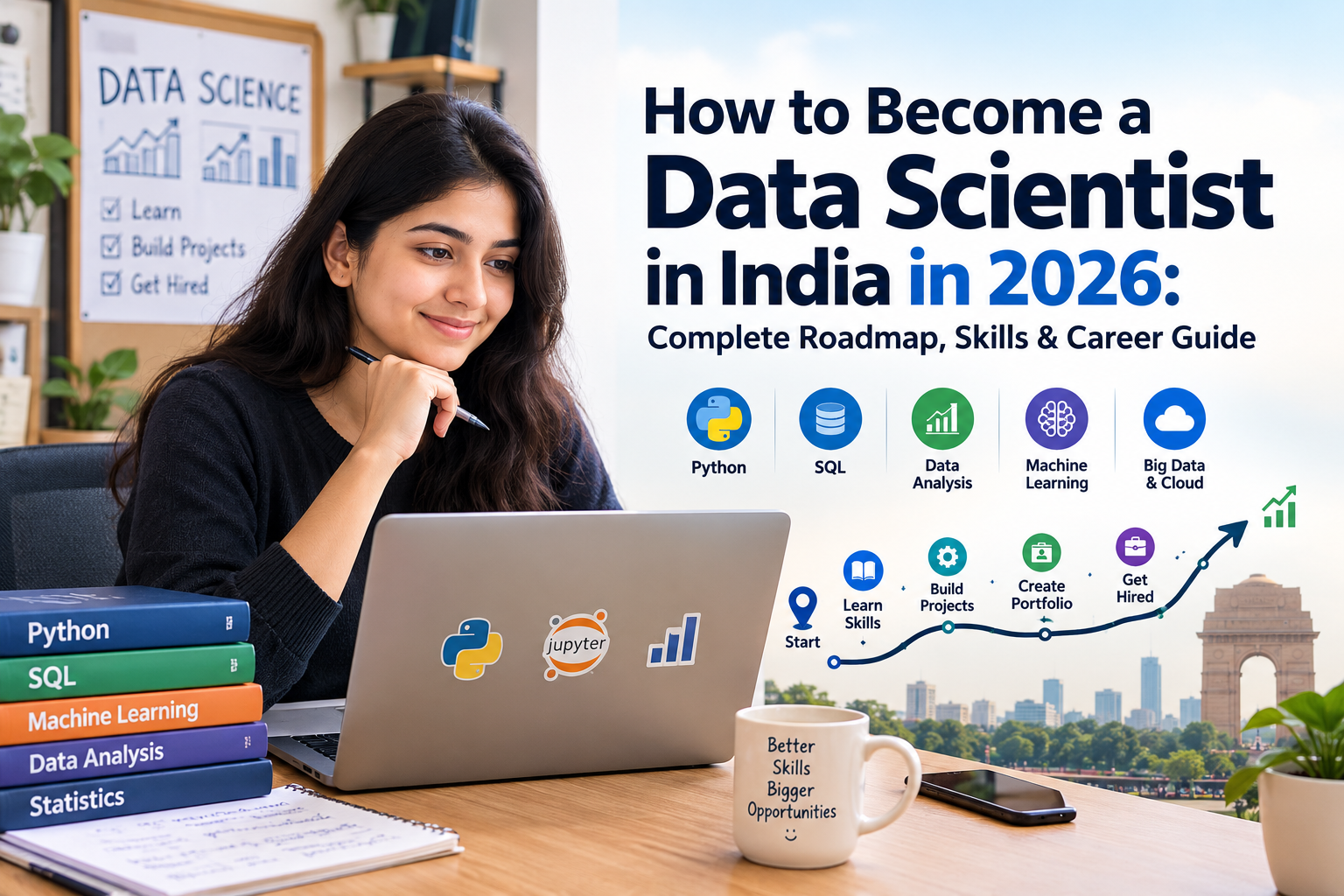
How to Become a Data Scientist in India in 2026

Why the Data Scientist Role Looks Different in 2026
A few years ago, becoming job-ready as a data scientist mostly meant learning to write model code from scratch, manually tuning parameters, and building everything line by line. By 2026, AI-assisted coding tools and automated machine learning platforms handle a lot of that routine execution work, which has genuinely shifted what employers actually value in a candidate.
Think of it like the shift that happened in accounting when spreadsheet software took over manual ledger calculations. The core skill of understanding accounting principles remained essential, but the specific task of manually calculating totals became automated. Similarly, in data science, the core skill of understanding statistics, framing the right problem, and correctly interpreting model outputs remains essential, but a lot of the routine coding execution has become faster and more automated than it used to be.
This does not mean the fundamentals matter less. If anything, understanding what a model is actually doing, and being able to catch when an AI-generated solution is wrong, has become more valuable, since anyone can generate code quickly now, but not everyone can judge whether that code is actually solving the right problem correctly.
Why This Updated Roadmap Matters
Following an updated, 2026-relevant roadmap matters for a few practical reasons:
Learning paths and course content from a few years ago sometimes emphasise skills that have since become partially automated, without adjusting for what genuinely still requires human judgment.
Employers in 2026 increasingly value candidates who can work effectively alongside AI tools, rather than those who either avoid them entirely or rely on them without understanding the underlying logic.
The job market has become somewhat more competitive as more people enter the field, making genuine conceptual depth and strong portfolios more important differentiators than surface-level tool familiarity.
Understanding what has changed helps you avoid spending excessive time on skills that matter less now, while properly investing time in the judgment-based skills that remain genuinely valuable.
A realistic, current roadmap helps set honest expectations about timeline and effort, rather than following outdated advice that may no longer reflect actual hiring patterns.
What Has Actually Changed Since Earlier Years
A few genuine shifts are worth understanding clearly before starting this roadmap.
AI-assisted coding tools now handle much of the routine syntax and boilerplate code writing, meaning raw coding speed matters less than problem-solving judgment.
Automated machine learning platforms can quickly test multiple model types on a dataset, shifting emphasis toward correctly framing the problem and validating results rather than manually building every model from scratch.
Employers increasingly ask interview questions designed to test genuine conceptual understanding, since they know candidates can generate code quickly using AI tools regardless of true understanding.
The volume of available learning content has grown significantly, making it more important to focus on structured, verified learning paths rather than getting overwhelmed by scattered online resources.
Demand has grown for data scientists who can clearly communicate findings and business impact, since technical execution alone has become a less scarce skill.
Step-by-Step Roadmap to Becoming a Data Scientist
- Build Strong Python Fundamentals
Learn core Python programming, understanding syntax and logic deeply enough to read, modify, and debug code, including AI-generated code, confidently. - Build a Genuine Statistics Foundation
Learn probability, distributions, hypothesis testing, and correlation versus causation, since this conceptual foundation is what lets you judge whether a model’s output actually makes sense. - Learn SQL for Data Extraction
Learn to write SQL queries confidently, since extracting and organising data from databases remains a consistently required, foundational skill. - Learn Data Cleaning and Exploration
Practise cleaning messy, real-world datasets and exploring them visually, since this remains a largely manual, judgment-based process even with modern tools. - Understand Machine Learning Concepts Deeply
Learn how different machine learning algorithms actually work conceptually, not just how to call them through a library, so you can judge when a model’s approach is appropriate. - Learn to Work Effectively With AI-Assisted Tools
Practise using AI coding assistants and automated ML platforms as tools that speed up execution, while maintaining the ability to verify and correct their output. - Practise Validating and Interpreting Model Results
Build the specific skill of checking whether a model’s output is genuinely reliable, rather than accepting results at face value just because a tool produced them. - Build a Portfolio That Shows Judgment, Not Just Output
Create projects that clearly document your reasoning, why you chose a particular approach, how you validated results, and what business insight you drew, not just a finished model. - Practise Communicating Findings Clearly
Practise explaining your analysis and its business implications in plain language, since this remains one of the most consistently valued, less automatable skills. - Gain Practical Experience Through Real Projects
Look for internships, freelance work, or entry-level roles where you can apply these combined skills to genuine business problems.
Core Skills vs AI-Assisted Skills
Understanding this distinction helps you prioritise your learning time effectively in 2026.
Core skills, statistics understanding, problem framing, result validation, and business communication, remain fundamentally human judgment tasks that AI tools cannot reliably replace, and these deserve the majority of your deep learning focus.
AI-assisted skills, writing boilerplate code, testing multiple model types quickly, and generating initial data visualisations, can be significantly accelerated using modern tools, meaning you need working familiarity with these tools rather than the same depth of manual practice earlier learners needed.
In simple words: understand deeply what makes an analysis correct and meaningful, and use available tools to accelerate execution once you already know what “correct” looks like.
Practical Examples
Beginner Learning Statistics First: A beginner spends significant early time building genuine statistical understanding before touching machine learning libraries, ensuring they can judge model outputs meaningfully once they start building projects.
Learner Using AI Coding Assistants Correctly: A learner uses an AI coding assistant to quickly generate initial code for a data cleaning task, then carefully reviews and adjusts the output, rather than accepting it without verification.
Candidate Building a Judgment-Focused Portfolio: A job seeker documents not just their final model results but also their reasoning process, including why they rejected certain approaches, making their portfolio stand out during interviews.
Working Professional Validating Automated Model Results: A working professional uses an automated machine learning platform to quickly test several models on a dataset, then manually validates the top result against business logic before presenting it to stakeholders.
Common Mistakes Beginners Make
Relying entirely on AI tools without building genuine conceptual understanding. This leaves you unable to catch errors or explain your work confidently during interviews or on the job.
Avoiding AI tools entirely out of fear they will “replace learning.” This unnecessarily slows down your learning and execution speed without adding proportional understanding.
Focusing only on tool usage rather than statistical reasoning. Knowing how to call a machine learning function means little if you cannot judge whether its output is actually meaningful.
Building a portfolio of only finished outputs without explaining reasoning. Employers increasingly want to see your thinking process, not just a completed model.
Underestimating the importance of communication skills. As technical execution becomes faster, the ability to clearly explain findings has become an increasingly important differentiator.
Following outdated learning roadmaps without adjusting for current tools and hiring expectations. Some older advice still emphasises manual coding speed over the judgment-based skills that matter more now.
Career Opportunities in 2026
Data science continues to offer strong career paths across industries, though role expectations have shifted somewhat. Common roles include:
Data Scientist — builds and validates models while increasingly working alongside AI-assisted tools to accelerate execution.
Machine Learning Engineer — focuses on deploying and maintaining models in production environments.
AI Solutions Analyst — an increasingly common role focused on evaluating and applying AI tools correctly to business problems.
Data Analyst — a related, often earlier-career role focused more on analysis and reporting than model building.
Research Scientist — works on advancing data science and AI techniques, typically in more research-focused environments.
Analytics Consultant — advises businesses on how to apply data science and AI tools effectively to their specific challenges.
As experience grows, professionals increasingly move into roles that combine technical judgment with strategic, cross-functional responsibility, reflecting how the field has evolved.
Salary Information
Salary for data scientists in India in 2026 depends on factors such as your city, the size and industry of the company, your specific role, your skill depth, and your years of experience. Entry-level roles naturally pay less than senior, specialised positions, and metro cities generally offer higher packages than smaller towns. Rather than fixed numbers, it is more useful to know that salaries continue to reward candidates who combine strong conceptual understanding with the ability to work effectively alongside modern AI-assisted tools, since this combination increasingly differentiates stronger candidates in a more competitive market.
Skills Required
Technical Skills
Strong Python programming skills, including the ability to read and debug code confidently
Solid understanding of statistics and probability
SQL for extracting and managing data from databases
Machine learning conceptual understanding, not just tool-level familiarity
Working ability to use AI-assisted coding and automated ML tools effectively and critically
Non-Technical Skills
Strong judgment for validating and interpreting model outputs correctly
Clear communication skills for explaining technical findings to non-technical stakeholders
Curiosity and structured problem-solving ability
Patience for the iterative, sometimes uncertain nature of model development
Business understanding to connect technical work with genuine organisational goals
Tools Used by Data Scientists
Tool | Primary Use
Python | Core programming language for data science tasks
SQL | Extracting and managing data from databases
AI Coding Assistants | Accelerating routine code writing, used with careful verification
Automated ML Platforms | Quickly testing multiple model types, requiring result validation
Power BI or Tableau | Visualising data and presenting insights clearly
Pandas and NumPy | Data manipulation and numerical computation
Eligibility
There is no single fixed background required to become a data scientist in 2026. Students from computer science, mathematics, statistics, engineering, or even non-technical fields with strong logical thinking can begin learning this skill set. Generally, learners should have completed higher secondary education (12th grade) or be graduates, along with basic comfort in mathematics and computer usage. Prior programming experience remains helpful but not compulsory, since structured courses continue to build these skills from the basics.
Course Duration
Data science courses in 2026 can range from a few months for focused, project-based programs to longer durations for in-depth training covering statistics, machine learning, and effective use of modern AI-assisted tools. The right duration depends on your existing skill level and how deep you want to go into advanced concepts. It is best to confirm the exact course structure and duration directly with the training provider.
Who Should Pursue This Path
College students who want to build a strong foundation for a high-demand technical career that has genuinely evolved with current tools
Working professionals looking to transition into data-focused or AI-related roles with realistic, updated expectations
Software developers who want to expand into data-driven application development
Business or finance professionals who want to make more data-informed decisions
Career changers willing to build genuine conceptual understanding, not just tool-level familiarity, for long-term career resilience
Frequently Asked Questions
How do I become a data scientist in India in 2026?
Start by building strong Python and statistics foundations, learn SQL and machine learning concepts, practise working effectively with AI-assisted tools, and build a portfolio that clearly shows your reasoning process.
Has AI made data science skills less important in 2026?
No, AI tools have automated some routine execution work, but genuine statistical understanding, problem framing, and result validation remain essential, human-judgment-based skills.
Do I still need to learn to code manually if AI tools can write code?
Yes, understanding code deeply enough to read, debug, and verify AI-generated output remains essential, since you cannot reliably validate results you do not understand.
What skills matter most for data scientists in 2026?
Statistical reasoning, correct problem framing, ability to validate model outputs, and clear communication of findings matter more than ever as differentiating skills.
Should beginners rely on AI coding assistants while learning?
AI tools can be used to accelerate learning, but beginners should focus on genuinely understanding the code rather than accepting AI-generated output without verification.
Can I become a data scientist in 2026 without a computer science degree?
Yes, a specific degree is not compulsory. Many professionals enter this field through structured courses and strong, well-documented project portfolios instead.
Conclusion
Becoming a data scientist in India in 2026 genuinely looks different from a few years ago, not because the core discipline has changed, but because AI-assisted tools have automated much of the routine execution work, shifting real value toward judgment, validation, and clear communication. The fundamentals of statistics and problem-solving matter more than ever, even as the specific tools around them continue to evolve.
The key is to build genuine conceptual understanding first, learn to use modern AI-assisted tools as accelerators rather than replacements for your own thinking, and build a portfolio that clearly demonstrates your reasoning process. This combination genuinely differentiates strong candidates in today’s more competitive, tool-rich data science job market.
Soft Call to Action
If you are based in Lucknow and want structured, updated training that reflects how the data science field genuinely works in 2026, Aptech Learning Lucknow offers data science courses designed for beginners and working professionals alike. You can visit the institute, speak with their counsellors, or attend a demo class to understand how the course is structured and whether it fits your career goals.