
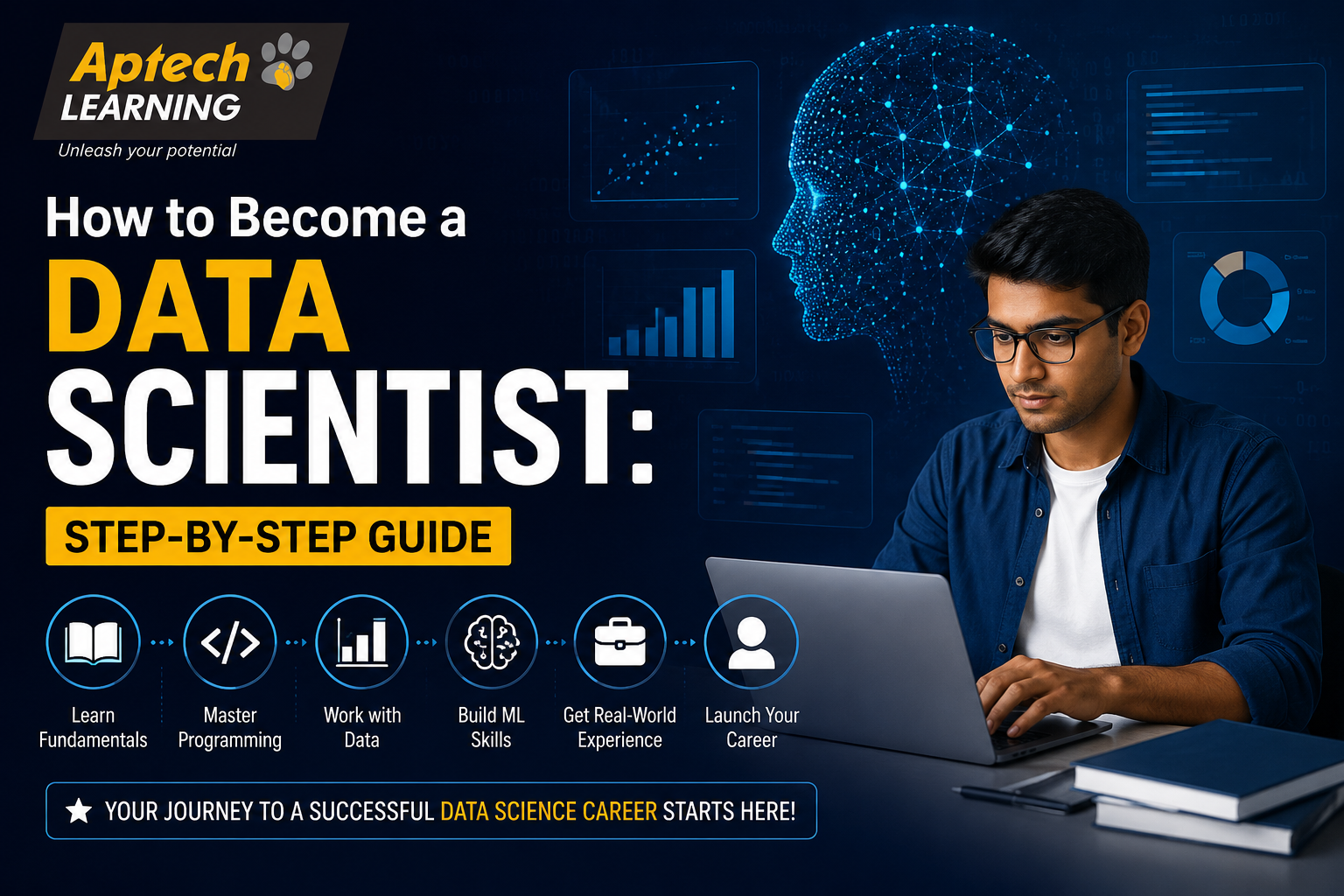
How to Become a Data Scientist: Step-by-Step Guide
Who is a Data Scientist
A data scientist is someone who uses statistics, programming, and business knowledge to extract insights from data and build models that can predict future outcomes. Unlike roles that mainly describe what already happened, data scientists often go a step further, building systems that can forecast what is likely to happen next.
Think of a data scientist like a skilled navigator on a ship. A navigator does not just look at where the ship has been; they study currents, weather patterns, and past routes to predict the best path forward. A data scientist does something similar, studying historical data to build models that help a business predict customer behaviour, demand, or risk.
In India, data scientists work across industries like IT, banking, e-commerce, healthcare, and manufacturing, applying predictive models to solve real business problems rather than just producing descriptive reports.
Why Data Science is a Strong Career Choice
Becoming a data scientist continues to be a strong career choice for a few clear reasons:
Businesses across nearly every industry are investing in predictive capabilities, creating consistent demand for skilled data scientists.
The role combines technical depth with real business impact, since data scientists often work directly on problems that affect company strategy and revenue.
It offers strong long-term growth, with clear paths into senior technical roles, specialised research positions, or leadership in data-driven teams.
The learning path, while demanding, has become more structured and accessible through project-based courses rather than requiring years of academic research alone.
It connects closely with related fields like AI and machine learning, giving data scientists flexibility to specialise further as the field evolves.
Types of Data Scientist Roles
Data scientist roles can vary depending on industry focus and specialisation.
Business-Focused Data Scientist
This role focuses on solving specific business problems, such as predicting customer churn or optimising pricing strategies.
Research-Focused Data Scientist
This role focuses on developing new methods or models, often working closely with more theoretical or academic approaches.
Product Data Scientist
This role focuses on improving a specific product using data, such as refining recommendation systems or personalisation features.
Healthcare Data Scientist
This role focuses on applying data science techniques to medical data, supporting diagnosis, treatment planning, or hospital operations.
Financial Data Scientist
This role focuses on building models related to risk assessment, fraud detection, or investment forecasting within the finance sector.
Role Type | Main Focus | Example Task
Business-Focused | Solving specific business problems | Predicting customer churn
Product Data Scientist | Improving a specific product | Refining a recommendation engine
Financial Data Scientist | Risk and forecasting models | Building a fraud detection model
Healthcare Data Scientist | Medical and hospital data | Predicting patient readmission risk
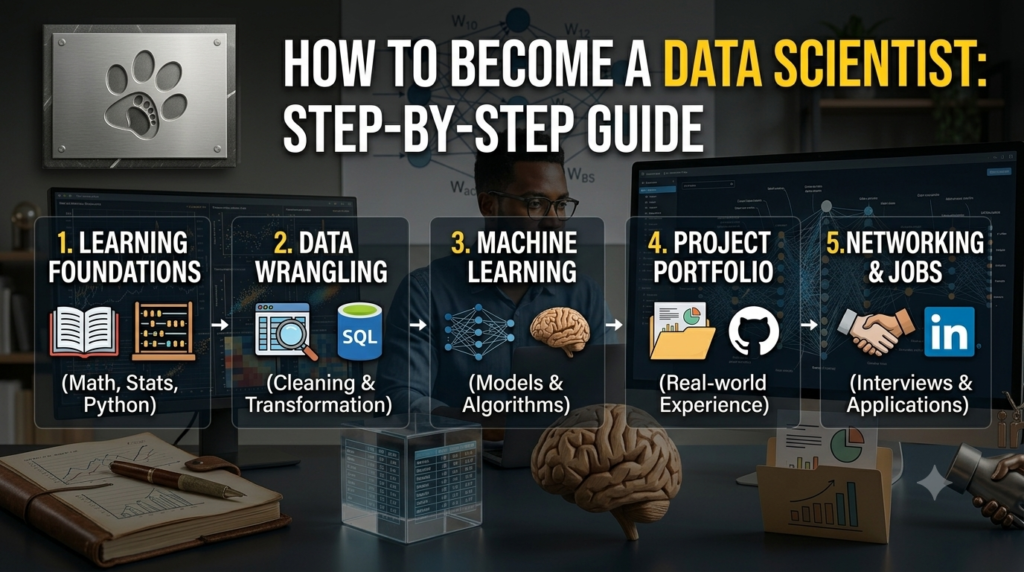
Step-by-Step Guide to Becoming a Data Scientist
- Learn Python or R Programming
Start with Python, since it is the most widely used language in data science, offering strong support for data handling, analysis, and modelling. - Build a Strong Foundation in Statistics
Learn core statistical concepts like probability, hypothesis testing, and distributions, since these form the logical foundation of data science work. - Learn SQL for Data Extraction
Learn how to write SQL queries to extract and organise data stored in databases, a skill needed in almost every data science role. - Learn Data Handling and Visualisation
Learn libraries like Pandas and Matplotlib to clean, organise, and visually explore data before building any models. - Understand Machine Learning Fundamentals
Learn core machine learning concepts and algorithms, understanding how models are trained, tested, and evaluated for accuracy. - Practise Building Predictive Models
Start with beginner-friendly projects like predicting house prices or classifying customer types, applying what you have learned on structured datasets. - Learn Model Evaluation and Improvement
Understand how to test model accuracy, avoid overfitting, and refine models to perform better on new, unseen data. - Build a Strong Portfolio
Put together a portfolio of projects that clearly show your process, from data cleaning to model building to explaining your results. - Gain Practical Experience
Look for internships, freelance projects, or entry-level roles that allow you to apply your skills to real business problems. - Keep Learning Continuously
Data science tools and techniques evolve constantly, so staying updated through ongoing learning and practice remains an important part of long-term growth in this field.
Data Scientist vs Data Analyst vs Machine Learning Engineer
These three roles overlap but focus on different responsibilities.
A data analyst focuses mainly on analysing existing data to answer specific business questions, typically using tools like SQL, Excel, and visualisation software.
A data scientist goes further, building predictive models using machine learning and statistics, often requiring stronger programming and mathematical skills.
A machine learning engineer focuses specifically on building, optimising, and deploying machine learning models into real, production-level applications, often requiring stronger software engineering skills.
In simple words: a data analyst studies existing data, a data scientist builds predictive models from that data, and a machine learning engineer focuses on turning those models into reliable, real-world systems.
Practical Examples
E-commerce Company: A data scientist builds a recommendation model that predicts which products a customer is most likely to buy next, based on past purchase behaviour.
Banking Sector: A data scientist builds a credit risk model that predicts the likelihood of loan default, helping the bank make more informed lending decisions.
Healthcare Organisation: A data scientist builds a model that predicts which patients are at higher risk of readmission, allowing hospitals to plan follow-up care more effectively.
Retail Business: A data scientist builds a demand forecasting model that predicts inventory needs across different store locations, reducing both stockouts and overstocking.
Common Mistakes Beginners Make
Jumping into machine learning without strong statistics. Beginners sometimes try to build models before understanding the underlying statistical concepts, making it harder to interpret results correctly.
Skipping data cleaning and exploration. Moving straight to modelling without properly cleaning and exploring the data often leads to inaccurate or misleading results.
Focusing only on model accuracy. Beginners sometimes focus purely on technical accuracy while ignoring whether the model actually solves a meaningful business problem.
Not validating models properly. Skipping proper testing can lead to models that appear accurate during training but perform poorly on new, real-world data.
Trying to learn every tool at once. Beginners often attempt to learn multiple programming languages and tools simultaneously, which slows down genuine mastery of core skills.
Underestimating communication skills. Being able to clearly explain complex models and findings to non-technical stakeholders is often just as important as technical modelling skill.
Career Opportunities
A career in data science opens up a wide range of roles across technical and business-facing positions. Common roles include:
Data Scientist — builds predictive models and extracts insights from complex datasets.
Machine Learning Engineer — focuses on building and deploying machine learning models into real applications.
Data Analyst — a related, often earlier-career role focused more on analysing existing data.
Research Scientist — works on advancing data science techniques, often in more research-focused environments.
Business Intelligence Developer — builds dashboards and reporting systems that support data-driven decisions.
AI Engineer — applies data science and machine learning techniques to build intelligent systems and applications.
As experience grows, professionals can move into roles like Senior Data Scientist, Lead Data Scientist, or specialised research and leadership positions.
Salary Information
Salary for data scientists depends on factors such as your city, the industry and size of the company, your specific role, your skill level, and your years of experience. Entry-level roles naturally pay less than senior, specialised positions, and metro cities generally offer higher packages compared to smaller towns. Rather than fixed numbers, it is more useful to understand that salaries tend to grow steadily as you gain practical project experience and strengthen skills in statistics, programming, and machine learning.
Skills Required
Technical Skills
Strong programming skills in Python or R for data manipulation and modelling
Solid understanding of statistics and probability
Knowledge of machine learning algorithms and when to apply them
SQL for extracting and managing data from databases
Data visualisation skills using tools like Power BI, Tableau, or Python libraries
Non-Technical Skills
Strong analytical and logical thinking
Curiosity and a habit of questioning data rather than accepting it at face value
Clear communication to explain technical findings to non-technical stakeholders
Patience, since building and refining models takes time and experimentation
Business understanding to connect technical work with real organisational goals
Tools Used by Data Scientists
Tool | Primary Use
Python | Main programming language for data science tasks
R | Statistical computing and analysis
SQL | Extracting and managing data from databases
Pandas and NumPy | Data manipulation and numerical computation
Scikit-learn | Building traditional machine learning models
Power BI or Tableau | Visualising data and presenting insights
Eligibility
There is no single fixed background required to become a data scientist. Students from computer science, mathematics, statistics, engineering, or even non-technical fields with strong logical thinking can begin learning this skill set. Generally, learners should have completed higher secondary education (12th grade) or be graduates, along with a basic comfort in mathematics and computer usage. Prior programming experience is helpful but not always compulsory, since many beginner-focused courses teach programming from the basics.
Course Duration
Data science courses can range from a few months for focused, project-based programs to longer durations for in-depth training covering statistics, machine learning, and model deployment. The right duration depends on your existing skill level, whether you already know programming and statistics, and how deep you want to go into advanced topics. It is best to confirm the exact course structure and duration directly with the training provider.
Who Should Learn Data Science
College students who want to build a strong foundation for a high-demand technical career
Working professionals looking to transition into data-focused or AI-related roles
Software developers who want to expand into data-driven application development
Business or finance professionals who want to make more data-informed decisions
Career changers who are willing to build strong technical and statistical foundations through structured learning
Frequently Asked Questions
How do I become a data scientist with no experience?
Start by learning Python and statistics, then build up to SQL and machine learning, practising with real datasets to build a portfolio that demonstrates practical skills.
Do I need a degree in data science to become a data scientist?
No, a specific data science degree is not compulsory. Many professionals enter this field through structured courses and strong, self-built project portfolios instead.
What is the first skill I should learn to become a data scientist?
Python programming is usually the first skill to learn, since it is widely used across almost all data science work, from data handling to model building.
Is mathematics necessary to become a data scientist?
Yes, a solid understanding of statistics and probability is important, and some advanced roles also benefit from linear algebra and calculus knowledge.
How long does it take to become a data scientist?
This depends on your starting point and how deep you want to go into machine learning and advanced modelling. Consistent, project-based practice generally leads to faster progress.
What is the difference between a data scientist and a data analyst?
A data analyst mainly studies existing data to answer specific questions, while a data scientist goes further by building predictive models using machine learning techniques.
Conclusion
Becoming a data scientist is a genuinely achievable goal today, especially with structured, project-based learning paths that build skills progressively rather than requiring years of academic research alone. Whether you come from a technical or non-technical background, a step-by-step approach makes this career path far more manageable.
The key is to start with Python and statistics, build a solid understanding of machine learning fundamentals, and practise consistently through real, hands-on projects. Steady, structured learning is what ultimately turns a beginner into a confident, job-ready data scientist.
Soft Call to Action
If you are based in Lucknow and want structured, hands-on training instead of learning everything alone, Aptech Learning Lucknow offers data science courses designed for beginners and working professionals alike. You can visit the institute, speak with their counsellors, or attend a demo class to understand how the course is structured and whether it fits your career goals.