

Data Analytics Course in Lucknow: Online vs Offline Classes, Fees & Career Scope
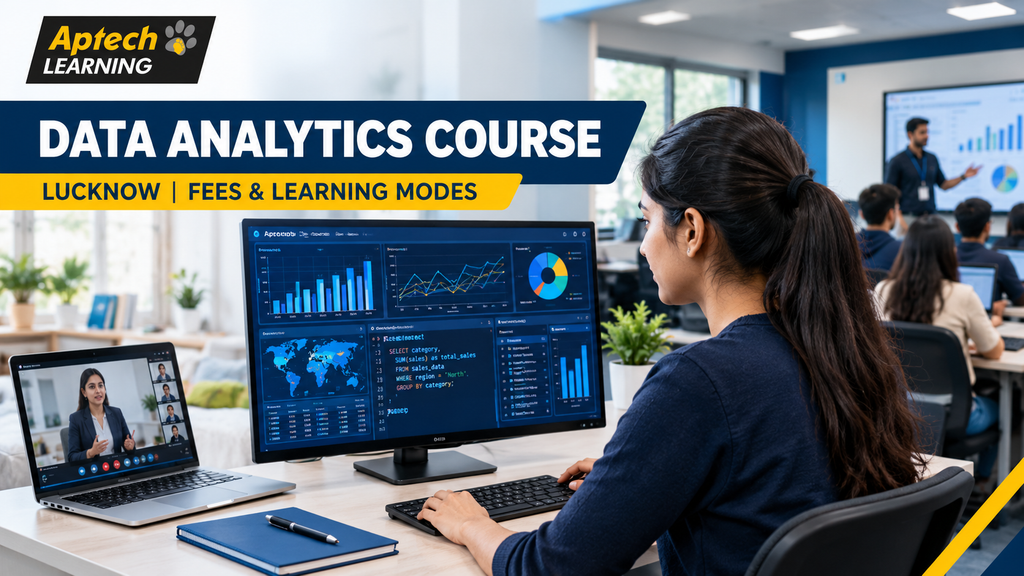
Choosing a data analytics course in Lucknow can be confusing, especially when every institute promises practical training, affordable fees and career opportunities. Some learners prefer online classes because they can study from home, while others learn better in a classroom with direct guidance from a trainer.
The right choice depends on your learning style, budget, current education and career goals. Before enrolling, it is worth comparing the teaching methods, practical exposure, course fees and job opportunities associated with each option.
This guide explains how to choose between online and offline data analytics classes in Lucknow, what you should expect to pay, and how the skills you learn can help you prepare for entry-level analytics roles.
What Is a Data Analytics Course?
A data analytics course teaches you how to collect, organise, examine and present data so that businesses can make informed decisions. Instead of relying on guesswork, organisations use data to understand customer behaviour, monitor performance, identify problems and plan future activities.
For example, a retail business may analyse monthly sales to find its best-selling products. A marketing team may compare campaign results to understand which advertisements attract more customers. A finance department may use reports to track expenses and identify unusual transactions.
A practical course should help you understand these business situations and use suitable tools to solve them.
Online vs Offline Data Analytics Classes in Lucknow
Both learning formats can help you develop analytics skills. However, the experience differs depending on how classes are conducted and how much support you receive.
| Comparison factor | Online classes | Offline classes |
|---|---|---|
| Learning location | Home or any convenient location | Physical training centre |
| Schedule | Often flexible, depending on the course | Usually follows a fixed timetable |
| Trainer interaction | Live sessions, chat or video calls | Face-to-face explanations |
| Doubt solving | Depends on trainer availability | Direct interaction during class |
| Practical learning | Software exercises and online projects | Guided computer lab practice, where available |
| Travel expenses | Usually lower | Travel costs and time may apply |
| Peer interaction | Online groups and discussions | In-person teamwork and discussions |
| Best suited for | Self-disciplined learners and busy professionals | Beginners who prefer structured guidance |
When Should You Choose an Online Data Analytics Course?
Online classes can be a sensible option if you are attending college, preparing for competitive examinations or working alongside your studies. You can avoid daily travel and use the saved time for assignments, revision and projects.
However, check whether the course offers live trainer interaction or only recorded videos. A collection of recorded lessons may explain concepts, but beginners can struggle when they encounter errors in SQL queries, Excel formulas or Python code.
Before paying, ask about doubt-clearing sessions, assignment reviews, project feedback and access to recorded lessons.
When Are Offline Data Analytics Classes Better?
Classroom learning may be more suitable if you are new to technical subjects or need a regular routine to stay consistent. You can ask questions directly, observe demonstrations and discuss difficult concepts with your trainer and classmates.
For students in Mahanagar, Aliganj, Indira Nagar and nearby parts of Lucknow, the practical benefit of an offline institute also depends on its location and batch timings.
Before joining, check whether students get individual computer practice, whether trainers review their assignments, and whether the classroom activities involve actual datasets rather than demonstrations alone.
The important point: Online and offline classes can both work well. The quality of teaching, practical assignments and feedback matters more than the format by itself.
Data Analytics Course Fees in Lucknow
The fee for a data analytics course depends on its duration, syllabus, teaching format, trainer support and project requirements. A short introductory course will generally offer a different level of training from a comprehensive programme designed for career preparation.
Rather than choosing an institute solely because it advertises a low fee, compare what is included in the total cost.
| Course type | What to check before enrolling |
|---|---|
| Short online course | Course access, learning materials and practical exercises |
| Live online training | Trainer interaction, doubt sessions and assignment feedback |
| Classroom training | Computer lab access, batch size and practical hours |
| Career-focused programme | Project reviews, portfolio development and interview preparation |
There is no single fee that applies to every institute in Lucknow. Request the current fee structure directly from your shortlisted training centres.
Ask whether the quoted amount includes software practice, study materials, project assessments, certification and taxes. If instalments or EMI are available, confirm the total payable amount and any additional charges.
Also compare the number of practical learning hours. A course that includes guided projects and regular feedback may provide better value than one that covers the same tools mainly through recorded demonstrations.
What Should You Learn in a Data Analytics Course?
Before choosing an institute, review its syllabus carefully. A useful programme should explain not only how individual tools work but also how to use them together to answer business questions.
1. Advanced Excel
Excel is commonly used to organise data, perform calculations and prepare reports. You should learn sorting, filtering, lookup functions, PivotTables, data cleaning and basic visualisation.
2. SQL and Database Queries
SQL helps analysts retrieve information from databases. Important topics include SELECT statements, filtering, grouping, joins, aggregate functions and subqueries.
These skills are useful when working with large datasets that cannot be managed conveniently in a spreadsheet.
3. Power BI or Tableau
Visualisation tools help convert numerical information into understandable dashboards and reports. Learn how to select appropriate charts, organise data, create meaningful metrics and communicate findings clearly.
4. Python for Data Analysis
Python can help automate repetitive tasks and analyse datasets. Depending on the course level, the syllabus may cover basic programming, Pandas, NumPy and data visualisation libraries.
Beginners should first understand variables, conditions, loops and basic data structures before moving into more advanced analysis.
5. Statistics and Business Interpretation
Analysing data involves more than creating charts. You should understand averages, percentages, distributions, comparisons and trends.
You should also learn to distinguish a meaningful pattern from a coincidence and explain the limitations of your findings.
6. Practical Projects
Ask whether the course includes projects using realistic business scenarios. For example, you could analyse retail sales, compare marketing campaigns, prepare an employee attendance report or build a customer dashboard.
A completed project should demonstrate the question you investigated, the tools you used, the steps you followed and the conclusions you reached.
Career Scope After a Data Analytics Course in Lucknow
Data analytics skills are relevant across many industries because organisations need to understand their operations and make decisions using information.
Depending on your skills, qualifications and experience, you can explore the following entry-level career paths.
| Job role | Typical responsibilities |
|---|---|
| Junior Data Analyst | Clean datasets, analyse trends and prepare reports |
| MIS Executive | Maintain spreadsheets and generate regular business reports |
| Reporting Analyst | Prepare performance reports and monitor key metrics |
| Business Analyst Trainee | Help document business requirements and interpret information |
| Power BI Developer Trainee | Assist with dashboards, data models and visual reports |
| Operations Analyst | Examine operational performance and identify process improvements |
Opportunities may exist in IT services, banking, retail, healthcare, education, logistics, marketing and other business sectors. Your actual options will depend on the vacancies available and the skills employers require.
Students in Lucknow can search for local openings as well as opportunities in other cities and remote-friendly organisations. Learning analytics does not guarantee a job, but a relevant skill set, strong projects and interview preparation can improve your applications.
What Salary Can You Expect?
There is no fixed salary after completing a data analytics course. Compensation depends on the employer, job responsibilities, educational background, technical ability and interview performance.
Instead of relying on a single advertised salary figure, compare recent entry-level job listings and note their requirements. Look at the expected proficiency in Excel, SQL, Power BI, Python and communication skills.
A certificate can support your application, but employers may also ask you to solve practical problems or explain a project you have completed.
How to Choose the Right Data Analytics Institute in Lucknow
Use these checks before making your final decision:
- Review the syllabus: Ensure it covers relevant analytics tools and foundational concepts.
- Ask for a practical demonstration: See how trainers explain a concept and guide students through an exercise.
- Check project quality: Find out whether you will complete projects independently and receive feedback.
- Understand the fee: Request a written breakdown of tuition, certification and other charges.
- Confirm batch timings: Choose a schedule that you can maintain alongside college or work.
- Ask about career support: Check whether resume guidance, mock interviews or job-search assistance are included.
- Verify course claims: Request clear information about certification, placement support and eligibility rather than relying on promotional promises.
If you are considering Aptech Learning in Mahanagar, Lucknow, contact the centre to confirm the current data analytics syllabus, fees, available learning modes and batch schedule before enrolling.
A Simple Learning Plan for Beginners
You do not need to master every analytics tool at the same time. A step-by-step approach makes the subject easier to understand.
Stage 1: Build your foundation. Learn Excel, basic statistics, data types and spreadsheet organisation.
Stage 2: Work with databases. Practise SQL queries and learn how to retrieve, filter and combine information.
Stage 3: Create reports. Use Power BI or Tableau to build dashboards and explain important trends.
Stage 4: Add Python. Learn how to clean and analyse datasets programmatically.
Stage 5: Build a portfolio. Complete two or three projects that demonstrate your ability to solve practical problems.
Stage 6: Prepare for interviews. Practise SQL questions, spreadsheet exercises, dashboard explanations and common interview questions.
Your progress will depend on your starting level and the amount of time you dedicate to practice. Focus on understanding each step rather than completing the syllabus as quickly as possible.
Frequently Asked Questions
1. Which is better for a data analytics course in Lucknow: online or offline?
Online classes offer convenience and save travel time, while offline classes provide direct interaction with trainers. Choose the format that matches your schedule, learning style and need for practical guidance.
2. What is the fee for a data analytics course in Lucknow?
Fees vary by institute, course duration, syllabus and learning format. Ask for the latest written fee structure and confirm whether projects, certification, study materials and taxes are included.
3. Can beginners join a data analytics course without coding experience?
Yes, many beginner-level courses start with Excel, basic statistics and introductory concepts. You can gradually learn SQL and Python as your confidence improves. Check the eligibility requirements of the specific programme.
4. Which tools should I learn to become a data analyst?
Start with Excel and SQL, then learn a visualisation tool such as Power BI or Tableau. Python and statistics can strengthen your analytical abilities and help you work with more complex datasets.
5. What jobs can I apply for after completing a data analytics course?
Depending on your qualifications and practical skills, you can explore junior data analyst, MIS executive, reporting analyst, operations analyst and business analyst trainee roles.
6. Is a data analytics certificate enough to get a job?
A certificate alone does not guarantee employment. Employers may also evaluate your tool proficiency, problem-solving ability, communication skills, project work and interview performance.
Conclusion
Choosing a data analytics course in Lucknow is not simply a decision between online and offline classes. It is about finding a learning programme that helps you understand data, practise relevant tools and apply your knowledge to realistic business problems.
Online learning can suit students who need flexibility, while classroom training can benefit beginners who prefer regular guidance and direct interaction. Compare the total fees, practical learning opportunities, project support and career preparation before making a decision.
If you want to develop analytics skills for your first job or a future career change, begin by comparing the available courses and identifying the skills you need to learn. For students exploring classroom training, Aptech Learning Mahanagar, Lucknow, is one option to contact for current course information and batch availability.
The best starting point is a programme that matches your goals, fits your budget and gives you enough practical experience to demonstrate what you can do with data.