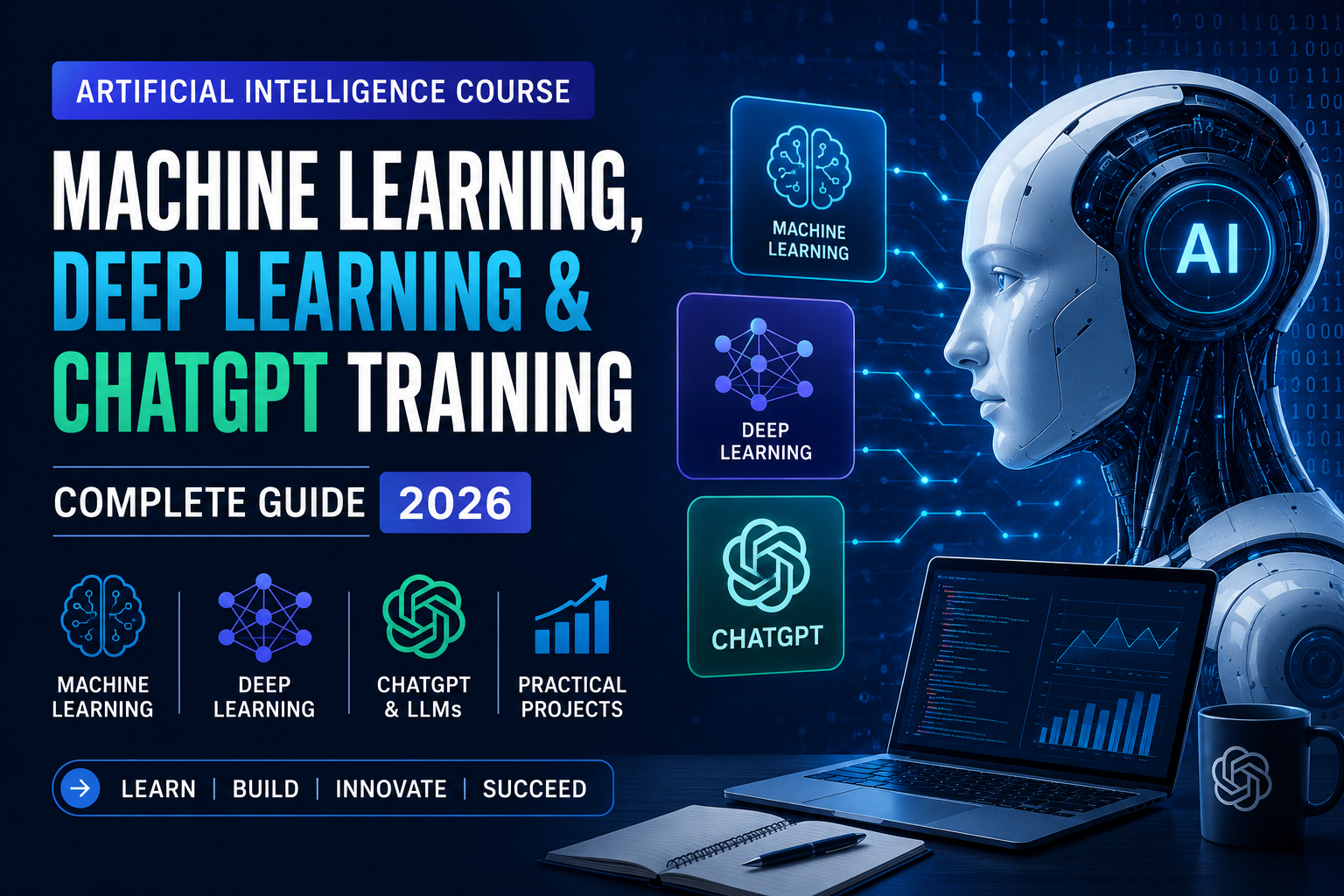
Artificial Intelligence Course: Machine Learning, Deep Learning & ChatGPT Training — Complete Guide 2026
There is a moment every professional, student, or curious learner reaches at some point — you hear about Machine Learning, Deep Learning, or ChatGPT, you know these things are important, and then you realize you have no clear picture of what any of it actually means or where to start.
This article is written for exactly that moment.
By the time you finish reading, you will understand what an AI machine learning course actually covers, why Deep Learning and ChatGPT training belong in the same program, what you will be able to do after completing it, and why this is one of the smartest career decisions you can make in 2026.
First — What Are We Actually Talking About?
A lot of people search “AI machine learning course” or “deep learning course” and get confused by overlapping terms. Let us clear that up right here.
| Term | Simple Meaning | Real-World Example |
|---|---|---|
| Artificial Intelligence (AI) | Machines that can do tasks that require human intelligence | A chatbot answering customer queries |
| Machine Learning (ML) | A type of AI where computers learn from data without being explicitly programmed | Netflix recommending shows based on your watch history |
| Deep Learning (DL) | A type of ML that uses neural networks with many layers | Face recognition on your smartphone |
| Neural Networks | A system inspired by the human brain — layers of connected nodes that process information | The engine behind ChatGPT and image recognition |
| ChatGPT | A large language model (LLM) built using Deep Learning that generates human-like text | Writing emails, answering questions, coding assistance |
| Generative AI | AI that can create new content — text, images, audio, video, code | ChatGPT, Midjourney, GitHub Copilot |
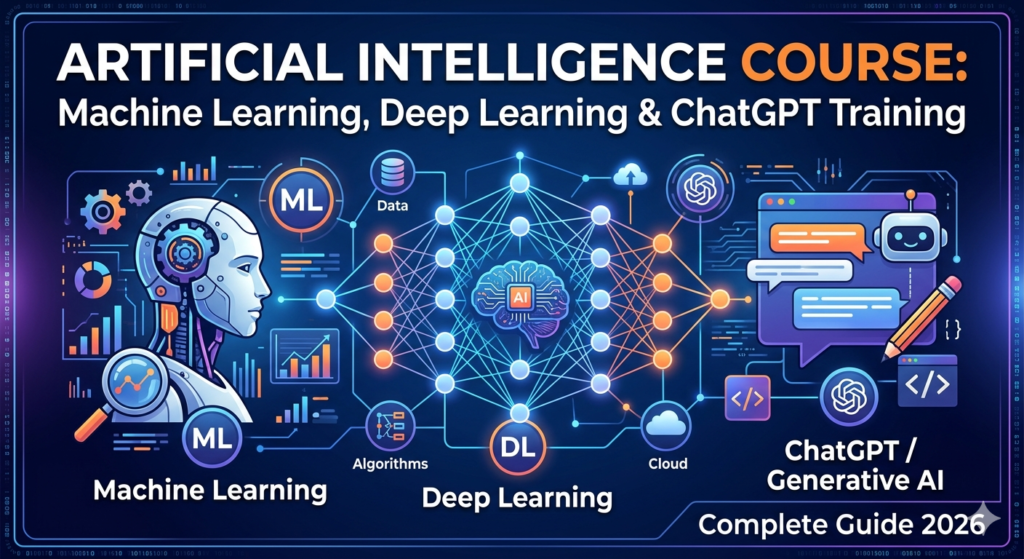
These are not separate fields you study in isolation. They are layers of the same subject. A solid AI machine learning course covers all of them in the right order, building from fundamentals up to practical applications.
Why This Combination of ML + Deep Learning + ChatGPT Matters in 2026
A few years ago, knowing basic machine learning was enough to stand out. That bar has moved.
Today, employers want professionals who understand the full AI stack — from classical ML algorithms to the transformer-based models that power tools like ChatGPT and Google Gemini. Here is what the current market actually looks like:
| Skill | Why It Is In Demand Right Now |
|---|---|
| Machine Learning | Core of every data-driven product — fraud detection, recommendation engines, analytics |
| Deep Learning | Powers computer vision, NLP, autonomous systems, and large language models |
| ChatGPT & Prompt Engineering | 78% of enterprises are integrating LLMs into their workflows in 2026 |
| Python for AI | The dominant language for AI development — used in over 90% of ML projects |
| TensorFlow / PyTorch | Industry-standard frameworks for building and deploying AI models |
| Generative AI | Creating content, automating tasks, and building AI-powered products |
Knowing just one of these is like knowing how to drive but not how to read a map. The combination is where the real career advantage lies.
What a Comprehensive AI Machine Learning Course Covers — Full Syllabus
A well-structured program takes you from zero to job-ready. Here is a module-by-module breakdown of what you should expect:
Module 1 — Introduction to Artificial Intelligence
| Topic | What You Learn |
|---|---|
| What is AI and how it evolved | From rule-based systems to modern AI |
| AI vs ML vs Deep Learning | How they relate and differ |
| Types of AI problems | Classification, regression, clustering, generation |
| Real-world AI applications | Industry use cases across sectors |
| AI tools landscape 2026 | ChatGPT, Gemini, Claude, Copilot overview |
Module 2 — Python Programming for AI
| Topic | What You Learn |
|---|---|
| Python fundamentals | Variables, loops, functions, data types |
| NumPy for numerical computing | Array operations, matrix math |
| Pandas for data handling | DataFrames, data cleaning, transformation |
| Matplotlib & Seaborn | Data visualization and charting |
| Jupyter Notebooks | The standard environment for AI development |
Python is the backbone of every AI project. You do not need to be a programmer before you start — this module is specifically designed for those learning Python for the first time with a focus on AI tasks.
Module 3 — Machine Learning Fundamentals
| Topic | What You Learn |
|---|---|
| Supervised learning | Models that learn from labeled data |
| Unsupervised learning | Finding patterns without labels |
| Regression algorithms | Linear regression, polynomial regression |
| Classification algorithms | Decision trees, KNN, SVM, logistic regression |
| Clustering | K-Means, hierarchical clustering |
| Model evaluation | Accuracy, precision, recall, F1 score |
| Train/test split, cross-validation | Avoiding overfitting and underfitting |
| Scikit-learn (hands-on) | Python’s go-to ML library |
Module 4 — Deep Learning & Neural Networks
| Topic | What You Learn |
|---|---|
| How neural networks work | Neurons, layers, weights, activations |
| Forward propagation | How data flows through a network |
| Backpropagation | How a network learns from its errors |
| Activation functions | ReLU, Sigmoid, Softmax — when to use each |
| Convolutional Neural Networks (CNNs) | Image recognition and computer vision |
| Recurrent Neural Networks (RNNs) | Sequential data — text, time series, audio |
| LSTMs and GRUs | Advanced RNN architectures for long sequences |
| TensorFlow & Keras | Build and train deep learning models |
| PyTorch basics | Alternative to TensorFlow — widely used in research |
Module 5 — Natural Language Processing (NLP)
| Topic | What You Learn |
|---|---|
| What is NLP | Teaching machines to understand human language |
| Text preprocessing | Tokenization, stopword removal, stemming |
| Bag of Words, TF-IDF | Classical text representation |
| Word embeddings | Word2Vec, GloVe — semantic meaning in vectors |
| Sentiment analysis | Positive, negative, neutral classification |
| Text classification | Spam detection, topic labeling |
| Named entity recognition (NER) | Extracting key information from text |
Module 6 — Transformers & Large Language Models (LLMs)
| Topic | What You Learn |
|---|---|
| What are transformers | The architecture that changed AI forever |
| Attention mechanism | Why transformers outperform RNNs |
| BERT, GPT, and their variants | The models behind modern AI tools |
| How ChatGPT actually works | From training to response generation |
| Fine-tuning vs prompting | Two ways to adapt LLMs for your needs |
| Hugging Face library | Access to hundreds of pre-trained models |
| Building with LLM APIs | OpenAI API, Google Gemini API, Anthropic |
Module 7 — ChatGPT & Generative AI Training
| Topic | What You Learn |
|---|---|
| What is Generative AI | LLMs, image generation, code generation |
| ChatGPT prompt engineering | Writing prompts that get precise results |
| Advanced prompting techniques | Chain-of-thought, few-shot, zero-shot |
| AI for content creation | Blog posts, reports, emails, presentations |
| AI for coding | GitHub Copilot, ChatGPT for code review |
| AI for data analysis | Asking AI to analyse datasets |
| Image generation with AI | Midjourney, DALL-E, Stable Diffusion |
| Building AI-powered applications | Integrating APIs into real projects |
Module 8 — AI Projects & Portfolio Building
| Topic | What You Learn |
|---|---|
| End-to-end ML project | From raw data to deployed model |
| Deep learning image classifier | Build a CNN that recognizes objects |
| NLP sentiment analyser | Analyse product reviews automatically |
| ChatGPT-powered chatbot | Build a working chatbot using OpenAI API |
| Capstone project | Your own AI project selected with mentor guidance |
Tools & Technologies You Will Master
| Category | Tools |
|---|---|
| Programming | Python, Jupyter Notebook |
| Machine Learning | Scikit-learn, XGBoost |
| Deep Learning | TensorFlow, Keras, PyTorch |
| Data Handling | Pandas, NumPy |
| Visualization | Matplotlib, Seaborn, Plotly |
| NLP & LLMs | NLTK, spaCy, Hugging Face Transformers |
| Generative AI | ChatGPT (OpenAI API), Google Gemini API |
| Deployment | Flask, Streamlit (for model hosting) |
| Cloud | Google Colab (free GPU for training) |
Who Should Enroll in This Course?
| Profile | Reason to Join |
|---|---|
| Engineering / CS graduates | Bridge the gap between academics and industry-ready AI skills |
| Working professionals (any domain) | Add AI to your existing expertise for faster career growth |
| Data analysts | Move from dashboards to predictive models and AI automation |
| Software developers | Add ML and deep learning to your tech stack |
| Final year students | Make your resume stand out before you even graduate |
| Entrepreneurs | Build AI-powered products without hiring a full team |
| Career switchers | Transition into one of the fastest-growing fields globally |
No prior experience in AI, ML, or Deep Learning is required to start. The course builds from the ground up.
Career Paths After Completing This Course
| Job Role | Average Salary Range (India, 2026) |
|---|---|
| Machine Learning Engineer | ₹8L – ₹25L per annum |
| Deep Learning Engineer | ₹10L – ₹30L per annum |
| AI Research Scientist | ₹15L – ₹50L per annum |
| Data Scientist | ₹7L – ₹22L per annum |
| NLP Engineer | ₹9L – ₹28L per annum |
| Prompt Engineer | ₹6L – ₹18L per annum |
| AI Product Manager | ₹12L – ₹35L per annum |
| Generative AI Developer | ₹10L – ₹30L per annum |
These are not aspirational numbers. These are current market rates for professionals with verifiable AI skills. Experienced ML engineers with 5 to 8 years in the field are regularly seeing packages between ₹25L and ₹45L, and those who specialize in MLOps or AI Strategy have a 2x to 3x growth advantage over their peers.
Course Details at Aptech Learning Lucknow
| Feature | Details |
|---|---|
| Course Name | AI Course: Machine Learning, Deep Learning & ChatGPT Training |
| Duration | 4 to 6 months |
| Batch Options | Weekday / Weekend / Evening batches |
| Mode | Classroom (Lucknow) + Online |
| Level | Beginner to Advanced |
| Prerequisite | None — basic computer literacy sufficient |
| Certification | Aptech Certified AI & ML Professional |
| Placement Support | Yes — resume prep, interview training, job referrals |
| Projects | Minimum 3 hands-on projects + 1 capstone |
| Instructor | Industry-experienced AI practitioners |
| Location | Aptech Learning Lucknow |
| Website | aptechlearninglko.com |
How This Course Is Different From Online Platforms
A common question is: “Why not just do a free Coursera or YouTube course?”
Fair question. Here is the honest answer:
| Factor | YouTube / Coursera | Aptech Learning Lucknow |
|---|---|---|
| Structure | Scattered, no clear path | Designed curriculum with clear milestones |
| Accountability | None — you stop, nothing happens | Instructor + batch pressure keeps you on track |
| Doubt resolution | Comment section at best | Live Q&A, direct mentor access |
| Projects | Sample datasets only | Real-world problem-based projects |
| Certificate weight | Completion badge | Aptech certification — recognized by employers |
| Placement | None | Active support with job referrals |
| Hands-on labs | Pre-recorded exercises | Live lab sessions with tools |
| Duration discipline | Takes years to complete | Fixed timeline keeps you focused |
Self-learning works for a small percentage of people with extreme discipline. A structured course with an instructor and a classroom — even a virtual one — produces better outcomes faster for the vast majority of learners.
What Makes a Good AI Machine Learning Course in 2026?
Before you enroll anywhere, here is a checklist to evaluate any program:
| Checklist Item | Why It Matters |
|---|---|
| Covers Python end-to-end | Python is non-negotiable for AI work |
| Includes both ML and Deep Learning | ML alone is no longer enough |
| Teaches with TensorFlow and PyTorch | These are the two dominant frameworks |
| Has a ChatGPT / LLM module | Generative AI is now part of every AI job description |
| Gives real project experience | Theory without practice does not get you hired |
| Provides a recognized certificate | Proof of skills for employers |
| Offers placement or career support | The point of training is a better career outcome |
| Has flexible batch timings | Especially important for working professionals |
Aptech Learning Lucknow checks every item on this list. That is not a marketing claim — it is the structure of the program.
Frequently Asked Questions (FAQs)
Q1. What is the difference between an AI course, a machine learning course, and a deep learning course?
These are related but distinct. An AI course covers the broad field of making machines intelligent. A machine learning course focuses specifically on algorithms that allow computers to learn from data. A deep learning course goes deeper into neural networks — the subset of ML that powers modern AI like image recognition and ChatGPT. The best approach is a single program that covers all three in sequence, which is what this course does.
Q2. Do I need to know Python before joining this AI machine learning course?
No. Python is taught from scratch in the course, specifically with an AI and data science focus. You do not need any prior programming experience. If you already know basic Python, you will simply move through those modules faster and have more time for the AI-specific content.
Q3. How is deep learning different from machine learning?
Machine learning uses algorithms that find patterns in structured data. Deep learning uses neural networks — computational systems loosely inspired by the human brain — that can find patterns in unstructured data like images, audio, and raw text. Deep learning requires more data and computing power, but it achieves results that classical ML cannot. ChatGPT, for example, is built on a deep learning architecture called a transformer.
Q4. What will I be able to do after completing the ChatGPT training module?
After the ChatGPT and Generative AI module, you will be able to write advanced prompts that produce precise, useful outputs for professional tasks. You will also know how to integrate the OpenAI API into applications, automate repetitive content and data tasks using AI, use tools like GitHub Copilot for coding, and understand how large language models work under the hood. These skills are immediately applicable in virtually any professional role.
Q5. Is there a certificate after completing this course, and will employers recognize it?
Yes, you receive an Aptech Certified AI & ML Professional certificate on successful completion. Aptech has been a recognized name in IT training in India for over 30 years. The certificate, combined with the project portfolio you build during the course, is what gives employers confidence in your skills. The portfolio often matters more than the certificate itself — which is why hands-on projects are built into every module.
Q6. How long does it take to complete this course, and can I manage it alongside a job?
The program is designed to be completed in 4 to 6 months. Weekend and evening batches are specifically structured for working professionals who cannot attend weekday daytime sessions. The curriculum is chunked into manageable weekly goals so that you are consistently making progress without burning out.
Final Thought — Why Now Is the Right Time
The gap between where AI is today and where most professionals are in their understanding of it is still wide enough for early movers to build a real advantage.
In two years, AI literacy will be a standard expectation — like knowing how to use Excel was in the 2000s. The professionals who learn it now will be the ones who have already built things, already solved problems with it, and already have the proof on their resume.
An AI machine learning course that covers Deep Learning, Neural Networks, and ChatGPT training is not a luxury investment in 2026. It is a practical, career-defining one.
Aptech Learning Lucknow gives you the structure, mentorship, and project experience to make that investment count.
Start your AI journey today. Visit 👉 aptechlearninglko.com — enroll in the AI Machine Learning, Deep Learning & ChatGPT Training program and build skills that the market is actively looking for right now.