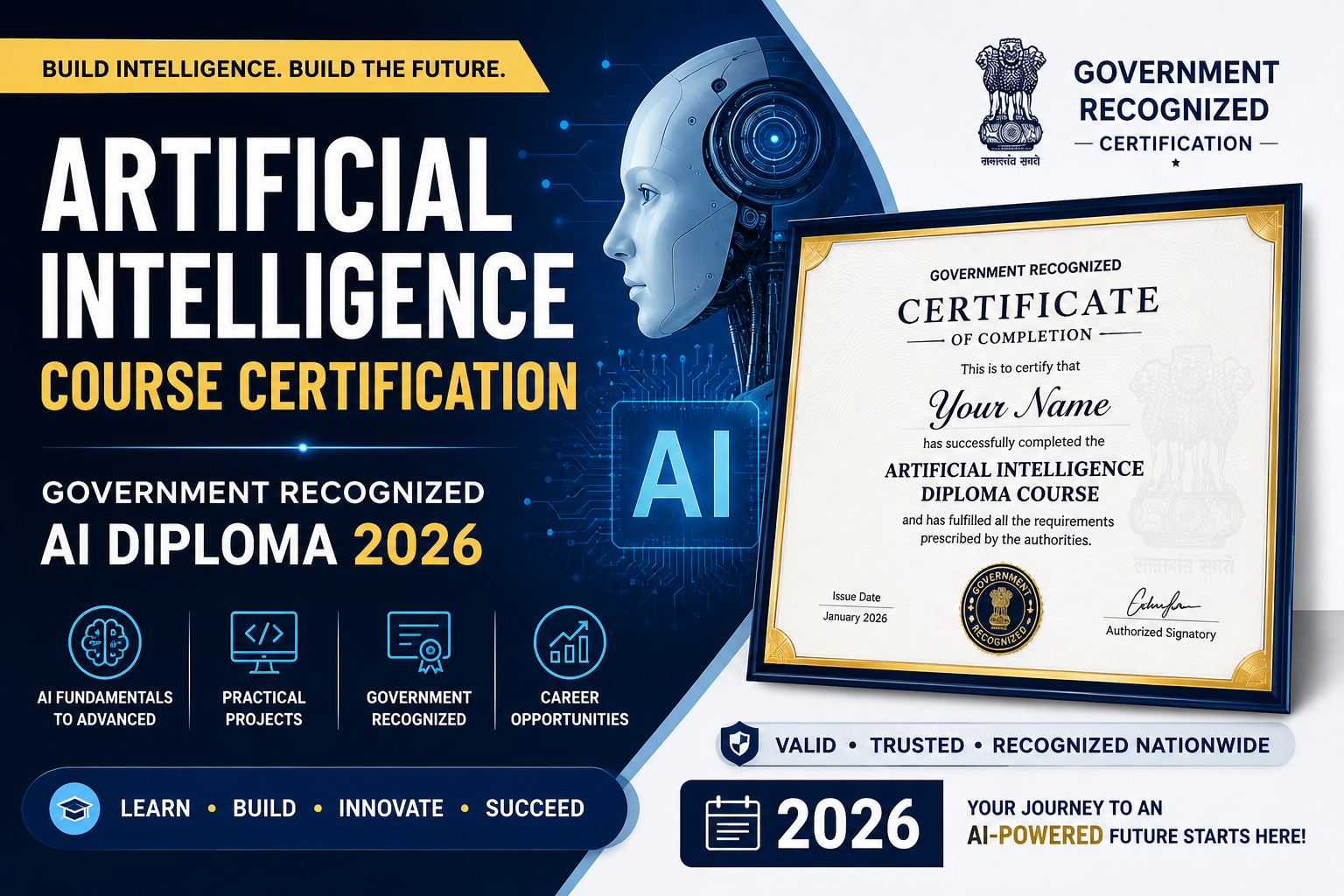
Artificial Intelligence Course Certification | Government Recognized AI Diploma 2026
There is one question almost every person asks before enrolling in any AI course: “Will this certificate actually mean something?”
It is the right question to ask. Because in 2026, the market is flooded with AI courses — YouTube playlists, weekend bootcamps, random online programs — all handing out certificates that employers quietly ignore. The difference between a certificate that opens doors and one that collects digital dust comes down to three things: who gave it, what it proves, and how it was earned.
This guide answers all three — and tells you exactly what to look for in a government recognized AI diploma or AI certification course that actually holds weight in the Indian job market.
Why an AI Certification Matters More Than Ever in 2026
A few years ago, saying “I know AI” was enough to get a second look from recruiters. That era is over. Employers now want proof. Not confidence — proof.
Here is what the hiring landscape currently looks like:
| What Employers Ask | What They Are Really Looking For |
|---|---|
| “Do you have an AI certification?” | Structured training, not self-taught random knowledge |
| “What projects have you built?” | Practical skills, not just theoretical understanding |
| “Is the certificate recognized?” | A credential from a trusted, verifiable institution |
| “What tools do you know?” | Python, TensorFlow, ChatGPT — not just buzzwords |
| “When were you trained?” | Relevant and current — not a 2019 course in 2026 |
An AI certification course that is government recognized or from a nationally trusted institution answers all of these questions before the interview even begins. It signals to the recruiter that your skills have been verified by a body they already trust — not just claimed on a resume.
What Does “Government Recognized AI Diploma” Actually Mean?
This term causes a lot of confusion. Let us break it down simply.
| Recognition Type | What It Means | Example |
|---|---|---|
| Government of India Certified | Certificate issued directly by a central ministry or initiative | YUVA AI for ALL by MeitY / IndiaAI Mission |
| NSDC / Skill India Aligned | Training aligned with National Skills Qualification Framework (NSQF) — recognized by employers nationwide | NSDC-affiliated AI training programs |
| AICTE / UGC Approved | Certificate or diploma from an institution approved by technical education regulators | PG Diploma programs by IITs and approved colleges |
| ISO Certified Institution | Training body with quality certification — employer-verified credibility | ISO 9001:2015 certified training centers |
| Brand-Recognized Institutions | Certifications from long-standing, nationally known training brands | Aptech, NIIT, TCS iON, Wipro TalentNext |
Aptech Learning has been operating in India for over 30 years. It is one of the most recognized names in IT and computer education in the country. An Aptech AI certification carries a level of credibility that newer or unknown platforms simply cannot match — especially with recruiters who have been in the industry long enough to recognize the name.
Types of AI Certification Courses Available in India
Before choosing a program, it helps to understand the different types of AI certifications in the market:
| Type | Duration | Depth | Best For |
|---|---|---|---|
| Short-Term AI Certificate | 1–3 months | Foundational | Freshers, quick upskilling, office use |
| AI Diploma Course | 3–6 months | Intermediate | Students, career switchers |
| Advanced AI Diploma | 6–12 months | Comprehensive | Professionals targeting high-paying roles |
| PG Diploma in AI | 6–12 months | Advanced | Graduates wanting academic credentials |
| AI Professional Certification | Ongoing (exam-based) | Specialized | IT professionals, engineers |
For most learners — whether fresh graduates, working professionals, or career switchers — a 4 to 6 month AI diploma course with hands-on projects and a recognized certificate offers the best combination of depth, speed, and market value.
Full Curriculum — What a Government Recognized AI Certificate Program Covers
A credible AI certification course is not just about handing you a PDF at the end. It is a structured learning journey. Here is what a comprehensive program looks like:
Phase 1 — Foundations of Artificial Intelligence
| Topic | What You Learn |
|---|---|
| What is AI — history and evolution | From early rule-based systems to modern neural networks |
| AI vs Machine Learning vs Deep Learning | How these three layers relate and where each applies |
| Types of AI problems | Classification, regression, clustering, prediction, generation |
| Real-world AI applications | Healthcare, finance, retail, logistics, education examples |
| Overview of AI tools in 2026 | ChatGPT, Gemini, Copilot, TensorFlow, Scikit-learn |
Phase 2 — Python Programming for AI
| Topic | What You Learn |
|---|---|
| Python syntax and basics | Variables, data types, loops, functions |
| NumPy and Pandas | Data manipulation and analysis |
| Data visualization | Matplotlib, Seaborn — charts and graphs |
| File handling and APIs | Read data, call external services |
| Jupyter Notebooks | Standard environment for AI development |
No prior coding experience needed. Python is taught from the very beginning, specifically aimed at AI tasks.
Phase 3 — Machine Learning
| Topic | What You Learn |
|---|---|
| Supervised learning | Train models on labeled data |
| Unsupervised learning | Find patterns without labels |
| Regression and classification | Predict values and categories |
| Model evaluation | Accuracy, precision, recall, F1 score |
| Scikit-learn (hands-on) | Build real ML models in Python |
| Overfitting and underfitting | How to build models that actually generalize |
Phase 4 — Deep Learning and Neural Networks
| Topic | What You Learn |
|---|---|
| How neural networks work | Layers, weights, activations, loss functions |
| CNNs — image recognition | How computers see and classify images |
| RNNs and LSTMs — sequence data | Text, audio, time-series processing |
| TensorFlow and Keras | Industry-standard deep learning frameworks |
| Transfer learning | Use pre-trained models for your own tasks |
Phase 5 — Natural Language Processing (NLP)
| Topic | What You Learn |
|---|---|
| Text preprocessing | Tokenization, stopwords, stemming, lemmatization |
| Sentiment analysis | Positive, negative, neutral classification |
| Text classification | Spam filters, topic detection |
| Word embeddings | Semantic meaning in vector form |
| Transformer models | The architecture behind ChatGPT and Gemini |
Phase 6 — Generative AI and ChatGPT
| Topic | What You Learn |
|---|---|
| What is Generative AI | How LLMs create text, images, code |
| ChatGPT prompt engineering | Write prompts that produce professional results |
| OpenAI and Gemini APIs | Integrate AI into your own applications |
| AI for productivity | Automate reports, emails, analysis using AI |
| Responsible AI use | Ethics, bias, privacy, and compliance |
Phase 7 — Projects and Certification
| Activity | Details |
|---|---|
| Mini projects (3–4) | Applied projects after each module |
| Capstone project | Full end-to-end AI project selected with mentor |
| Mock interviews | Technical and HR interview preparation |
| Portfolio building | GitHub profile, LinkedIn optimization |
| Final examination | Theory + practical assessment |
| Certificate awarded | Aptech Certified AI Professional |
AI Certification Course Details at Aptech Learning Lucknow
| Feature | Details |
|---|---|
| Program Name | AI Certification Course — Government Recognized AI Diploma 2026 |
| Duration | 4 to 6 months |
| Mode | Classroom (Lucknow) + Online |
| Batch Options | Weekday / Weekend / Evening |
| Eligibility | 10+2 or above (any stream) |
| Prerequisite | None — basic computer use is sufficient |
| Certificate | Aptech Certified AI Professional |
| Recognition | Aptech — 30+ years, nationally trusted institution |
| Projects Included | Yes — minimum 3 hands-on projects + capstone |
| Placement Support | Yes — resume prep, interview training, job referrals |
| Location | Aptech Learning, Mahanagar, Lucknow |
| Contact | aptechlearninglko.com |
Government AI Certification Programs in India — Overview
It is worth knowing about the government-backed AI programs currently running in India. These are not replacements for professional training — they are complementary credentials that strengthen your profile.
| Program | Issuer | Cost | Depth Level |
|---|---|---|---|
| YUVA AI for ALL | MeitY / IndiaAI Mission | Free | Foundational awareness |
| AI for All (Skill India Hub) | Intel + Skill India Digital Hub | Free | Basic literacy |
| NPTEL AI Courses | IITs via NPTEL | ₹1,000 (exam fee) | Intermediate — technical |
| FutureSkills Prime AI Courses | NASSCOM / MeitY | Subsidized | Intermediate |
| NSDC Aligned AI Programs | NSDC / Skill India | Varies | Certificate level |
These programs build AI awareness and add credibility to your profile. However, they are designed for foundational literacy — not job-ready technical training. For roles like Machine Learning Engineer, Data Scientist, or AI Developer, you need a structured course with practical project work, tool proficiency, and a recognized credential from an institution with market standing.
The combination of a government AI awareness certificate plus an Aptech AI diploma is one of the strongest profile signals you can present to an employer in 2026.
What Employers in India Actually Value in an AI Certificate
Based on what hiring managers and recruiters across India consistently say:
| Certificate Type | Employer Reaction |
|---|---|
| Unknown online platform certificate | Often ignored — no verification, no credibility |
| Free YouTube + self-declared learning | Needs strong portfolio to compensate for no certification |
| Government awareness certificates (YUVA AI, Skill India) | Noted positively — shows initiative, but not sufficient alone |
| NPTEL from IIT | High credibility in academic and research roles |
| Aptech / NIIT certification | Recognized across IT services, MNCs, and enterprises |
| Google / Microsoft / AWS vendor certifications | Very high weight at GCCs and large enterprises |
| Portfolio + recognized institute certificate combo | Strongest overall profile for freshers and switchers |
An Aptech AI certification sits in the recognized and trusted category — the kind recruiters do not question and candidates do not need to explain.
Career Opportunities After AI Certification
| Job Role | Entry-Level Salary (India 2026) | Experience-Level Salary |
|---|---|---|
| AI Engineer | ₹5L – ₹10L | ₹15L – ₹30L |
| Machine Learning Engineer | ₹6L – ₹12L | ₹18L – ₹35L |
| Data Analyst (AI-enabled) | ₹4L – ₹8L | ₹12L – ₹22L |
| Prompt Engineer | ₹4L – ₹9L | ₹12L – ₹20L |
| AI Developer | ₹6L – ₹12L | ₹18L – ₹30L |
| NLP Engineer | ₹7L – ₹14L | ₹20L – ₹35L |
| AI Consultant | ₹8L – ₹15L | ₹25L – ₹50L |
These figures reflect current market rates. Candidates with a recognized certification and a strong project portfolio consistently land at the upper end of the entry-level range — significantly above those with only self-learning credentials.
Who Should Enroll in This AI Certification Program?
| Profile | Why This Course Fits |
|---|---|
| Students (Class 12 passed or final year) | Build a job-ready credential before graduation |
| Fresh graduates (any stream) | Enter the AI field with verifiable, structured skills |
| Working professionals | Add AI certification to existing experience |
| Non-technical backgrounds | Course starts from scratch — no prior coding needed |
| Career switchers | Structured path from zero to certified AI professional |
| Entrepreneurs | Understand and apply AI in your business |
| Government job aspirants | AI skills increasingly required in public sector tech roles |
Frequently Asked Questions (FAQs)
Q1. Is the Aptech AI certification government recognized?
Aptech Learning is one of India’s longest-standing and most trusted IT education institutions, operating for over 30 years. While the Aptech certification is an industry-recognized credential from a nationally established institution rather than a direct government certificate, it carries significant weight with employers across India. For government-certified AI awareness certificates, programs like YUVA AI for ALL (by MeitY) and Skill India’s AI course are available free of cost and can be completed alongside your Aptech training. Together, both credentials give you a strong, well-rounded profile.
Q2. What is the difference between a government AI certificate and a professional AI diploma?
A government AI certificate — such as those from the IndiaAI Mission, NPTEL, or Skill India — typically covers foundational AI awareness and literacy. These are excellent for understanding the basics and adding credibility to your profile. A professional AI diploma, like the one offered at Aptech Learning Lucknow, goes significantly deeper — covering Python programming, Machine Learning, Deep Learning, NLP, ChatGPT, and real-world projects that make you employable. Ideally, you pursue both: the government certificate builds your awareness and profile signal, while the professional diploma builds your actual skills.
Q3. What is the minimum qualification to enroll in the AI certification course?
The minimum qualification is 10+2 or equivalent from any stream. You do not need a science or engineering background, and you do not need any prior knowledge of programming or mathematics. The course is designed to take you from foundational concepts to practical AI skills regardless of your academic background.
Q4. How long is the AI diploma certificate valid?
There is no expiry date on the certificate itself. However, the relevance of your AI skills depends on how current your knowledge is. The course curriculum at Aptech Learning Lucknow is updated to reflect 2026 tools and technologies, which means the skills you learn are relevant to the current market. Completing continuing education and adding to your project portfolio over time keeps your profile current even as the field evolves.
Q5. Can I get a government job with an AI certification diploma?
Government jobs in India are increasingly requiring digital and technical skills, especially in departments related to data management, IT infrastructure, and public services. While most central and state government roles still follow formal qualification requirements, having an AI certification diploma significantly strengthens your profile for technology-focused government roles, PSU positions in the IT sector, and contractual or consulting engagements with government bodies. It also helps you qualify for roles in NASSCOM-aligned firms that service government projects.
Q6. What happens after I complete the AI certification course at Aptech Learning Lucknow?
After completion, you receive the Aptech Certified AI Professional certificate. The placement support team helps you with resume building, LinkedIn optimization, mock technical interviews, and direct job referrals. You also graduate with a portfolio of at least 3 to 4 hands-on AI projects — which is often what tips the balance in your favor during hiring. Alumni support and access to the Aptech network continue to be available after the course ends.
Conclusion
In 2026, an AI certification is no longer a bonus on your resume. For anyone trying to enter or advance in technology, data, analytics, or even business roles with a digital edge, it is becoming a baseline expectation.
The difference between a certificate that matters and one that doesn’t is simple: who gave it, what you built to earn it, and whether the recruiter across the table recognizes the name on it.
Aptech Learning Lucknow gives you all three. A curriculum built for 2026, projects that prove your skills, and a certification from one of India’s most recognized AI and IT training institutions.
If you are ready to build the credentials that actually move your career forward — this is where that journey starts.
Take the first step toward your AI career today. Visit 👉 aptechlearninglko.com and enroll in the AI Certification Course — 2026 batches are now open.