
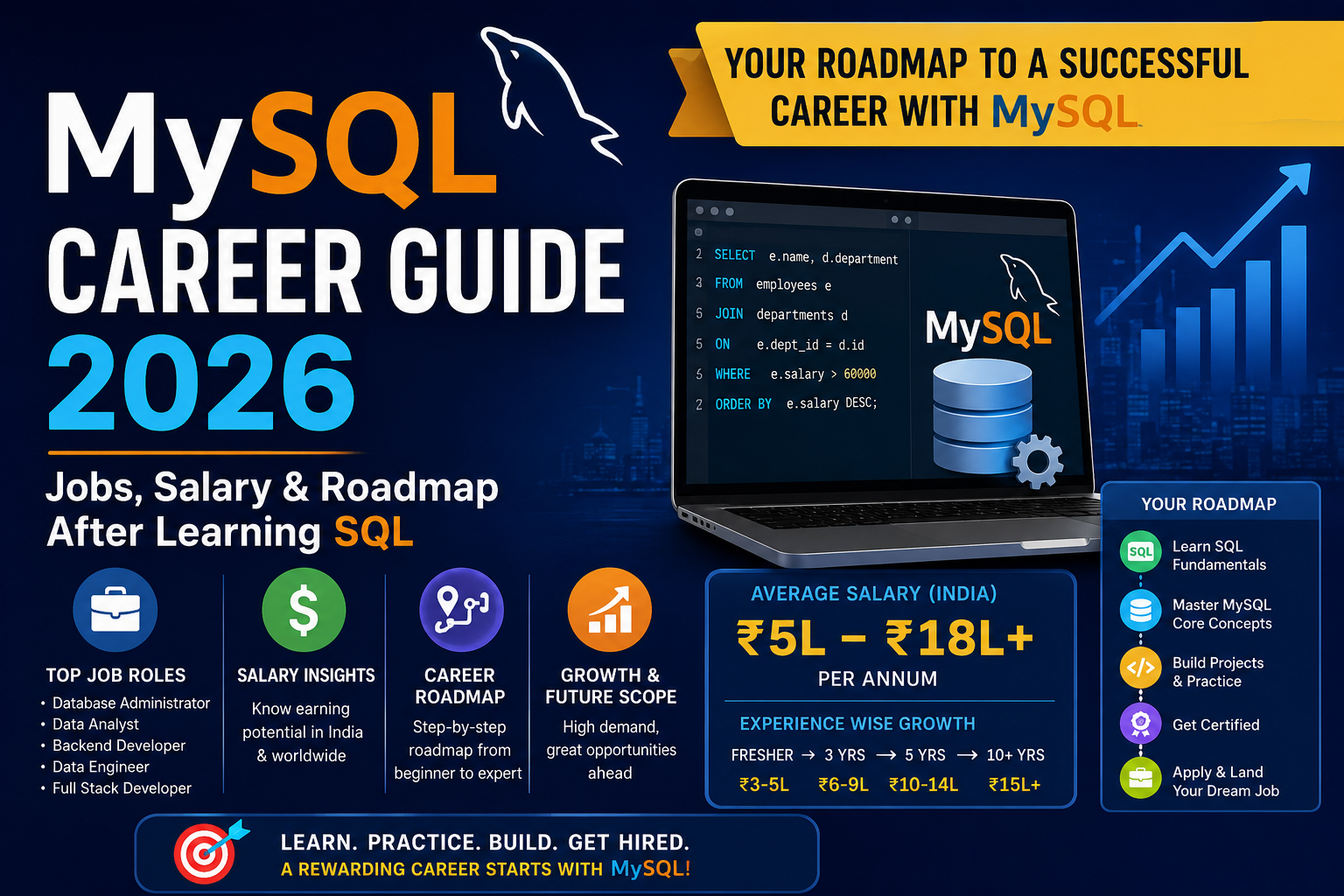
MySQL Career Guide 2026 | Jobs, Salary & Roadmap After Learning SQL
One question comes up constantly among students and freshers who have started learning MySQL: what actually happens after you learn it? What jobs are available, what do they pay, and what is the realistic path from learning SQL to getting hired?
This guide answers all of that directly. No vague promises — just a clear picture of the MySQL job market in India in 2026, the roles available at different experience levels, salary expectations, and a practical roadmap for getting from where you are now to where you want to be.
If you are in Lucknow and want structured training that takes you through this entire path with placement support, Aptech Learning Lucknow is built precisely for that purpose.
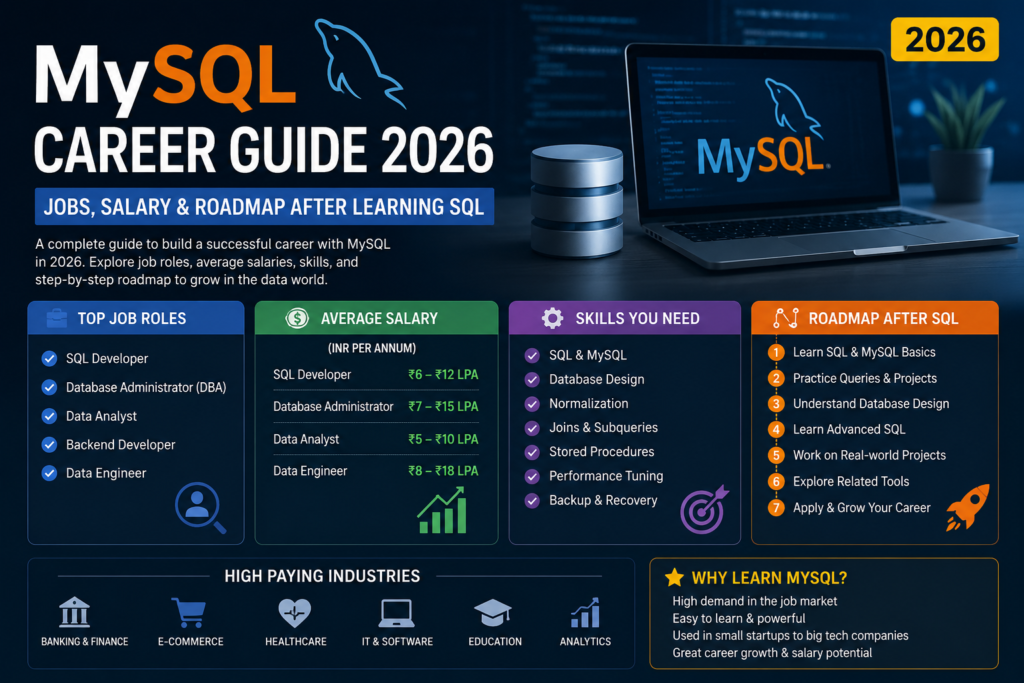
Why MySQL skills lead to real jobs in 2026
MySQL is not a niche skill. It is infrastructure. Every company that builds a web application, manages customer data, runs an e-commerce platform, or does any kind of data analysis needs people who understand relational databases. In India alone, thousands of job postings on LinkedIn, Naukri, and Indeed list MySQL as a required or preferred skill every single month.
What makes MySQL particularly valuable as a career skill is its versatility. It is not tied to one job title or one industry. SQL knowledge is required in backend development, data analysis, database administration, data engineering, and even in business analyst roles where querying data is part of the daily work. Learning MySQL does not just open one door — it opens several simultaneously.
Top career paths after learning MySQL
Here is a clear breakdown of the main roles available to someone with solid MySQL skills, from entry level to senior:
| Job Role | Core Skills Required | Experience Level | Avg. Salary India |
|---|---|---|---|
| SQL Developer | Queries, joins, stored procedures, views | Fresher to 2 years | ₹3.5 – ₹7 LPA |
| Backend Developer | MySQL + PHP or Python or Node.js | Fresher to 3 years | ₹4 – ₹10 LPA |
| Data Analyst | MySQL + Excel + Power BI or Tableau | Fresher to 3 years | ₹3.5 – ₹9 LPA |
| Database Administrator (DBA) | Indexing, backup, security, replication | 1 – 4 years | ₹5 – ₹14 LPA |
| Data Engineer | MySQL + Python + ETL + cloud basics | 2 – 5 years | ₹7 – ₹20 LPA |
| Business Analyst | SQL + business domain knowledge | 1 – 4 years | ₹4 – ₹12 LPA |
| Senior DBA / DB Architect | Full MySQL stack + replication + partitioning | 5+ years | ₹15 – ₹30 LPA |
Every single role in this table lists MySQL or SQL as a core requirement. The entry-level positions are genuinely accessible within three to six months of structured learning. The mid and senior roles become reachable as you combine MySQL expertise with one or two complementary skills.
What freshers can realistically expect
Fresh graduates often worry that employers will not consider them without prior work experience. In the database world, this concern is less of a barrier than in many other tech areas — because SQL skills are directly demonstrable.
A fresher who can sit in front of a computer during an interview, write a correct JOIN query, design a normalised table schema, and explain what an index does — that person gets hired. The skill is observable in real time. You do not need a portfolio of deployed projects the way a frontend developer might. You need to demonstrate that you can actually work with databases.
What gives freshers a genuine edge in 2026:
A MySQL certification from Oracle signals that your knowledge has been tested to a formal standard. Recruiters who see it on a resume pay attention.
Practice projects — a student management system, an inventory database, a simple e-commerce schema — show that you have applied the theory to something real.
Knowledge of one pairing skill — MySQL combined with Python, or MySQL combined with Power BI, makes you significantly more hirable than MySQL alone.
SQL developer salary in India — city-wise breakdown
Salaries vary considerably by city and company type. Here is a realistic picture for 2026:
| City | Fresher (0–1 yr) | Mid-Level (2–4 yrs) | Senior (5+ yrs) |
|---|---|---|---|
| Bengaluru | ₹4 – ₹7 LPA | ₹8 – ₹18 LPA | ₹20 – ₹35 LPA |
| Hyderabad | ₹3.5 – ₹6.5 LPA | ₹7 – ₹16 LPA | ₹18 – ₹30 LPA |
| Pune | ₹3.5 – ₹6 LPA | ₹7 – ₹15 LPA | ₹16 – ₹28 LPA |
| Mumbai | ₹4 – ₹7 LPA | ₹8 – ₹17 LPA | ₹18 – ₹32 LPA |
| Delhi / NCR | ₹3.5 – ₹6.5 LPA | ₹7 – ₹15 LPA | ₹16 – ₹28 LPA |
| Lucknow | ₹2.5 – ₹5 LPA | ₹5 – ₹10 LPA | ₹10 – ₹18 LPA |
| Other Tier 2 Cities | ₹2 – ₹4.5 LPA | ₹4 – ₹9 LPA | ₹8 – ₹15 LPA |
Lucknow’s tech sector has grown significantly over the past few years. IT services companies, fintech startups, healthcare technology firms, and e-commerce operations are all hiring SQL-skilled professionals locally — meaning you do not have to relocate to a metro city to start your database career.
The MySQL career roadmap — phase by phase
This is the realistic, step-by-step path from learning MySQL to building a career with it.
Phase 1 — Foundation (Month 1 to 2)
Install MySQL and Workbench. Learn SQL fundamentals: SELECT, INSERT, UPDATE, DELETE, WHERE, ORDER BY, GROUP BY. Understand data types, tables, and basic database concepts. By the end of this phase, you should be writing useful single-table queries confidently.
Phase 2 — Core Skills (Month 2 to 3)
Master SQL joins — INNER JOIN, LEFT JOIN, RIGHT JOIN. Learn subqueries, CTEs, and aggregate functions. Understand database design basics: primary keys, foreign keys, normalization to 3NF. Build your first complete database project from scratch.
Phase 3 — Intermediate to Advanced (Month 3 to 5)
Learn stored procedures, triggers, transactions, and ACID properties. Understand indexing deeply — B-Tree indexes, composite indexes, covering indexes. Practice using EXPLAIN to analyse and optimise query performance. Build two or three project databases of increasing complexity.
Phase 4 — Specialise and Certify (Month 5 to 6)
Choose a pairing skill based on your career direction. For development: add PHP or Python and learn how MySQL integrates into web applications. For analytics: add Power BI or Tableau and practice building dashboards from MySQL data. Pursue Oracle MySQL certification to formalise your skills. Begin interview preparation.
Phase 5 — Job Search and Beyond
Update your resume to highlight MySQL skills, certification, and projects. Practise common SQL interview questions under time pressure. Apply for fresher SQL developer, data analyst, and junior DBA roles. Expect your first job within one to three months of active searching if your skills are solid.
Industries hiring MySQL professionals in India 2026
MySQL skills are not limited to IT companies. The demand is spread across multiple sectors:
| Industry | How MySQL Is Used | Hiring Volume |
|---|---|---|
| IT Services & Software | Backend databases for client applications | Very High |
| E-commerce | Product catalogues, orders, inventory, users | Very High |
| Banking & Fintech | Transactions, accounts, fraud detection systems | High |
| Healthcare Technology | Patient records, appointments, billing systems | High |
| EdTech | Student data, course content, progress tracking | High |
| Logistics | Shipment tracking, warehouse management | Medium-High |
| Government & PSUs | Citizen databases, records management | Medium |
| Media & Publishing | Content management, user analytics | Medium |
Why Aptech Learning Lucknow is the right starting point
Knowing the career path is one thing. Having the guidance, structure, and support to actually walk it is another.
Aptech Learning Lucknow’s MySQL course is designed with exactly this career roadmap in mind. The curriculum covers every phase described above — from SQL fundamentals through advanced stored procedures, indexing, and certification preparation. Instructors bring real industry experience into the classroom, so the skills you build reflect what employers in 2026 are actually asking for.
Beyond the technical training, Aptech’s placement support connects students with companies hiring in Lucknow and surrounding regions. Resume preparation, mock interviews, and interview-focused SQL practice are built into the course — because getting the job matters as much as developing the skill.
If you are a fresher in Lucknow who wants to enter the database field with genuine skills, a recognised certification, and placement support behind you, this is the right place to start.
Visit aptechlearninglko.com for batch schedules, course details, and enrollment information.
Most asked questions about MySQL careers
Q1. Is MySQL enough to get a job in 2026?
MySQL alone can get you an entry-level SQL developer or junior DBA position if your practical skills are strong. However, pairing MySQL with one complementary skill dramatically improves your chances. For development roles, MySQL plus Python or PHP is a strong combination. For analytics roles, MySQL plus Power BI or Tableau works very well. For administration roles, MySQL plus Linux server basics is highly valued. The skill combination signals that you can work in a real environment, not just in a training lab.
Q2. What is the starting salary for a fresher SQL developer in India?
Fresher SQL developer salaries in India in 2026 typically range from ₹2.5 to ₹5 LPA depending on the city, company size, and the strength of your skills and interview performance. Metro cities like Bengaluru, Hyderabad, and Pune offer higher starting salaries. Tier 2 cities like Lucknow offer lower absolute numbers but often better cost-of-living adjusted value. Freshers who have a MySQL certification and can demonstrate practical skills in interviews consistently receive offers at the higher end of this range.
Q3. Which is better for a career — MySQL or PostgreSQL?
Both are strong choices, but MySQL is the better starting point for most career paths in India. MySQL has a significantly larger share of the Indian job market, more beginner resources, and wider adoption across the industries that do the most hiring — IT services, e-commerce, fintech, and healthcare technology. Once you have solid MySQL skills, transitioning to PostgreSQL is straightforward because both use SQL. Start with MySQL, build your foundation, and add PostgreSQL if the role specifically requires it.
Q4. How long does it take to get a job after learning MySQL?
Most students who complete a structured MySQL course and practice consistently are job-ready within three to six months from starting. After becoming job-ready, the time to actually land a first job depends on how actively you are applying and how strong your interview performance is. Freshers with solid practical skills, a project or two, and interview preparation typically receive their first offer within one to three months of active searching. Students who go through Aptech Learning Lucknow’s placement support process tend to have a shorter gap between course completion and employment.
Q5. Are there MySQL jobs in Lucknow specifically?
Yes, and the number has grown considerably in recent years. Lucknow’s IT sector expansion has brought IT services companies, fintech startups, logistics technology firms, and e-commerce operations to the city. These companies hire SQL developers, data analysts, and backend developers with MySQL skills locally. Additionally, many Lucknow-based professionals work remotely for companies in Delhi, Mumbai, and Bengaluru, making the geographic advantage of a Lucknow-based course even more significant.
Q6. What is the career growth path after becoming a SQL developer?
A typical MySQL career progression looks like this: fresher SQL developer or junior DBA (0 to 2 years) → mid-level developer or database analyst (2 to 4 years) → senior developer, senior DBA, or data engineer (4 to 7 years) → database architect, data engineering lead, or technical manager (7 years and above). At each stage, adding skills in cloud databases (AWS RDS, Google Cloud SQL), big data tools, or database performance engineering accelerates progression and salary growth significantly.
Final thoughts
MySQL is not just a skill you learn and then use occasionally. It is a career foundation that stays relevant regardless of which direction technology moves — because data will always need to be stored, managed, and queried. The career paths it opens are varied, the salaries are genuinely competitive, and the learning curve is manageable for anyone willing to put in consistent effort.
The roadmap is clear. The jobs are real. The salaries are competitive. What you need is the right training to walk that path with confidence.
Aptech Learning Lucknow is where that training happens — structured, practical, and built around getting you employed.
Visit aptechlearninglko.com to find out about current batches and take the first step toward your MySQL career.