
What is GST? Complete Beginner’s Guide to GST in India
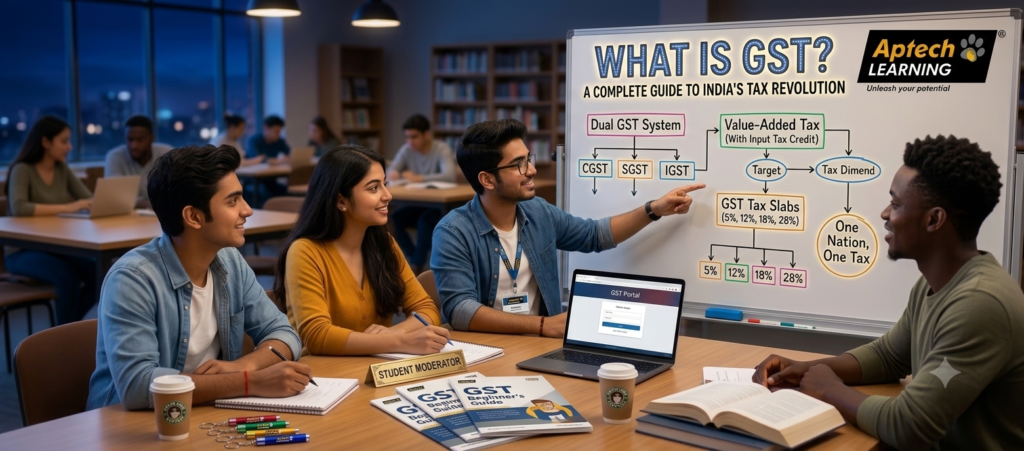
GST stands for Goods and Services Tax. It is an indirect tax, meaning it is collected by businesses on behalf of the government and ultimately paid by the person buying goods or services. GST was introduced to simplify India’s earlier tax system, which involved multiple different taxes at the state and central level, often applied at different rates and stages.
Think of GST like a single toll system replacing several different toll booths that used to exist on the same highway. Earlier, a product could be taxed multiple times as it moved from manufacturer to wholesaler to retailer, sometimes under different tax rules in different states. GST simplified this into one consistent system applied uniformly across the country.
Under GST, tax is charged at every stage of the supply chain, but businesses can claim credit for the tax they already paid on their purchases, meaning the final tax burden ultimately falls on the end consumer, not on each business individually.
Why GST Matters
GST has become a central part of how businesses operate in India, and here is why it matters:
It replaced a complicated system of multiple taxes with one unified structure, making compliance more consistent across states.
It reduced the problem of “tax on tax,” where a product previously got taxed at multiple stages without proper credit adjustments.
It created more transparency in business transactions, since GST-registered businesses must maintain proper records and file regular returns.
It affects nearly every business, from small shops to large corporations, making GST knowledge valuable across almost every industry.
It has created genuine job demand for people who understand GST compliance, filing, and reporting, particularly in accounting and finance roles.
Types of GST in India
GST in India is divided into different components depending on whether a transaction happens within a state or between states.
CGST (Central GST)
This is the portion of GST collected by the central government on transactions happening within a single state.
SGST (State GST)
This is the portion of GST collected by the respective state government, also applied on transactions within that state.
IGST (Integrated GST)
This applies to transactions between two different states or in cases of imports, and is collected by the central government, which then shares it with the relevant state.
UTGST (Union Territory GST)
This applies specifically to transactions within Union Territories, functioning similarly to SGST for those regions.
GST Type | Applies To | Collected By
CGST | Transactions within a state | Central Government
SGST | Transactions within a state | State Government
IGST | Transactions between states or imports | Central Government (shared with states)
UTGST | Transactions within Union Territories | Union Territory Administration
How GST Works (Step-by-Step)
- Business Registers Under GST
Businesses that cross a specified turnover limit or fall under mandatory categories must register for GST and receive a unique GST identification number. - GST is Charged on Sales
When a registered business sells goods or services, it charges GST on top of the price, based on the applicable rate for that product or service category. - Input Tax Credit is Claimed
Businesses can claim credit for the GST they already paid on their own purchases, reducing the amount of tax they owe on their sales. - GST Returns are Filed
Businesses regularly file GST returns, reporting their sales, purchases, and tax collected, as required by law. - Tax is Paid to the Government
After adjusting for input tax credit, the remaining GST amount is paid to the government within the required timelines. - Records are Maintained for Compliance
Businesses maintain proper invoices and records, which are important for audits, credit claims, and overall compliance. - Consumer Pays the Final Tax
Since GST is passed through the supply chain, the final consumer ultimately bears the tax cost reflected in the final price of the product or service.
GST vs Old Tax System (VAT, Service Tax, Excise Duty)
Understanding GST becomes easier when compared with the system it replaced.
VAT (Value Added Tax) was charged by state governments on the sale of goods, but rates and rules varied significantly from state to state, creating inconsistency.
Service tax was charged separately by the central government on services, functioning as a completely different tax from VAT, even when goods and services were part of the same transaction.
Excise duty was charged on the manufacturing of goods, adding another layer of tax before the product even reached the market.
GST replaced this fragmented system with one unified tax applied consistently across goods and services, throughout the country, significantly simplifying compliance for businesses operating across multiple states.
In simple words: the old system involved multiple different taxes at different stages and rates, while GST combines these into one consistent structure applied uniformly nationwide.
Practical Examples
Retail Purchase: When you buy clothing from a local shop, the bill includes CGST and SGST, since it is a transaction within the same state, with the tax amount clearly shown separately from the product price.
Interstate Business Transaction: A manufacturer in Uttar Pradesh selling goods to a retailer in Maharashtra charges IGST, since the transaction crosses state lines.
Restaurant Billing: When dining at a restaurant, GST is applied to the food and service provided, reflecting how GST covers both goods and services under one system.
Freelance Services: A freelance consultant providing services above the GST registration threshold must register for GST and charge it on their invoices to clients.
Small Business Compliance: A small business owner uses GST-compliant software to generate proper invoices, file monthly or quarterly returns, and maintain accurate records for their supplier and customer transactions.
Common Mistakes Beginners Make
Confusing GST rates with a single fixed percentage. GST has multiple rate slabs depending on the type of product or service, not one universal rate.
Not understanding input tax credit properly. Beginners often miss how businesses can offset the GST they paid on purchases against the GST they collect on sales.
Ignoring return filing deadlines. Missing GST filing deadlines can lead to penalties, and beginners sometimes underestimate how strictly these timelines are enforced.
Assuming GST only applies to large businesses. Many small businesses and even certain freelancers are required to register for GST once they cross the specified turnover threshold.
Not maintaining proper invoices. Incomplete or incorrect invoices can create complications when claiming input tax credit or during audits.
Overlooking state-specific nuances. While GST is largely uniform, beginners sometimes overlook specific compliance details that can vary slightly for certain categories or regions.
Career Opportunities
Understanding GST supports a range of career paths, particularly in accounting, tax, and compliance-related roles. Common roles include:
GST Practitioner — assists businesses with GST registration, filing, and compliance.
Accounts Executive — manages day-to-day accounting entries, including GST-related transactions.
Tax Consultant — advises businesses on GST compliance and broader tax planning.
Compliance Executive — ensures a business follows GST rules and files returns accurately and on time.
Junior Accountant — supports broader accounting functions, often including GST-related tasks early in their career.
Finance Executive — handles financial operations where GST compliance is a regular part of the role.
As professionals gain experience, GST knowledge often supports progression into senior accounting roles, specialised tax consulting, or broader finance and compliance positions.
Salary Information
Salary for roles involving GST knowledge depends on factors such as your city, the size and industry of the business, your specific role, your skill level, and your years of experience. Entry-level roles naturally pay less than senior tax or compliance positions, and metro cities generally offer higher packages than smaller towns. Rather than fixed numbers, it is more useful to know that GST expertise tends to strengthen an accounting or finance profile and can support steady salary growth over time.
Skills Required
Technical Skills
Basic understanding of accounting principles and how GST fits into financial records
Familiarity with GST return filing processes and deadlines
Comfort using accounting software like Tally for GST-related entries
Understanding of input tax credit and how it affects tax calculations
Ability to read and verify GST-compliant invoices accurately
Non-Technical Skills
Attention to detail, since small errors in GST filing can lead to compliance issues
Organisational skills, especially when managing GST records for multiple clients or transactions
Awareness of deadlines and strong time management for timely return filing
Clear communication to explain GST-related matters to clients or non-technical colleagues
Reliability, since accurate, consistent compliance work is essential in this field
Tools Used for GST Compliance
Tool | Primary Use
Tally | Recording transactions and generating GST reports
GST Portal | Official government platform for registration and return filing
Excel | Organising and cross-checking GST-related data
Accounting Software (various) | Managing invoices, credits, and compliance records
Digital Signature Tools | Authenticating and submitting official GST filings
Eligibility for GST Registration
GST registration eligibility generally depends on a business’s annual turnover, which varies based on the type of business and the state it operates in. Certain categories of businesses, such as those involved in interstate trade, may need to register regardless of turnover. It is always advisable to check the current turnover limits and specific requirements directly through official government sources, since these details can be updated over time.
Course Duration
GST courses can range from short, focused programs covering registration and return filing basics, to longer, in-depth training covering compliance, input tax credit, and practical filing practice. The right duration depends on your current accounting knowledge and how deep you want to go into GST-specific compliance work. It is best to confirm the exact course structure and duration directly with the training provider.
Who Should Learn GST
Commerce students who want practical, job-ready knowledge alongside their accounting studies
Working professionals in accounting or finance roles who want to strengthen their compliance knowledge
Business owners who want to understand and manage their own company’s GST compliance
Job seekers looking for a valuable, widely applicable skill in the accounting and finance field
Freelancers and consultants who may need to understand GST registration and filing for their own services
Frequently Asked Questions
What is GST in simple words?
GST is a single, unified indirect tax applied on the supply of goods and services in India, replacing multiple older taxes with one consistent system across the country.
What is the full form of GST?
GST stands for Goods and Services Tax, a tax system introduced to simplify and unify how goods and services are taxed across India.
What is the difference between CGST, SGST, and IGST?
CGST and SGST apply to transactions within the same state, split between central and state governments, while IGST applies to transactions between different states or imports.
Who needs to register for GST?
Businesses that cross a specified turnover threshold, or fall under certain mandatory categories like interstate trade, are required to register for GST as per current regulations.
What is input tax credit under GST?
Input tax credit allows businesses to reduce the GST they owe on sales by the amount of GST they already paid on their own business purchases.
Is GST applicable to services or only goods?
GST applies to both goods and services, which is one of the reasons it replaced multiple older taxes that separately covered goods and services differently.
Conclusion
GST has become a fundamental part of how businesses operate in India, affecting everything from a small retail purchase to large interstate trade. Understanding GST is not just useful for compliance; it also opens up genuine career opportunities in accounting, tax, and finance-related roles.
The key is to move beyond just knowing the term GST, and to build real understanding of how registration, filing, and input tax credit actually work in practice. Whether you are a student, a working professional, or a business owner, solid GST knowledge is a practical, valuable skill to build.
Soft Call to Action
If you are based in Lucknow and want structured, hands-on training instead of learning everything alone, Aptech Learning Lucknow offers GST and accounting-related courses designed for students and working professionals alike. You can visit the institute, speak with their counsellors, or attend a demo class to understand how the course is structured and whether it fits your career goals.